Mesha (Aries) in Vedic Astrology: Complete Guide to the First Rashi
Discover Mesha (Aries), the first sign of the Vedic zodiac. Learn why the Sun is exalted here, the significance of Mars rulership, the three nakshatras within, and classical insights on this fiery cardinal sign.
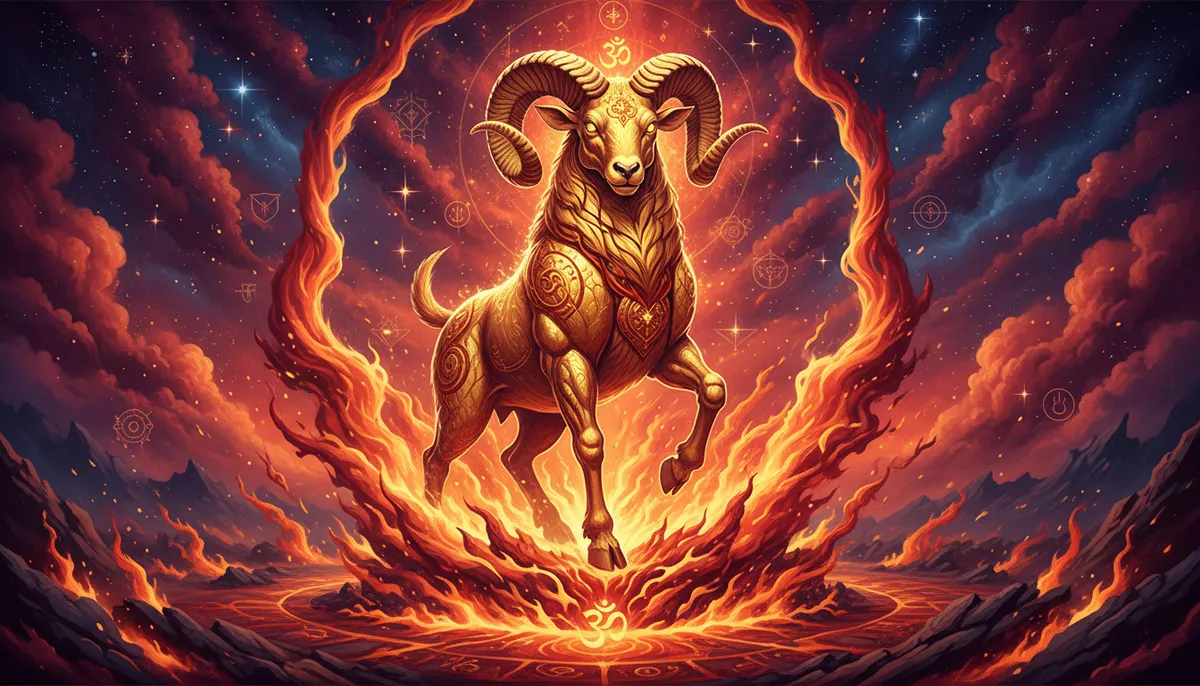
Quick Reference
| Attribute | Value |
|---|---|
| Sanskrit Name | Mesha (मेष) |
| English Name | Aries |
| Position | 1st sign (0°-30°) |
| Ruler | Mars (Mangala) |
| Element | Fire (Agni Tattva) |
| Modality | Cardinal/Movable (Chara) |
| Gender | Masculine (Purusha) |
| Body Part | Head |
| Direction | East |
| Color | Blood-red |
| Guna | Rajasic |
| Classification | Chatushpada (Quadruped) |
| Caste | Kshatriya |
Introduction
Mesha (Aries) opens the Vedic zodiac as the first of twelve signs—the point of cosmic dawn where the cycle begins. As the initial fire sign ruled by Mars, Aries embodies pure initiative, courageous action, and the primal life force that sparks all manifestation.
In Jyotish, Aries holds special significance as both the exaltation sign of the Sun and the Mooltrikona position of Mars—a double concentration of fiery, authoritative energy found nowhere else in the zodiac. This is the sign of beginnings, of warriors, of those who act first and contemplate later.
Classical Description
The ancient sages provided detailed characterizations of Mesha’s nature:
Aries is blood-red in complexion, has a prominent physique, is a quadruped sign, strong during night, denotes courage, resides in the east, is related to kings, wanders in hills, predominates in Rajoguna, rises with its back (Prishtodaya), is fiery, ruled by Mars.
This comprehensive portrait reveals:
- Blood-red color: Mars’ fiery, passionate influence
- Prominent physique: Strong, noticeable physical presence
- Quadruped (Chatushpada): Animal nature, instinctive action
- Night-strong: Gains power during nocturnal hours
- Courage: The fundamental virtue of this sign
- East direction: The realm of sunrise and new beginnings
- Related to kings: Natural leadership and royal connections
- Hill-dwelling: Affinity for elevated, rugged terrain
- Rajoguna: Driven by passion, activity, and worldly ambition
- Prishthodaya (back-rising): Rises with its back, instinctive nature
Core Nature & Qualities
Fundamental Temperament
Aries natives embody the archetype of the initiator—those who begin rather than follow, who act rather than wait. The cardinal (Chara) modality ensures constant movement toward new goals, while the fire element provides inexhaustible energy for pursuits.
The Rajasic guna (quality of passion and activity) ensures Aries natives are never content with stillness. They seek conquest, achievement, and the thrill of overcoming obstacles.
Strengths
Classical texts highlight these positive Aries qualities:
- Courage and valor: The defining Aries trait
- Initiative and leadership: Natural ability to begin new ventures
- Vitality and energy: Strong physical constitution
- Directness and honesty: Straightforward communication
- Warrior spirit: Ability to fight for what matters
The connection to royalty indicates natural authority and the capacity to lead others.
Challenges
The shadow aspects emerge from excess of the same qualities:
Aries is a sign that makes one susceptible to ire, interested in foreign places, miserly, emaciated, troubled by bilious and windy diseases.
Classical challenges include:
- Anger and irritability: Quick temper from Mars’ influence
- Impulsiveness: Acting before thinking
- Impatience: Difficulty with delays or slow processes
- Bilious health issues: Heat-related ailments
- Restlessness: Difficulty settling in one place
Planetary Dignities in This Sign
Aries hosts some of the most significant planetary dignities in the zodiac:
Sun: Exalted at 10°
The Sun reaches its peak strength in Aries. Why does the Sun—symbol of soul, authority, and vitality—find its highest expression in Aries?
The answer lies in perfect alignment: the Sun represents leadership and self-expression, while Aries provides the courage and initiative to manifest these qualities without hesitation. In Aries, the Sun can act on its authority immediately, facing no internal resistance. At exactly 10 degrees, this alignment reaches perfection.
Saturn: Debilitated at 20°
Saturn suffers its greatest weakness in Aries. Saturn represents patience, discipline, slow methodical progress, and careful structure. These qualities find no support in impulsive, action-oriented Aries. Where Saturn would carefully plan, Aries demands immediate action. Where Saturn counsels caution, Aries rushes forward. This fundamental incompatibility creates Saturn’s debilitation.
Mars: Mooltrikona (0°-12°) and Own Sign (12°-30°)
Mars enjoys exceptional dignity throughout Aries, with a special zone in the first 12 degrees. The Mooltrikona position (0°-12°) represents Mars at its most pure and powerful—even stronger than simply being in its own sign. Here, Martian energy expresses without distortion: courage, initiative, competitive drive, and physical vitality reach their zenith.
From 12°-30°, Mars remains in own sign (Swakshetra), still very strong but slightly less intense than the Mooltrikona zone.
Cosmic Correspondences
Kalapurusha Body Part
In the cosmic man (Kalapurusha), Aries governs the head—the seat of identity, intellect, and command.
The signs Aries etc., represent the limbs of Kalapurusha: Aries-head, Taurus-face, Gemini-arms, Cancer-heart, Leo-stomach, Virgo-hip, Libra-space below navel, Scorpio-private parts, Sagittarius-thighs, Capricorn-knees, Aquarius-ankles, Pisces-feet.
This placement explains Aries’ association with:
- Leadership and command: The head directs the body
- Individual identity: The face and head define uniqueness
- Mental activity: Thinking, deciding, initiating
- Physical vulnerabilities: Head injuries, headaches, fever, brain-related issues
Direction
Aries’ direction is East, associated with:
- Sunrise and new beginnings
- The start of the day’s journey
- Fresh starts and initiatives
- The spring equinox (in traditional reckoning)
Classification: Chatushpada (Quadruped)
Aries belongs to the Chatushpada (four-footed/quadruped) classification along with Taurus, Leo, Sagittarius, and Capricorn. This indicates:
- Animal-like instinctive nature
- Physical strength and stamina
- Connection to four-legged creatures
- Action before deliberation
Rising Type: Prishthodaya
Aries is a Prishthodaya (back-rising) sign, along with Cancer, Capricorn, Sagittarius, and Taurus. This means Aries:
- Rises over the horizon with its back rather than head
- Gains strength during night hours
- Has more instinctive, less intellectualized nature
- Acts first, reflects later
Guna and Caste
Aries is classified as Rajasic in nature—active, passionate, driven by desire and achievement. Its Kshatriya (warrior) caste assignment indicates:
- Martial orientation
- Protective and combative roles
- Connection to rulers and military
- Emphasis on action over contemplation
Nakshatras in Mesha
Three nakshatras span Aries, each contributing unique characteristics:
1. Ashwini (0°-13°20’)
| Attribute | Value |
|---|---|
| Ruler | Ketu |
| Deity | Ashwini Kumaras (Divine Physicians) |
| Symbol | Horse’s Head |
| Caste | Vaishya |
| Degrees | 0°-13°20’ Aries |
Ashwini combines Ketu’s spiritual insight with Aries’ initiative. The Ashwini Kumaras are divine healers, granting this nakshatra associations with:
- Medicine and healing arts
- Speed and swiftness (like horses)
- Miraculous interventions
- New beginnings and fresh starts
Person born under star Ashwini will have great intelligence, wealth, modesty, sagacity and fame and will be happy.
2. Bharani (13°20’-26°40’)
| Attribute | Value |
|---|---|
| Ruler | Venus (Shukra) |
| Deity | Yama (Lord of Death) |
| Symbol | Yoni (female organ) |
| Degrees | 13°20’-26°40’ Aries |
Bharani brings Venus’ influence into Mars’ domain—a paradoxical combination of love and war, pleasure and discipline. Yama’s rulership connects this nakshatra to:
- Life-death cycles
- Moral judgment and dharma
- Transformation and rebirth
- Creative and procreative power
If Moon is in Bharani at birth, person will have defective limb, be addicted to another's wife, cruel, ungrateful but possess wealth.
3. Krittika (26°40’ Aries - 10° Taurus)
| Attribute | Value |
|---|---|
| Ruler | Sun (Surya) |
| Deity | Agni (Fire God) |
| Symbol | Razor/Flame |
| Caste | Brahmin |
| Degrees | 26°40’ Aries - 10° Taurus |
Only the first pada (3°20’) of Krittika falls in Aries. This Sun-ruled nakshatra in Mars’ sign creates intense fire energy. The razor symbolism suggests:
- Cutting through obstacles
- Sharp intellect and speech
- Ability to separate truth from falsehood
- Potential for criticism and harshness
Significations & Terrain
Places Ruled
Aries governs:
- Hills and mountains: Elevated, rugged terrain
- Forests: Wild, natural environments
- Battlefields: Places of conflict and competition
- Athletic grounds: Sports and physical contests
- Metal workshops: Mars’ connection to iron and fire
Creatures Associated
Aries with its divisions having Mars' aspect portends births of goat, ram.
Aries-associated creatures include rams, goats, and other horned, headstrong animals that embody the sign’s charging, aggressive nature.
Aries Ascendant (Mesha Lagna)
When Aries rises at birth, the native receives Mars as their chart ruler, creating a life colored by initiative, courage, and the warrior archetype.
Benefic planets for Aries Ascendant:
- Sun (5th lord): Creativity, intelligence, authority
- Jupiter (9th and 12th lord): Fortune, wisdom, spirituality
- Moon (4th lord): Emotional stability, home, mother
Challenging planets for Aries Ascendant:
- Saturn (10th and 11th lord): Career challenges, delayed results
- Mercury (3rd and 6th lord): Communication struggles, health issues
- Venus (2nd and 7th lord): Relationship and financial challenges
Fire Triplicity
Aries shares the fire element with Leo and Sagittarius, but each expresses fire differently:
- Aries (Mars): Initiating fire—the spark that ignites action
- Leo (Sun): Sustaining fire—the steady blaze of authority
- Sagittarius (Jupiter): Spreading fire—the expansive flame of wisdom
All fire signs share energy, enthusiasm, and transformative power, but Aries’ cardinal modality makes it the initiator of the triplicity.
Opposite Sign: Libra
Aries’ opposite, Tula (Libra), represents:
- Self vs. Partnership
- Initiative vs. Deliberation
- Mars (action) vs. Venus (harmony)
- Individual will vs. Cooperative agreement
The Aries-Libra axis represents the 1st-7th house dynamic: self-assertion vs. relationship, independence vs. interdependence.
Summary & Classical Sources
Mesha stands as the pioneer of the zodiac—the first burst of cosmic energy that initiates the great cycle of manifestation. Its Mars rulership provides courage and drive; its fire element grants transformative power; its cardinal modality ensures constant forward movement.
The Sun’s exaltation here confirms that Aries provides the optimal environment for self-expression, leadership, and vital force. Saturn’s debilitation reminds us that patient, methodical approaches struggle in territory that demands immediate action.
Key Takeaways
- First sign: Initiation, beginnings, the spark of creation
- Mars rulership: Courage, warrior energy, direct action
- Sun exalted at 10°: Leadership and authority find perfect expression
- Saturn debilitated at 20°: Patience and caution struggle here
- Mars Mooltrikona 0°-12°: Zone of purest martial expression
- Head of Kalapurusha: Leadership, identity, intellect
- Prishthodaya: Back-rising, night-strong, instinctive nature
- Rajasic Kshatriya: Passionate warrior orientation
Classical Sources
The information in this guide derives primarily from:
- Brihat Parashara Hora Shastra (BPHS) — foundational Jyotish text
- Saravali by Kalyana Varma
- Phaladeepika by Mantreswara
Continue Your Study
Same Ruler (Mars):
Fire Triplicity:
Cardinal Signs:
Opposite Sign:
Related Guides:
Related Articles
Vrishchika (Scorpio) in Vedic Astrology: Complete Guide to the Eighth Rashi
Discover the mysterious depths of Vrishchika (Scorpio) in Vedic astrology. Learn why Moon is debilitated here, its Kalapurusha significance, the three nakshatras within, and classical insights on this transformative eighth sign.
Simha (Leo) in Vedic Astrology: Complete Guide to the Fifth Rashi
Discover Simha (Leo), the royal fifth sign of the Vedic zodiac. Learn about the Sun's Mooltrikona position, the lion symbolism, the three nakshatras within, and classical insights on this majestic fixed fire sign.
Dhanu (Sagittarius) in Vedic Astrology: Complete Guide to the Ninth Rashi
Discover Dhanu (Sagittarius), the ninth sign of the Vedic zodiac. Learn about Jupiter's Mooltrikona here, the centaur symbolism, the three nakshatras within, and classical insights on this mutable fire sign.