Surya: The Radiant Soul of the Cosmos
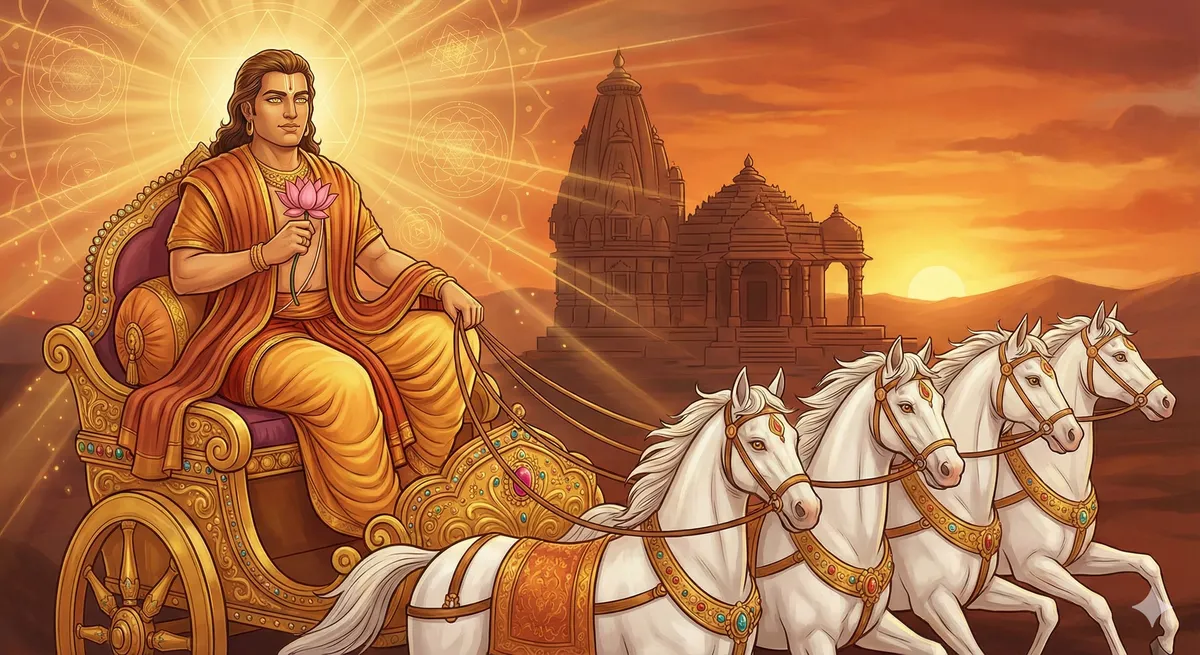
In the celestial parliament of the Navagrahas, the Sun reigns as sovereign—a cosmic monarch whose very presence illuminates both heaven and earth, embodying the eternal principle of consciousness itself.
Quick Reference
| Attribute | Description |
|---|---|
| Sanskrit Name | Surya (Synonyms: Heli, Bhanu) |
| Nature | Natural Malefic |
| Cabinet Status | King (Royal) |
| Cosmic Symbolism | Soul of the Cosmic Man (Kalapurusha) |
| Gender | Male |
| Caste | Kshatriya (Warrior-Royal) |
| Element | Fire (Agni) |
| Guna | Sattvic (Pure, Kind, Firm, Truthful) |
| Dosha | Pitta (Bilious/Heat Nature) |
| Deity | Agni (Fire God) |
| Direction | East / South (directional strength) |
| Color | Copper-red; Blood-red; Red-green mix |
| Taste | Pungent (Acrid) |
| Time Period | Ayana (Solstice/6 months) |
| Season | Grishma (Summer) |
| Abode | Temples |
| Apparel | Coarse cloth; Saffron robes |
| Substance | Copper |
| Tree Type | Strong trees with stout trunks |
| Classification | Roots and vegetables (Moola) |
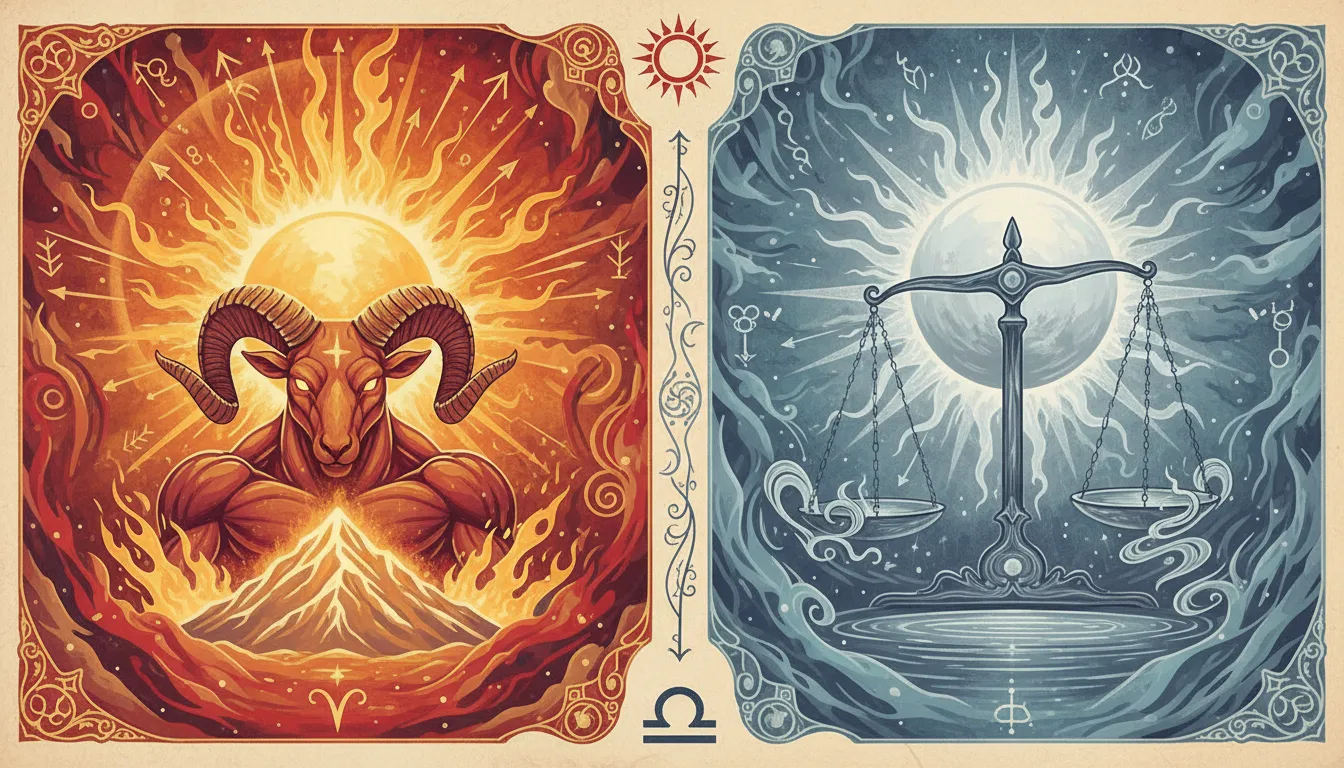
| Exaltation | Aries at 10° |
| Moolatrikona | Leo 0°–20° |
| Own Sign | Leo 20°–30° |
| Friends | Jupiter, Mars, Moon |
| Enemies | Venus, Saturn |
| Neutral | Mercury |
Astronomical Overview
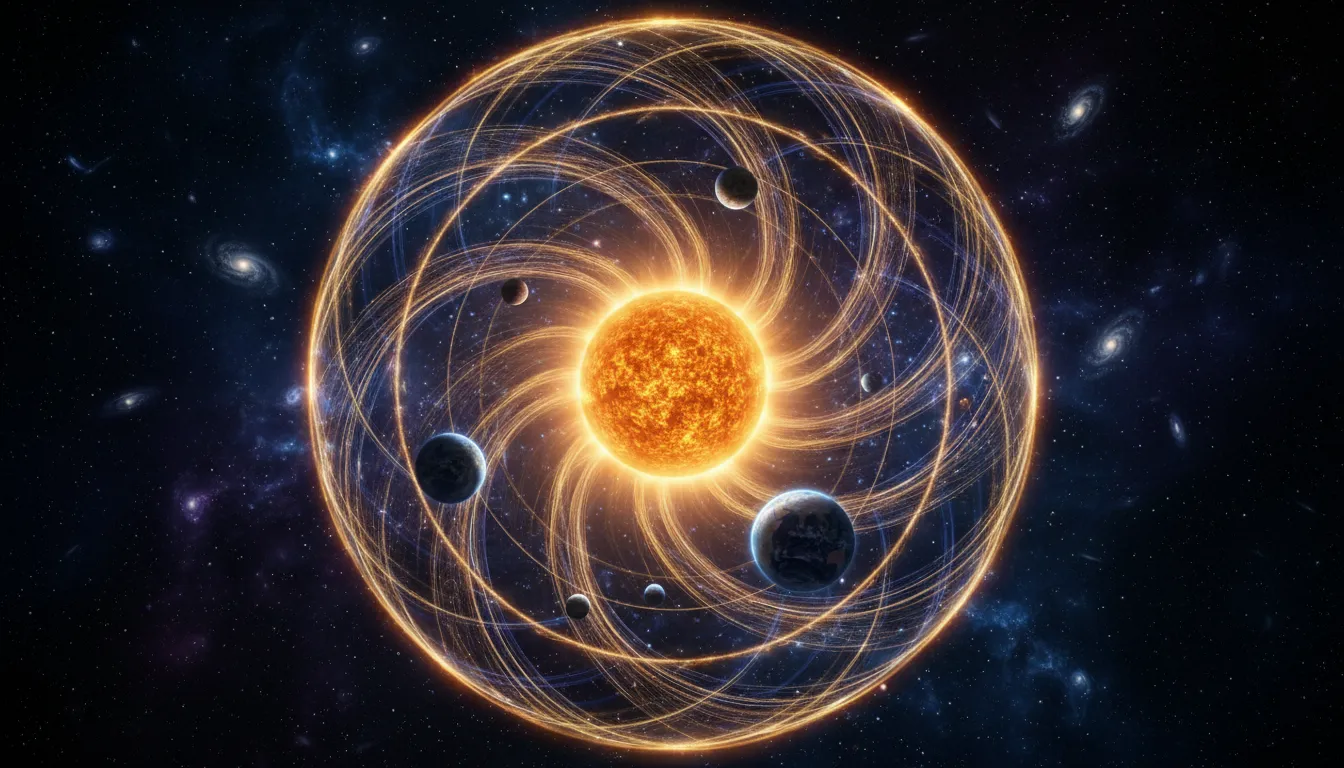
The Sun is a G-type main-sequence star (G2V) at the heart of our solar system, approximately 149.6 million kilometers from Earth. With a diameter of about 1.39 million kilometers, it contains 99.86% of the system’s total mass. The Sun’s energy emanates from nuclear fusion in its core, where hydrogen atoms merge to form helium, releasing the radiant light that sustains all terrestrial life.
The Earth completes one orbit around the Sun in approximately 365.25 days, defining our solar year. From our geocentric perspective in Vedic astrology, the Sun appears to traverse the twelve zodiacal signs over this annual cycle, spending roughly one month in each constellation. This apparent motion marks the foundation of solar time-keeping and seasonal rhythms.
The Sun’s surface temperature reaches approximately 5,500°C, while its corona extends millions of kilometers into space. Solar activity follows an approximately 11-year cycle, marked by variations in sunspot activity and solar flares.
Mythological Origins: The Aditya, Son of the Infinite
The mythological tapestry of Surya weaves through the earliest layers of Vedic literature, establishing the Sun as far more than a celestial body—he is a divine personality whose family dramas mirror the cosmic tensions that shape existence itself.
Birth and Lineage
Surya descends from the great Sage Kashyapa and his wife Aditi, the goddess of boundless space and mother of the gods. As one of the twelve Adityas—solar deities who represent different aspects of cosmic law—Surya holds the supreme position, the visible face of the life-giving principle. His very name connects him to this divine motherhood: “Aditya” means “son of Aditi,” and through this lineage, Surya inherits the responsibility of upholding dharma and illuminating truth across the three worlds.
The Sanjna Story: When Radiance Became Too Much
Perhaps no myth captures Surya’s essential nature more poignantly than the story of his marriage to Sanjna, daughter of the divine architect Vishwakarma. Sanjna—whose name means “conscience” or “consciousness”—found her husband’s brilliance literally unbearable. Unable to look directly at him, she grew weary and eventually fled, leaving behind Chaya, her own shadow, to take her place.
Surya, unaware of the substitution, lived with Chaya, who bore him children including Shani (Saturn) and the river goddess Tapti. When the truth emerged, Surya pursued his true wife, who had transformed herself into a mare and hidden in the forest. In his pursuit, he too assumed equine form, and from this union were born the Ashwini Kumaras, the divine twin physicians of the gods.
To prevent further separation, Vishwakarma placed Surya upon his lathe and reduced his brilliance by one-eighth, making him bearable to his wife. From the excess radiance that was shaved away, Vishwakarma fashioned the weapons of the gods—including Vishnu’s discus and Shiva’s trident—ensuring that solar power continues to protect the cosmic order even in diminished form.
Divine Children
Through his unions with Sanjna and Chaya, Surya fathered beings who govern fundamental aspects of existence:
- Yama, the lord of death and dharma, who judges all souls
- Yami (the Yamuna), the sacred river that flows through the heart of India
- Vaivasvata Manu, the progenitor of the current human race
- The Ashwini Kumaras, divine physicians who heal both gods and mortals
- Shani (Saturn), the lord of karma and consequences
The relationship between Surya and Shani deserves special note. Born of the shadow-wife Chaya, Shani emerged with such intensity that his very first glance caused an eclipse of his father. This eternal tension between father and son—between radiant authority and karmic consequence—plays out in every horoscope where Sun and Saturn interact.
Karna: The Tragic Solar Hero
In the Mahabharata, Surya’s mortal son Karna embodies the Sun’s highest virtues and deepest tragedies. Born to the princess Kunti before her marriage, Karna arrived wearing golden armor and earrings that made him virtually invincible. Abandoned by his mother to hide her shame, raised by a charioteer, yet possessing the unmistakable radiance of solar nobility, Karna became the greatest warrior of his age—generous to a fault, loyal beyond reason, and tragically fighting on the wrong side of dharma. His story illustrates how solar qualities—courage, generosity, honor—can lead to both glory and destruction.
Biological Sovereignty
Modern science validates ancient intuition: the Sun governs the fundamental rhythms of life itself. Circadian cycles—the approximately 24-hour patterns of physiological activity—synchronize to solar light through specialized retinal cells that communicate directly with the brain’s master clock. Body temperature peaks in afternoon as the Sun reaches zenith, while restorative hormones flow during solar absence. This biological dependence on solar presence explains why the texts assign vitality, health, and life force to the Sun’s portfolio. The soul of the cosmos manifests as the timekeeper of the body, the conductor of our metabolic orchestra.
Classical Description
The ancient texts speak of Surya with reverence befitting a celestial monarch. His form carries the dignity of royalty—a square, sturdy body of moderate height, neither towering nor diminutive, crowned with curly hair that suggests the spiraling flames of consciousness itself. His honey-colored eyes hold the penetrating gaze of pure awareness, while his complexion shifts between copper-red and a mysterious blend of red and green, as if sunset and dawn meet perpetually in his countenance.
The Sun’s physical frame reveals strength through subtlety. His bones are sturdy, providing internal fortitude, while his feet remain small and unobtrusive—a reminder that true sovereignty requires no ostentatious display. Limited hair adorns his head, and he maintains impeccable cleanliness, reflecting the purity of fire that consumes all impurity.
Draped in coarse saffron robes befitting an ascetic king, Surya embodies the paradox of royal authority wedded to spiritual discipline. His voice carries majesty, his mind moves with sharpness, and his courage flows steady and unwavering. He is intelligence incarnate, the very principle of discernment and conscious will.
Essential Qualities
Element & Nature
The Sun belongs to the realm of Fire (Agni), the transformative element that illuminates, purifies, and destroys. As the presiding deity Agni suggests, this is not passive warmth but active, consuming radiance—the flame of consciousness that burns away ignorance.
Guna
Sattvic in essence, the Sun represents the purest mode of existence—truth, clarity, kindness, and unwavering firmness. This is not the cruel rigidity of ego but the benevolent steadiness of dharma itself.
Dosha
The Sun governs Pitta, the fire-nature within the body. This manifests as metabolic heat, digestive power, sharp intellect, and the capacity for transformation. Pitta’s qualities—intensity, focus, and penetrating clarity—flow directly from solar influence.
Temperament
Courageous (Shura) and Steady (Dhira)—the Sun’s temperament blends fearless action with patient endurance. This is the warrior-king who neither rushes rashly nor hesitates in doubt, but moves with measured certainty.
Physical, Emotional & Psychological Traits
Physical Characteristics
Those born under strong solar influence often display distinctive physical characteristics:
- Square, well-proportioned build with sturdy bone structure
- Moderate height
- Reddish or warm-toned complexion
- Unusual brightness in the eyes—honey-colored or luminous
- Hair tends toward curls or may thin with age
- Body runs warm with strong digestive fire
- Aversion to excessive heat
Emotional Nature
Emotionally, the solar native embodies steadiness and courage. There is an inherent nobility of spirit, a natural authority that requires no external validation. Pride lives here, but ideally tempered by Sattvic wisdom—pride in righteous action rather than ego-driven superiority. The emotional landscape tends toward clarity rather than complexity, with feelings expressed directly and honestly.
Psychological Profile
Psychologically, the Sun bestows sharp intelligence, particularly the discriminating faculty that separates truth from illusion. The mind prefers:
- Clarity to ambiguity
- Structure to chaos
- Principle to expedience
There is an innate sense of purpose, a drive toward self-realization that transcends mere personal ambition. At its highest expression, solar consciousness recognizes itself as the eternal witness, the Atman that observes without attachment yet participates fully in the cosmic drama.
Symbolism & Mythic Archetypes
The Divine King
The Sun embodies the archetype of the Divine King—not the tyrant who rules through fear, but the righteous sovereign who illuminates and protects his realm. In temples, his natural abode, we find the fusion of temporal and spiritual authority, the recognition that true kingship is service to cosmic order. The seven horses of Surya’s chariot represent the seven days of the week, the seven colors of light, and the seven chakras—all aspects of creation that unfold under solar governance.
Agni, the Fire God
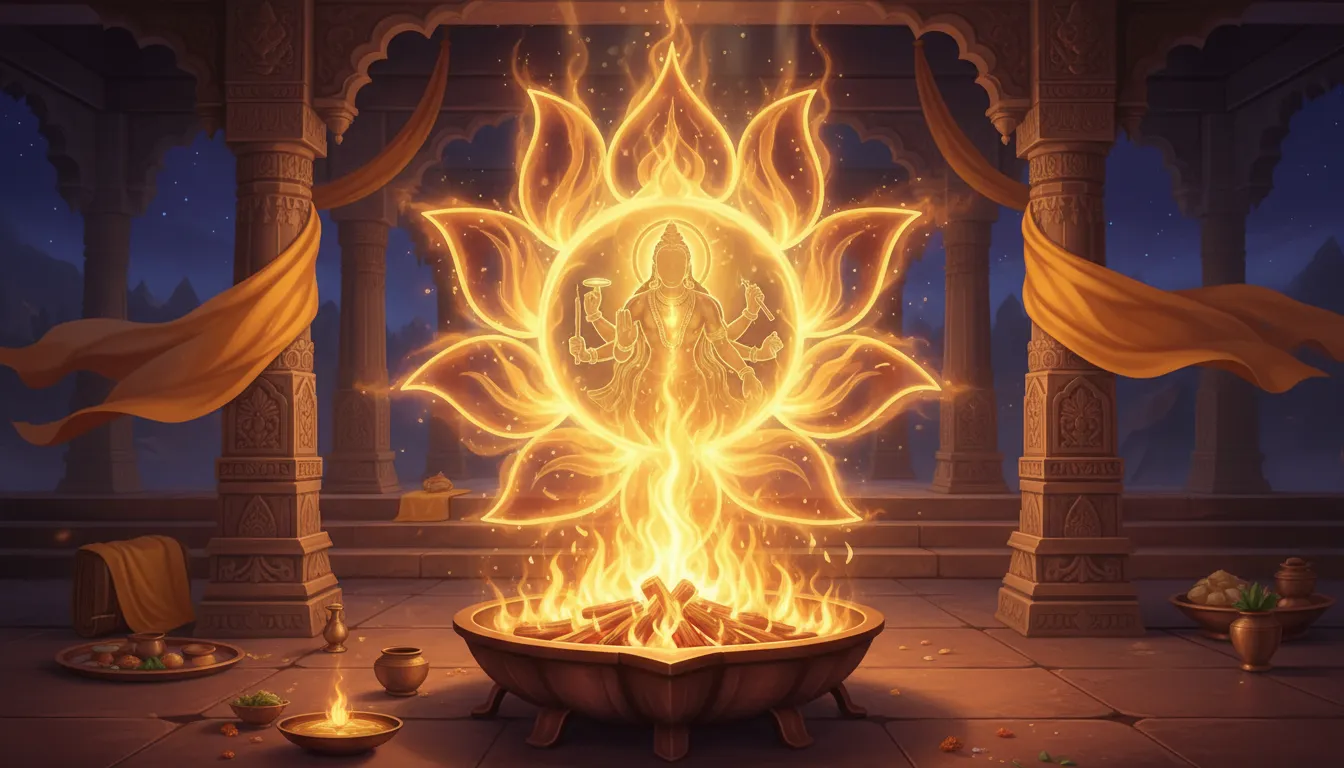
As Agni, Surya represents the sacred flame on every altar and the digestive fire in every belly—the principle that transforms, purifies, and releases energy from matter. He is the mediator between earth and heaven, carrying offerings upward and blessings downward. This connection to Agni explains the Sun’s pungent taste and its role in digestion—the internal fire that processes both food and experience.
The Cosmic Soul
In the body of the Cosmic Man (Kalapurusha), the Sun forms the Soul itself—the animating principle, the essence of “I am.” Without solar consciousness, the body remains a mere collection of elements. With it, life awakens to self-awareness. This is why the Sun rules Leo, the sign of the heart—the organ that pumps life through all channels, just as solar consciousness animates all mental functions.
The Father of Time
The Sun’s rulership over the Ayana—the six-month period between solstices—establishes it as the Father of Time in the cosmic scheme. While the Moon governs the smaller cycle of the month (paksha), and Saturn the longer cycle of years, the Sun measures the great rhythms of the year through its northward (Uttarayana) and southward (Dakshinayana) journeys. The festivals of Makar Sankranti and the calculation of auspicious muhurtas depend on solar position. In this sense, Surya is not merely in time—he is time, the cosmic clock against which all other rhythms are measured.
Sakshi: The Eternal Witness
The Vedas speak of the Sun as Sakshi—the witness of all actions. Nothing done under the sky escapes his gaze. This is not the witness of a judge preparing punishment, but the witness of pure awareness that illuminates without interfering. In the Gayatri Mantra, the most sacred of all Vedic mantras, the devotee meditates upon the Sun (Savitr) as the source of illuminating wisdom. This solar witnessing represents the Atman’s quality of pure observation—the consciousness that watches thoughts arise and fall without identifying with any of them.
Pranadaata: The Life-Giver
Beyond illumination, beyond warmth, the Sun is Pranadaata—the giver of prana, the life force itself. The Upanishads declare that prana follows the Sun, rising when he rises, settling when he sets. This is why morning sun exposure energizes while evening darkness invites rest. The solar principle does not merely support life; it is life, the animating current that flows through all beings and withdraws at the moment of death.
Significations
Personal Domains
- The soul, consciousness, and sense of self
- Father figures and paternal lineage
- Authority, leadership, and governance
- Personal dignity and self-respect
- Vitality and life force
- Confidence and courage
Professional Realms
- Kings, rulers, and governmental authority
- Administrative positions and leadership roles
- Positions requiring command and decision-making
- Work with copper, gold, or precious metals
- Temple service and spiritual leadership
- Medical fields related to heart, eyes, and bones
Physical Correspondences
- Heart and circulatory system
- Right eye (for males)
- Bones and skeletal strength
- Digestive fire and metabolism
- Head and brain
- General vitality and immunity
Environmental & Material
- Temples and places of worship
- Eastern and southern directions
- Summer season and heat
- Strong trees with thick trunks
- Root vegetables
- Copper and gold
- Saffron and pungent substances
Temporal Rulership
- Daytime (especially noon)
- Sunday
- The six-month period between solstices (Ayana)
- Summer months
Nakshatra Rulership
The Sun governs three nakshatras, each carrying solar themes of authority, purification, and leadership across different zodiacal territories:
Krittika (26°40’ Aries – 10° Taurus) Named for the Pleiades star cluster, Krittika means “the cutter” or “the one who cuts.” Its symbol is a flame or razor—instruments of purification and separation. The presiding deity is Agni, the fire god, linking this nakshatra directly to the Sun’s transformative essence. Krittika natives possess the solar capacity to cut through illusion, separate truth from falsehood, and purify through intense focus. The mythological Kartikeya (Skanda), god of war, was nursed by the six Krittikas, connecting this nakshatra to martial courage and divine protection.
Uttara Phalguni (26°40’ Leo – 10° Virgo) Meaning “the latter reddish one,” Uttara Phalguni follows its more playful sibling Purva Phalguni with themes of stability, contracts, and patronage. Its symbol is a bed or hammock—representing rest, comfort, and the fruits of righteous action. The presiding deity is Aryaman, god of contracts, friendship, and proper social conduct. This nakshatra spans from the Sun’s own sign Leo into Virgo, bridging solar authority with practical service. Those with strong Uttara Phalguni placements often become patrons, benefactors, or reliable authorities who honor their commitments.
Uttara Ashadha (26°40’ Sagittarius – 10° Capricorn) The “later invincible one” represents lasting victory and unshakeable achievement. Its symbol is an elephant’s tusk—signifying penetrating power, wisdom, and the removal of obstacles. The presiding deities are the Vishvadevas, the collective gods who represent universal virtues. Spanning from philosophical Sagittarius into ambitious Capricorn, this nakshatra channels solar energy toward enduring accomplishment and leadership that serves the greater good. The Sun’s rulership here speaks to authority earned through righteous persistence rather than force.
Common Thread: All three Sun-ruled nakshatras share themes of purification (Krittika), proper conduct (Uttara Phalguni), and righteous victory (Uttara Ashadha)—the solar principles of dharma manifesting across the zodiac.
Strengths & Weaknesses
Strengths
The Sun reaches peak strength in several conditions:
Directional Strength
Thrives in the South, though its natural abode is the East where it rises.
Temporal Power
All daylight hours favor solar influence, with maximum power at noon when the Sun occupies the tenth house from the ascendant.
Exaltation
In Aries, particularly at the tenth degree, the Sun achieves exaltation—its most refined and powerful expression.
Own Sign
Leo serves as both its own sign and Moolatrikona territory (0°–20°), providing natural dignity and rulership.
Planetary Hierarchy
The first position in the planetary hierarchy marks the Sun as naturally strongest among the nine grahas.
Seasonal Power
Summer months amplify solar power, as does the presence of friendly planets Jupiter, Mars, and Moon in close association.
Weaknesses
Debilitation
The Sun’s light dims in Libra, its sign of debilitation, where its fierce independence must bow to partnership and compromise.
Temporal Weakness
During nighttime, particularly midnight, solar influence wanes significantly.
House Positions
The twelfth house position (before rising) weakens the Sun, as does the sixth or eighth house placement in difficult configurations.
Planetary Conflicts
Association with enemies Venus and Saturn can create friction, though these relationships often drive important evolutionary growth.
Malefic Nature
The Sun’s inherent malefic nature means it can scorch what it touches—excessive pride, arrogance, estrangement from father, and domineering behavior emerge when solar influence becomes distorted.
Physical Imbalances
The heat nature, when imbalanced, manifests as Pitta disorders: inflammation, anger, skin conditions, and digestive disturbances.
Symbolic Weaknesses
The Sun’s limited hair and small feet, mentioned in classical texts, point toward symbolic weaknesses: difficulty with humility (the head) and groundedness (the feet). The king sometimes forgets he walks the same earth as his subjects.
Classical Reference Notes
The portrait of Surya drawn here synthesizes descriptions from the Brihat Parashara Hora Shastra, the Saravali, and the Phaladeepika—three foundational texts of Jyotisha. All sources agree on the Sun’s royal status, Kshatriya caste, and natural malefic nature, while describing physical appearance in remarkably consistent terms—the square body, honey-colored eyes, limited hair, and bilious constitution appear across traditions.
Brihat Parashara Hora Shastra
The Brihat Parashara Hora Shastra emphasizes the Sun’s role as the soul of the Cosmic Man (Kalapurusha Atma), establishing its supreme importance in chart interpretation. It details the Sun’s friendships and enmities, placement strengths, and behavioral significations. The text’s description of physical appearance focuses on the honey-colored eyes, sturdy bones, and moderate stature. BPHS assigns the Sun directional strength in the South and temporal strength during day hours.
Saravali
The Saravali provides additional layers, noting the Sun’s Sattvic guna and the specific shade of complexion—a unique red-green mixture that suggests the meeting of passion (red) and growth (green) in conscious awareness. It elaborates on the Sun’s association with copper, temples, and pungent tastes, while confirming the courageous, steady temperament and sharp intellectual faculties. Kalyana Varma’s treatment emphasizes the solar connection to governmental authority and royal dignity.
Phaladeepika
The Phaladeepika of Mantreswara confirms the essential solar attributes while providing additional context for predictive application. It notes the Sun’s significance as karaka for the father and for positions of authority, and elaborates on the effects of solar placement in various houses and signs. The text’s treatment of combustion (Asta) effects is particularly detailed, explaining how other planets lose strength when too close to the Sun’s overwhelming radiance.
Consistency Across Texts
Unlike some planets where classical sources diverge on key attributes (such as Venus’s directional strength), the major texts agree remarkably on solar characteristics. The Sun’s exaltation at ten degrees of Aries, debilitation in Libra, Leo rulership, and Moolatrikona in Leo 0°–20° appear consistently across all traditions. This unanimity befits the Sun’s role as the central, unifying principle of the horoscope.
Temporal Rulership
The assignment of the six-month Ayana period to the Sun reflects ancient recognition of the solstice cycle—the northward (Uttarayana) and southward (Dakshinayana) journeys that mark the apparent path of the Sun through the year. This temporal rulership connects the Sun to the largest seasonal rhythms, befitting its royal status among the grahas.
Closing Reflection
The Sun asks us to remember what we truly are—not the accumulated roles and masks, but the witnessing consciousness behind all experience. In its heat, we find the courage to burn away what no longer serves. In its light, we discover the path forward. In its steady presence, we recognize the soul that neither rises nor sets, but eternally observes the cosmic dance from the still center of being.
The myths of Surya illuminate our own solar journey. Like Sanjna, we may find certain intensities unbearable—the full blaze of truth, the demands of authority, the expectations that come with visibility. Like Vishwakarma, we learn to temper our radiance so that we can be in relationship without scorching those we love. Like Karna, we may possess solar gifts—courage, generosity, nobility—while struggling to claim our rightful place in the world. And like Shani, we may carry the task of holding our luminous fathers accountable to the consequences of their actions.
To know the Sun in your chart is to know where your sovereignty lies, where your father’s legacy lives, where your courage will be tested and your dignity established. It marks the throne room of your existence—sometimes occupied with grace, sometimes vacant through abdication, but always waiting for you to claim your rightful place in the kingdom of consciousness. The Sun neither apologizes for its brilliance nor dims itself unnecessarily—it simply shines, fulfilling its dharma of illumination, inviting all beings to do the same.
Explore the Navagraha
This article is part of our comprehensive series on the nine celestial powers of Vedic astrology. Discover how all the grahas work together in the cosmic parliament:
The Complete Guide to Navagraha: Nine Planets of Vedic Astrology →
References
This article synthesizes knowledge from the following classical Vedic astrology texts:
-
Brihat Parashara Hora Shastra - The foundational text of Vedic astrology attributed to Sage Parashara, detailing planetary characteristics, significations, and interpretive principles.
-
Saravali - A comprehensive classical text by Kalyana Varma, providing detailed descriptions of planetary qualities, physical appearances, and astrological effects.
-
Phaladeepika - A classical text offering insights into planetary dignities, strengths, and predictive techniques.
These ancient texts form the bedrock of Vedic astrological wisdom, passed down through generations of practitioners and scholars.
Want to discover how the Sun influences your personal birth chart? Join our waitlist for personalized Vedic astrology insights when Lopamudra launches.
Related Articles
The Moon (Chandra): Sovereign of the Mind, Keeper of the Tides
In the ancient sky-map of Jyotisha, Chandra rises as the luminous reflection of the soul - the mind's mirror, ever waxing and waning with the pulse of creation.
Mars (Mangala): The Crimson Warrior of the Celestial Realm
In the vast architecture of Jyotisha, Mars rises like a flame against the dark sky—fierce, unrelenting, and alive with the pulse of action.
Budha: The Awakened Messenger, Prince of Intellect and Speech
Born of cosmic scandal yet blessed with divine wit—Mercury stands as the chameleon among planets, a neutral prince whose nature mirrors those who surround him, awakening the mind to language, logic, and the mercurial dance of thought.