Tula (Libra) in Vedic Astrology: Complete Guide to the Seventh Rashi
Discover Tula (Libra), the seventh sign of the Vedic zodiac. Learn why Saturn is exalted here, the Sun is debilitated, the three nakshatras within, and classical insights on this cardinal air sign.
Quick Reference
| Attribute | Value |
|---|---|
| Sanskrit Name | Tula (तुला) |
| English Name | Libra |
| Position | 7th sign (180°-210°) |
| Ruler | Venus (Shukra) |
| Element | Air (Vayu Tattva) |
| Modality | Cardinal/Movable (Chara) |
| Gender | Masculine (Purusha) |
| Body Part | Groins/Lower Abdomen |
| Direction | West |
| Color | Black |
| Guna | Rajasic |
| Classification | Dwipada (Biped/Human) |
| Caste | Shudra |
| Rising Type | Shirshodaya (Head-rising) |
Introduction
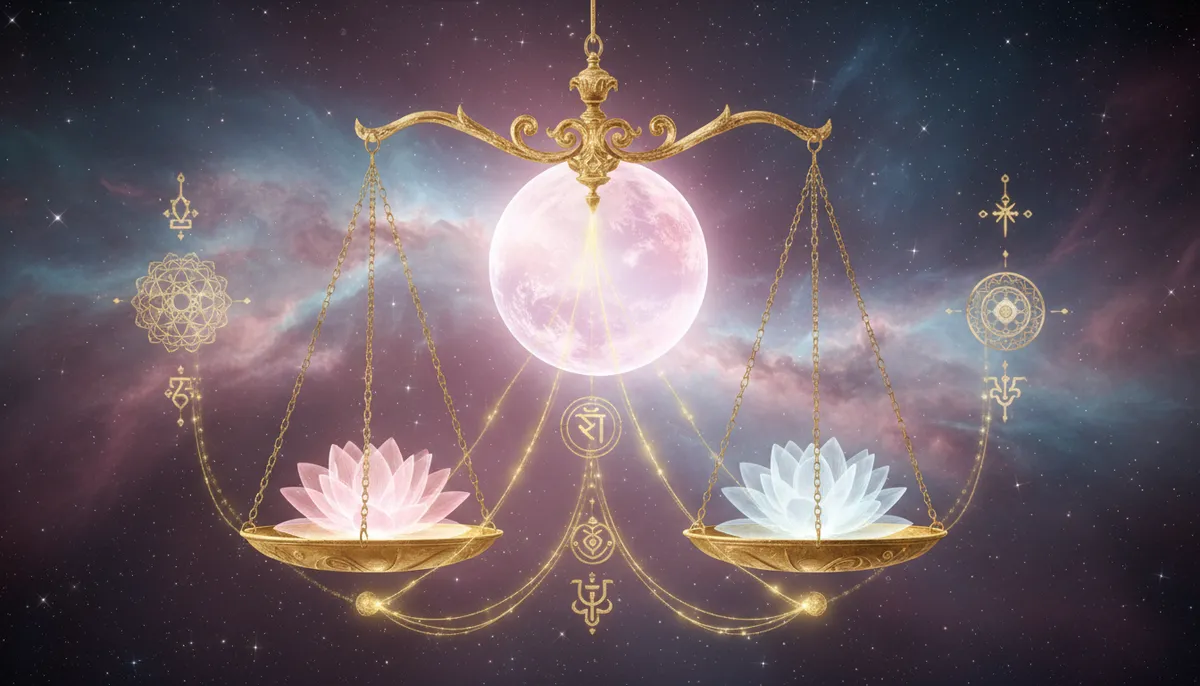
Tula (Libra) stands as the seventh sign of the Vedic zodiac—the point of balance where self meets other, where individual identity dissolves into partnership. As Venus’ air sign and Mooltrikona, Libra represents the highest expression of harmony, justice, and relational refinement.
In Jyotish, Tula holds unique significance as the sign where Saturn is exalted and the Sun is debilitated—a profound inversion of Aries’ dynamics. This polarity reveals Libra’s essential nature: the ego must yield for partnership to flourish.
Classical Description
The ancient sages provided detailed characterizations of Tula’s nature:
Libra is a Seershodaya sign rising with its head, is strong in day time, is black in complexion, is predominant with Rajoguna, relates to the western direction, resorts to land, is destructive or mischievous, represents Sudras, has a medium build, is a biped sign, ruled by Venus
This comprehensive portrait reveals:
- Shirshodaya (head-rising): Intellectual approach, rising headfirst
- Day-strong (Divasbali): Gains power during daylight hours
- Black color: Saturnine influence despite Venus rulership
- Rajasic guna: Active, passionate, worldly engagement
- West direction: The realm of sunset and partnership
- Land-resorting: Grounded despite air element
- Medium build: Balanced, proportionate form
- Biped (Dwipada): Human nature, civilized, refined
- Destructive/mischievous: Capacity to disturb through imbalance
Libra produces natives who are phlegmatic and windy in humour, learned, very intelligent, who honour guests, gods and Brahmins
Core Nature and Qualities
Tula represents the balancing principle in the zodiac—the force that weighs, measures, and seeks equilibrium in all things. As a masculine air sign with cardinal quality, Libra initiates relationship and actively pursues harmony.
The Venus Connection
Venus as ruler bestows:
- Aesthetic refinement: Love of beauty, art, and elegance
- Relationship focus: Deep need for partnership and connection
- Diplomatic skill: Ability to mediate and harmonize
- Social grace: Charm, courtesy, and pleasant manner
- Justice orientation: Desire for fairness and balance
The Groins of Kalapurusha
As the lower abdomen and groin region of the Cosmic Being, Libra governs:
- Partnership and union: The joining of opposites
- Reproduction: Creative potential through relationship
- Balance point: The center of the cosmic body
- Sexual dynamics: The interplay of masculine and feminine
The Rajasic Air Nature
The Rajasic quality combined with air element creates:
- Active socialization: Energetic pursuit of relationship
- Intellectual engagement: Weighing ideas and perspectives
- Creative dynamism: Artistic and aesthetic innovation
- Worldly refinement: Sophisticated material tastes
Planetary Dignities
Libra serves as the stage for one of astrology’s most significant polarities—Saturn’s exaltation directly opposite the Sun’s debilitation.
Saturn’s Exaltation (Uccha)
Saturn reaches its exaltation in Libra, with the deepest point at 20 degrees. Saturn finds supreme expression in Libra because:
- Service over self: Saturn’s self-denial serves partnership ideals
- Discipline in relationship: Commitment and responsibility flourish
- Justice through structure: Fair systems and balanced frameworks
- Patience with others: Slow, steady approach to harmony
This is the only sign where Saturn—the great malefic—achieves its highest dignity, revealing that discipline and restraint create the strongest relationships.
Sun’s Debilitation (Neecha)
The Sun reaches its debilitation in Libra, with the deepest point at 10 degrees. The Sun struggles in Libra because:
- Ego must yield: Individual authority conflicts with partnership
- Compromise required: Self-assertion disturbs balance
- Others matter equally: Solar centrality is inappropriate
- Consultation needed: Unilateral action fails
| Planet | Dignity | Degrees | Significance |
|---|---|---|---|
| Saturn | Exaltation | 20° | Discipline perfects relationship |
| Sun | Debilitation | 10° | Ego impairs partnership |
| Venus | Mooltrikona | 0° - 15° | Highest relational expression |
| Venus | Own Sign | 15° - 30° | Strong partnership capacity |
Venus’ Mooltrikona
Venus enjoys Mooltrikona dignity in the first 15 degrees of Libra, making this the supreme position for relational and aesthetic expression—even stronger than Venus’ own sign of Taurus.
Cosmic Correspondences
Beyond basic characteristics, classical texts assign specific cosmic mappings to Tula:
| Correspondence | Value | Significance |
|---|---|---|
| Direction | West | Sunset, partnership, other |
| Rising Type | Shirshodaya | Head-first, intellectual |
| Day/Night | Diurnal strength | Power during daylight |
| Caste | Shudra | Service orientation |
| Guna | Rajas | Active engagement |
| Terrain | Land | Grounded relationships |
Libra Ascendant Characteristics
When the Lagna is Tula (Libra), the person has a lean and frail body, will have a limited number of children, will be intent on worshipping Gods and Brahmins, will be wandering, will have two names, will be tall in stature, will be clever in trading, brave, merciless and impartial in argument
Person born in Libra Lagna will have lovely face and charming eyes, be honored by kings, learned, fond of love pleasures, possessing women and wealth and lands, principal teeth apart, calm, pensive, irresolute and timid
Key Libra Ascendant traits from classical sources:
- Physical: Lean, tall, lovely face, charming eyes
- Character: Calm, pensive, learned, diplomatic
- Skills: Clever in trading, impartial in argument
- Challenges: Irresolute, indecisive, wandering
- Spiritual: Intent on worshipping Gods and Brahmins
- Worldly: Fond of love pleasures, possessing wealth
Nakshatras in Tula
Three lunar mansions span Libra, each contributing unique qualities:
Chitra (23°20’ Virgo - 6°40’ Libra)
The latter half of Chitra (0° - 6°40’ Libra) falls within Tula.
| Attribute | Value |
|---|---|
| Ruling Planet | Mars (Mangala) |
| Deity | Vishwakarma (Celestial Architect) |
| Symbol | Bright Jewel/Pearl |
| Quality | Creation, beauty, brilliance |
Chitra in Libra combines Mars’ creative drive with Venus’ aesthetic refinement—the architect of beautiful relationships, the jewel of harmonious design.
Swati (6°40’ - 20° Libra)
The independent, wind-blown nakshatra falls entirely within Libra.
| Attribute | Value |
|---|---|
| Ruling Planet | Rahu |
| Deity | Vayu (Wind God) |
| Symbol | Young Plant / Coral |
| Quality | Independence, flexibility, growth |
Swati in Libra creates exceptional:
- Independent balance: Self-sufficient yet relational
- Flexible diplomacy: Bending without breaking
- Business acumen: Trade, commerce, negotiation
- Spiritual seeking: Freedom within partnership
Vishakha (20° Libra - 3°20’ Scorpio)
The first three-quarters of Vishakha (20° - 30° Libra) reside in Tula.
| Attribute | Value |
|---|---|
| Ruling Planet | Jupiter (Guru) |
| Deity | Indra-Agni (Dual Deity) |
| Symbol | Triumphal Gateway |
| Quality | Determination, ambition, transformation |
Vishakha in Libra blends Jupiter’s expansion with Venus’ harmony—the gateway to transformation through relationship, ambitious pursuit of balanced growth.
Significations and Terrain
Classical texts associate Tula with specific environments, beings, and activities:
Places and Environments
- Marketplaces: Places of trade and exchange
- Courts of justice: Legal and judicial settings
- Art galleries: Aesthetic and cultural venues
- Social gatherings: Parties, receptions, meetings
- Western regions: Areas in the west direction
Living Beings
- Humans (bipeds): Civilized, refined individuals
- Merchants and traders: Commercial people
- Artists and aesthetes: Those devoted to beauty
- Diplomats and mediators: Balance-seekers
Professions and Activities
- Trade and commerce: Buying, selling, negotiating
- Law and justice: Legal profession, arbitration
- Art and design: Aesthetic creation, fashion
- Diplomacy: Mediation, international relations
- Counseling: Relationship guidance, therapy
The Saturn-Sun Polarity
Libra’s unique dignity pattern—Saturn exalted, Sun debilitated—teaches a profound lesson:
In partnership, the ego (Sun) must yield for commitment (Saturn) to succeed.
This polarity manifests as:
| Sun Debilitated | Saturn Exalted |
|---|---|
| Self-assertion fails | Service succeeds |
| Individual focus disrupts | Collective focus harmonizes |
| Authority alienates | Humility attracts |
| Speed creates imbalance | Patience creates stability |
Understanding this dynamic unlocks Libra’s deepest wisdom—the strongest relationships require the temporary eclipse of personal ego.
Summary
Tula (Libra) represents the zodiac’s supreme domain of balance, partnership, and harmonious relationship. As Venus’ Mooltrikona and Saturn’s exaltation sign, Libra offers unparalleled capacity for refined relationship and disciplined commitment.
The cardinal air nature creates initiative in partnership—active pursuit of harmony rather than passive acceptance. The three nakshatras—Chitra, Swati, and Vishakha—each contribute unique qualities from Martian brilliance to Rahuvian independence to Jupiterian ambition.
The Sun’s debilitation here highlights Libra’s essential teaching—ego must be balanced, not dominant, for true partnership to flourish. Saturn’s exaltation reveals that discipline, patience, and service create the strongest bonds.
For the Vedic astrologer, understanding Libra means appreciating the power of balance as a path to harmony, the virtue of compromise as relational wisdom, and the significance of partnership as a vehicle for spiritual growth.
Classical Sources Referenced
- Brihat Parashara Hora Shastra (BPHS): Chapters 4, 46
- Jataka Parijata: Chapters 1, 8, 9
- Saravali: Chapter 48
- Phaladeepika: Chapter 9
Related Articles
Zodiac Series
- Dwadasha Rashi: Complete Guide to the 12 Zodiac Signs
- Kanya (Virgo): The Sixth Sign
- Vrishchika (Scorpio): The Eighth Sign
- Mesha (Aries): The Opposite Sign
- Vrishabha (Taurus): Venus’ Other Sign
Planetary Guides
- Venus (Shukra): The Ruler of Libra
- Saturn (Shani): Exalted in Libra
- Sun (Surya): Debilitated in Libra
Nakshatra Guides
Related Articles

Mithuna (Gemini) in Vedic Astrology: Complete Guide to the Third Rashi
Discover Mithuna (Gemini), the intellectual third sign of the Vedic zodiac. Learn about Mercury's rulership, the twin symbolism, the three nakshatras within, and classical insights on this airy dual sign.

Kumbha (Aquarius) in Vedic Astrology: Complete Guide to the Eleventh Rashi
Discover Kumbha (Aquarius), the eleventh sign of the Vedic zodiac. Learn about Saturn's Mooltrikona here, Rahu's connection, the three nakshatras within, and classical insights on this fixed air sign.
Vrishabha (Taurus) in Vedic Astrology: Complete Guide to the Second Rashi
Discover Vrishabha (Taurus), the second sign of the Vedic zodiac. Learn why the Moon is exalted here, the significance of Venus rulership, the three nakshatras within, and classical insights on this fixed earth sign.