Dhanu (Sagittarius) in Vedic Astrology: Complete Guide to the Ninth Rashi
Discover Dhanu (Sagittarius), the ninth sign of the Vedic zodiac. Learn about Jupiter's Mooltrikona here, the centaur symbolism, the three nakshatras within, and classical insights on this mutable fire sign.
Quick Reference
| Attribute | Value |
|---|---|
| Sanskrit Name | Dhanu / Dhanus (धनु) |
| English Name | Sagittarius |
| Position | 9th sign (240°-270°) |
| Ruler | Jupiter (Guru) |
| Element | Fire (Agni Tattva) |
| Modality | Dual/Mutable (Dwiswabhava) |
| Gender | Masculine (Purusha) |
| Body Part | Thighs |
| Direction | East |
| Color | Tawny |
| Guna | Sattvic |
| Classification | Biped (1st half) / Quadruped (2nd half) |
| Status | Royal Sign |
| Rising Type | Shirshodaya (Head-rising) |
Introduction
Dhanu (Sagittarius) stands as the ninth sign of the Vedic zodiac—the domain of dharma, higher wisdom, and the expansive quest for truth. As Jupiter’s fire sign and Mooltrikona, Sagittarius represents the outward expression of philosophical wisdom, the archer aiming toward the highest goal.
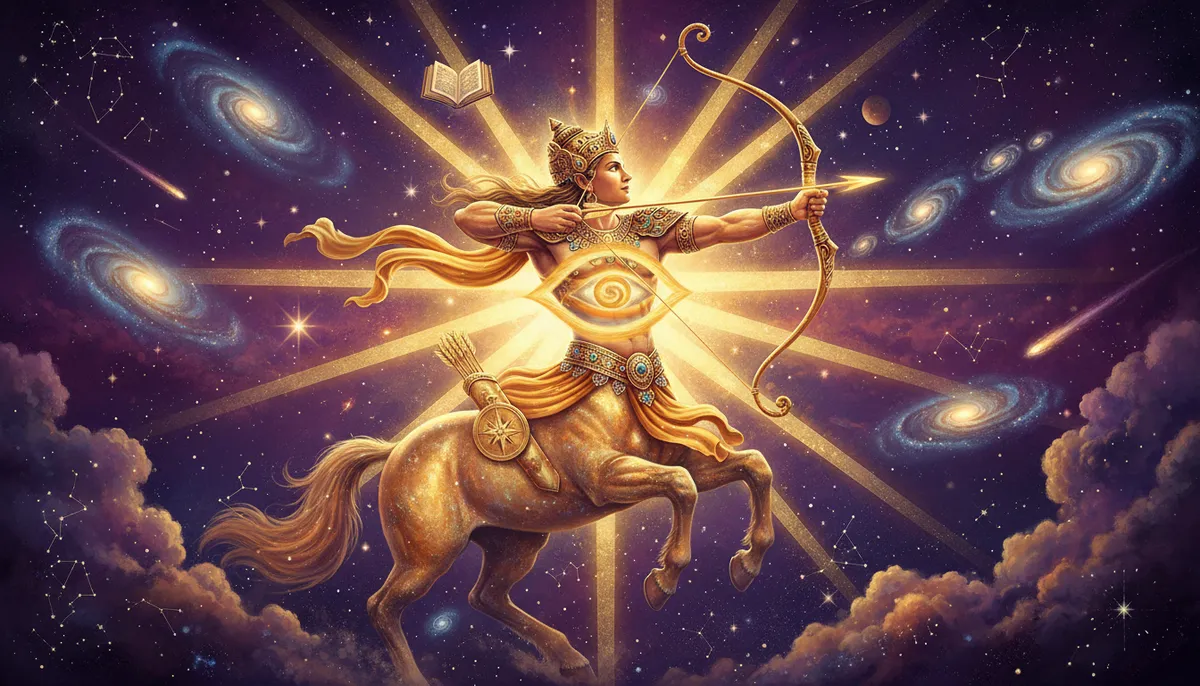
In Jyotish, Dhanu holds special significance as Jupiter’s Mooltrikona—the sign where the great benefic achieves maximum outward expression. The centaur symbol—half human, half horse—embodies the dual nature bridging earthly instinct and heavenly aspiration.
Classical Description
The ancient sages provided detailed characterizations of Dhanu’s nature:
Sagittarius rises with its head, is lorded by Jupiter, is a Satwik sign, is tawny in hue, has strength in night, is fiery, is a royal sign, is biped in first half and quadruped in second half, has an even build, adores an arch, resides in the east, resorts to land, is splendorous
This comprehensive portrait reveals:
- Shirshodaya (head-rising): Intellectual approach, rising headfirst
- Jupiter-lorded: Wisdom, expansion, grace, teaching
- Sattvic guna: Pure, balanced, spiritually inclined
- Tawny color: Warm, earthy-golden hue
- Night-strong (Nishabhali): Gains power during nocturnal hours
- Fiery element: Enthusiasm, inspiration, spiritual fire
- Royal sign (Raja): Noble authority, righteous leadership
- Dual classification: Biped (human) first half, quadruped (animal) second half
- Even build: Balanced, proportionate form
- Adores an arch: The bow and arrow symbolism
- East direction: Realm of sunrise, new beginnings
- Splendorous: Brilliant, radiant, magnificent
Sagittarius produces natives who are courageous, strong, just, skilful in Sastras, of high intelligence
Core Nature and Qualities
Dhanu represents the aspiring principle in the zodiac—the force that aims toward higher truth, expands understanding, and seeks the ultimate goal. As a masculine fire sign with mutable quality, Sagittarius combines enthusiasm with adaptability.
The Jupiter Connection
Jupiter as ruler bestows:
- Wisdom and philosophy: Deep understanding, higher knowledge
- Dharmic orientation: Righteousness, ethical conduct
- Teaching ability: Natural capacity to share wisdom
- Expansion and growth: Optimism, abundance, opportunity
- Fortune and grace: Blessings, protection, good luck
The Thighs of Kalapurusha
As the thigh region of the Cosmic Being, Sagittarius governs:
- Locomotion: Movement toward goals
- Journey and pilgrimage: Physical and spiritual travel
- Forward momentum: Progress, advancement
- Physical strength: Power for the quest
The Centaur Symbolism
The half-human, half-horse archer represents:
- Human wisdom: Intellect, philosophy, discrimination
- Animal instinct: Power, speed, natural impulse
- Aimed purpose: The arrow directed at truth
- Bridge function: Connecting earthly and celestial realms
Planetary Dignities
Sagittarius serves as Jupiter’s Mooltrikona—the position of maximum outward planetary expression.
Jupiter’s Mooltrikona and Own Sign
Jupiter enjoys Mooltrikona (0°-10°) and own sign (10°-30°) in Sagittarius:
| Dignity | Degrees | Expression |
|---|---|---|
| Mooltrikona | 0° - 10° | Maximum teaching, dharma, expansion |
| Own Sign | 10° - 30° | Strong wisdom, philosophy, fortune |
Jupiter in Sagittarius vs. Pisces
Jupiter rules two signs with different expressions:
| Jupiter’s Sign | Element | Expression |
|---|---|---|
| Sagittarius | Fire | Outward wisdom, teaching, dharma, philosophy |
| Pisces | Water | Inward wisdom, meditation, moksha, transcendence |
Sagittarius represents Jupiter’s active, worldly expression—the teacher, philosopher, and guardian of righteousness. Pisces represents Jupiter’s contemplative, spiritual expression—the mystic, sage, and seeker of liberation.
Cosmic Correspondences
Beyond basic characteristics, classical texts assign specific cosmic mappings to Dhanu:
| Correspondence | Value | Significance |
|---|---|---|
| Direction | East | Sunrise, new beginnings |
| Rising Type | Shirshodaya | Head-first, intellectual |
| Day/Night | Nocturnal strength | Power at night |
| Status | Royal | Noble authority |
| Guna | Sattva | Pure, balanced |
| Realm | Suvarloka | Celestial/heavenly |
The Celestial Realm
Classical texts associate Sagittarius with Suvarloka—the celestial realm:
“The four Rasis commencing with Dhanus constitute the Suvarloka (celestial realm)”
This places Sagittarius (along with Capricorn, Aquarius, and Pisces) in the heavenly tier of the zodiac, emphasizing its connection to higher truth and divine wisdom.
Sagittarius Ascendant Characteristics
If the Lagna be Dhanus (Sagittarius) at a person's birth, he will have a very long face and neck, his ears and nose will be big, will be intent on his business, will be dwarfish in stature, will be the favourite of the King, will be eloquent, will be liberal in gifts, will destroy his enemies, can be won over only by kind treatment and will be endowed with great strength
Person born in Sagittarius Lagna will be wise, best of family, prosperous and possessing fame and wealth
Key Sagittarius Ascendant traits from classical sources:
- Physical: Long face and neck, large ears and nose
- Character: Eloquent, liberal in gifts, strong
- Status: Favourite of kings, wise, famous
- Nature: Intent on business, best of family
- Temperament: Can be won only by kind treatment
Nakshatras in Dhanu
Three lunar mansions span Sagittarius, each contributing unique qualities:
Moola (0° - 13°20’ Sagittarius)
The “root” nakshatra opens Sagittarius with transformative energy.
| Attribute | Value |
|---|---|
| Ruling Planet | Ketu |
| Deity | Nirriti (Goddess of Destruction) |
| Symbol | Root / Lion’s Tail |
| Quality | Uprooting, foundation, transformation |
Moola in Sagittarius creates exceptional:
- Foundational wisdom: Getting to the root of truth
- Transformative insight: Destroying ignorance
- Spiritual seeking: Ketu’s liberation merged with Jupiter’s wisdom
- Research ability: Digging deep into knowledge
Purva Ashadha (13°20’ - 26°40’ Sagittarius)
The “early victory” nakshatra brings invincible determination.
| Attribute | Value |
|---|---|
| Ruling Planet | Venus (Shukra) |
| Deity | Apas (Water Deity) |
| Symbol | Elephant’s Tusk / Fan |
| Quality | Invincibility, purification, victory |
Purva Ashadha in Sagittarius blends Venus’ grace with Jupiter’s wisdom:
- Persuasive eloquence: Winning through refined speech
- Philosophical beauty: Wisdom expressed aesthetically
- Purification: Cleansing through higher knowledge
- Early success: Victory in dharmic pursuits
Uttara Ashadha (26°40’ Sagittarius - 10° Capricorn)
The first pada of Uttara Ashadha (26°40’ - 30° Sagittarius) resides in Dhanu.
| Attribute | Value |
|---|---|
| Ruling Planet | Sun (Surya) |
| Deity | Vishve Devas (Universal Gods) |
| Symbol | Elephant’s Tusk |
| Quality | Final victory, leadership, universal appeal |
Uttara Ashadha in Sagittarius combines solar authority with Jupiterian wisdom—leadership through righteousness, ultimate victory through dharma.
Significations and Terrain
Classical texts associate Dhanu with specific environments, beings, and activities:
Places and Environments
- Temples and places of worship: Spiritual sanctuaries
- Universities and academies: Higher learning institutions
- Courts of law: Places of justice and righteousness
- Foreign lands: Distant countries and cultures
- Open spaces: Fields, plains, expansive areas
Living Beings
- Teachers and philosophers: Those who transmit wisdom
- Priests and spiritual leaders: Religious authorities
- Horses and archers: The centaur’s dual nature
- Kings and nobles: Righteous rulers
Professions and Activities
- Teaching: Education at all levels
- Preaching: Religious and spiritual instruction
- Law and justice: Legal profession, judiciary
- Publishing: Spreading knowledge through writing
- Travel: Long journeys, especially for learning
- Philosophy: Pursuit of wisdom and truth
The Dual Nature
Sagittarius’ classification as both biped (first half) and quadruped (second half) reveals profound symbolism:
| Half | Degrees | Nature | Expression |
|---|---|---|---|
| First Half | 0° - 15° | Biped/Human | Intellectual, philosophical, refined |
| Second Half | 15° - 30° | Quadruped/Animal | Instinctive, powerful, action-oriented |
This duality manifests as:
- Human intellect + Animal power: Wisdom backed by strength
- Philosophy + Action: Ideas that move the world
- Refinement + Instinct: Cultivated nature with raw power
- Teaching + Doing: The philosopher who practices
The centaur symbol perfectly captures this—the human torso of wisdom directing the horse body of power toward a single, aimed purpose.
Summary
Dhanu (Sagittarius) represents the zodiac’s supreme domain of dharma, philosophy, and the quest for higher truth. As Jupiter’s Mooltrikona, Sagittarius offers maximum expression of wisdom, teaching, and righteous expansion.
The mutable fire nature creates adaptable enthusiasm—philosophical flexibility that can engage any topic while maintaining core principles. The three nakshatras—Moola, Purva Ashadha, and Uttara Ashadha—each contribute unique qualities from Ketu’s transformative roots to Venus’ persuasive grace to the Sun’s ultimate victory.
The dual biped-quadruped classification reveals Sagittarius’ bridging function—connecting human wisdom with natural power, philosophy with action, the earthly with the celestial.
For the Vedic astrologer, understanding Sagittarius means appreciating the power of aimed purpose, the virtue of dharmic action, and the significance of wisdom as the path to fortune and fulfillment.
Classical Sources Referenced
- Brihat Parashara Hora Shastra (BPHS): Chapters 3, 4, 46
- Jataka Parijata: Chapters 1, 9
- Saravali: Chapter 48
- Phaladeepika: Chapter 9
Related Articles
Zodiac Series
- Dwadasha Rashi: Complete Guide to the 12 Zodiac Signs
- Vrishchika (Scorpio): The Eighth Sign
- Makara (Capricorn): The Tenth Sign
- Mithuna (Gemini): The Opposite Sign
- Meena (Pisces): Jupiter’s Other Sign
Planetary Guides
Nakshatra Guides
Related Articles
Mesha (Aries) in Vedic Astrology: Complete Guide to the First Rashi
Discover Mesha (Aries), the first sign of the Vedic zodiac. Learn why the Sun is exalted here, the significance of Mars rulership, the three nakshatras within, and classical insights on this fiery cardinal sign.
Simha (Leo) in Vedic Astrology: Complete Guide to the Fifth Rashi
Discover Simha (Leo), the royal fifth sign of the Vedic zodiac. Learn about the Sun's Mooltrikona position, the lion symbolism, the three nakshatras within, and classical insights on this majestic fixed fire sign.

Meena (Pisces) in Vedic Astrology: Complete Guide to the Twelfth Rashi
Discover Meena (Pisces), the final sign of the Vedic zodiac. Learn why Venus is exalted here, the significance of Jupiter's rulership, the three nakshatras within, and classical insights on this spiritual water sign.