Simha (Leo) in Vedic Astrology: Complete Guide to the Fifth Rashi
Discover Simha (Leo), the royal fifth sign of the Vedic zodiac. Learn about the Sun's Mooltrikona position, the lion symbolism, the three nakshatras within, and classical insights on this majestic fixed fire sign.
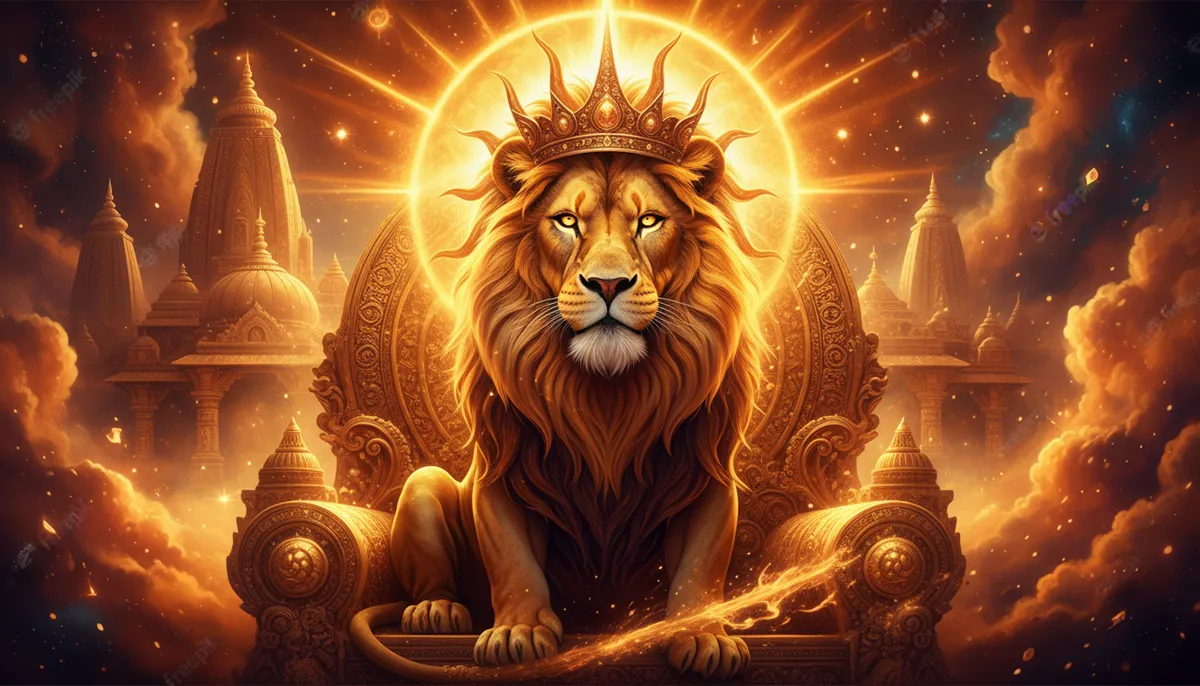
Quick Reference
| Attribute | Value |
|---|---|
| Sanskrit Name | Simha (सिंह) |
| English Name | Leo |
| Position | 5th sign (120°-150°) |
| Ruler | Sun (Surya) |
| Element | Fire (Agni Tattva) |
| Modality | Fixed (Sthira) |
| Gender | Masculine (Purusha) |
| Body Part | Stomach/Belly |
| Direction | East |
| Color | White (large body) |
| Guna | Sattvic |
| Classification | Chatushpada (Quadruped) |
| Status | Royal Sign |
Introduction
Simha (Leo), the fifth sign of the Vedic zodiac, reigns as the royal seat of the celestial wheel. Ruled by the Sun—king of the planetary cabinet—Leo embodies authority, dignity, and the radiant power of self-expression.
This is the only sign where the Sun holds both Mooltrikona and own-sign status, making Leo the pure domain of solar energy. The lion symbolism captures this essence: majestic, courageous, commanding—the king of beasts ruling a kingdom of fire.
Classical Description
The ancient sages provided detailed characterizations of Simha’s noble nature:
Leo is ruled by the Sun, is Satwik, is a quadruped sign, is a royal sign, resorts to forests, rises with its head, has a large white body, resides in the east, is day-strong.
This classical portrait reveals:
- Sun rulership: The seat of royal authority
- Sattvic nature: Pure, harmonious, spiritually inclined
- Quadruped (Chatushpada): Animal nature, strong instincts
- Royal sign: Natural kingship and authority
- Forest-dwelling: Wild, majestic, free
- Shirshodaya (head-rising): Intellectual pride, direct approach
- Large white body: Impressive physical presence
- East direction: Sunrise, new beginnings, leadership
- Day-strong: Solar power peaks in daylight hours
Core Nature & Qualities
Fundamental Temperament
Leo natives embody the archetype of the sovereign—those who lead by natural authority rather than force. The fixed (Sthira) modality grants unwavering determination, while the fire element provides passionate drive and creative power.
Leo produces natives who are majestic, strong, bold, with face resembling lion, who hold high rank of office.
The Sattvic guna ensures that Leo’s power serves higher purposes—not mere ego gratification but the maintenance of dharmic order and the protection of those under their care.
Strengths
Classical texts highlight these positive Leo qualities:
- Authority and leadership: Natural command presence
- Courage and boldness: Fearless in pursuit of goals
- Dignity and self-respect: Unwavering sense of honor
- Creative expression: Dramatic, artistic talents
- Generosity: Royal magnanimity toward others
- Firm-mindedness: Resolute once committed
Challenges
The shadow aspects emerge from excess of the same qualities:
If a person be born when the Ascendant is Simha (Leo), he will have reddish eyes, large chin, and a broad face, will be arrogant and powerful, will be angry at trifles, will like to go to forests and hills, will be obedient to his mother and firm-minded.
Classical challenges include:
- Arrogance and pride: Excessive self-importance
- Anger at trifles: Disproportionate reactions to minor slights
- Stubbornness: Fixed nature resists necessary change
- Need for recognition: Dependence on external validation
- Dominating tendency: Difficulty sharing power
Planetary Dignities in This Sign
Sun: Mooltrikona (0°-20°) and Own Sign (20°-30°)
Leo is the Sun’s domain, divided into zones of exceptional and strong dignity. The Mooltrikona (0°-20°) represents the Sun’s office—where solar energy expresses most purely. Here, authority, vitality, and self-expression reach their zenith. When the Sun occupies its Mooltrikona, the native is wealthy, revered, intelligent, and skillful.
From 20°-30°, the Sun remains in own sign—still powerful but slightly less intense than the Mooltrikona zone.
Rahu: Inimical Position
Rahu finds Leo uncomfortable territory. The Sun represents clarity, legitimacy, and direct expression. Rahu embodies illusion, unconventional approaches, and hidden agendas. These fundamental oppositions create friction when Rahu occupies Leo.
Other Planetary Positions
- Moon: Functions adequately; receives Sun’s light well
- Mars: Strong; fire in fire, warrior in royal court
- Mercury: Challenged; intellect struggles with ego dominance
- Jupiter: Excellent; wisdom in kingly domain
- Venus: Mixed; luxury and creativity, but ego conflicts
- Saturn: Challenging; service planet in master’s house
Cosmic Correspondences
Kalapurusha Body Part
In the cosmic man (Kalapurusha), Leo governs the stomach and belly—the seat of fire, digestion, and personal power.
The signs Aries etc., represent the limbs of Kalapurusha: Aries-head, Taurus-face, Gemini-arms, Cancer-heart, Leo-stomach, Virgo-hip, Libra-space below navel, Scorpio-private parts, Sagittarius-thighs, Capricorn-knees, Aquarius-ankles, Pisces-feet.
This placement explains Leo’s association with:
- Digestive fire (Agni): Processing and transformation
- Solar plexus: Center of personal power and will
- Vitality: Core energy and strength
- Physical vulnerabilities: Heart, stomach, and spine issues
The belly represents the furnace that powers the body—perfectly aligned with Leo’s fiery, energizing nature.
Direction
Leo’s direction is East, associated with:
- Sunrise and the birth of new light
- Beginnings and leadership
- The ascendant position in charts
- Solar energy at its source
Classification: Chatushpada (Quadruped)
Leo belongs to the Chatushpada (four-footed/quadruped) classification along with Aries, Taurus, Sagittarius, and Capricorn. This indicates:
- Animal-like instincts and power
- Physical strength and presence
- Territorial nature
- Natural predator/protector instincts
Rising Type: Shirshodaya
Leo is a Shirshodaya (head-rising) sign:
- Rises over the horizon head-first
- Emphasizes intellectual pride and dignity
- Gains strength during daytime hours
- Approaches situations directly, openly
Guna: Sattvic
Leo’s Sattvic nature indicates:
- Pure, harmonious intentions
- Spiritual orientation of power
- Nobility and ethical leadership
- Protective rather than predatory use of authority
Nakshatras in Simha
Three nakshatras span Leo, each contributing unique characteristics:
1. Magha (0°-13°20’)
| Attribute | Value |
|---|---|
| Ruler | Ketu |
| Deity | Pitris (Ancestors) |
| Symbol | Throne/Royal Chamber |
| Degrees | 0°-13°20’ Leo |
Magha means “the mighty” or “the great.” Ketu’s rulership in the Sun’s sign creates:
- Connection to ancestral lineage and heritage
- Royal authority inherited from the past
- Spiritual detachment within material power
- Rituals and traditions of kingship
The throne symbolism indicates authority derived from legitimate succession and ancestral blessing.
2. Purva Phalguni (13°20’-26°40’)
| Attribute | Value |
|---|---|
| Ruler | Venus (Shukra) |
| Deity | Bhaga (God of Fortune) |
| Symbol | Front legs of a bed/couch |
| Degrees | 13°20’-26°40’ Leo |
| Dasha Period | 20 years |
Venus in the Sun’s domain brings luxury, pleasure, and creative indulgence to Leo’s royal nature:
- Artistic and aesthetic refinement
- Romantic and sensual expression
- Enjoyment of royal pleasures
- Creative performance and drama
Person born in Purva Phalguni will be restless, practising evil, liberal, strong and longing for women.
3. Uttara Phalguni (26°40’ Leo - 10° Virgo)
First pada (3°20’) falls in Leo
| Attribute | Value |
|---|---|
| Ruler | Sun (Surya) |
| Deity | Aryaman (God of Patronage) |
| Symbol | Back legs of a bed |
| Degrees | 26°40’-30° Leo |
The Sun rules its own nakshatra within its own sign—doubling the solar potency:
- Legitimate authority and patronage
- Contracts and agreements honored
- Noble conduct and dignified bearing
- Leadership through merit and respect
Significations & Terrain
Places Ruled
Leo governs:
- Forests: Wild, majestic natural domains
- Hills and elevated places: Commanding views and positions
- Palaces and royal courts: Seats of authority
- Theaters and performance venues: Creative expression
- Government buildings: Official authority
Creatures Associated
Leo Dwadasamsa in Aries ascendant gives birth of tiger.
Leo-associated creatures include lions, tigers, and other majestic predators that embody the sign’s regal, powerful nature.
Leo Ascendant (Simha Lagna)
When Leo rises at birth, the native receives the Sun as their chart ruler, creating a life colored by authority, self-expression, and the pursuit of recognition.
Benefic planets for Leo Ascendant:
- Mars (4th and 9th lord): Fortune and home stability
- Jupiter (5th and 8th lord): Intelligence and transformation
- Sun (1st lord): Self, vitality, leadership
Challenging planets for Leo Ascendant:
- Saturn (6th and 7th lord): Relationship and health struggles
- Venus (3rd and 10th lord): Career and communication challenges
- Mercury (2nd and 11th lord): Financial and gain-related issues
Fire Triplicity
Leo shares the fire element with Aries and Sagittarius, but each expresses fire differently:
- Aries (Mars): Initiating fire—the spark that ignites action
- Leo (Sun): Sustaining fire—the steady blaze of authority
- Sagittarius (Jupiter): Spreading fire—the expansive flame of wisdom
Leo’s fixed modality makes it the most stable fire expression—the eternal flame that burns steadily rather than flaring and fading.
Opposite Sign: Aquarius
Leo’s opposite, Kumbha (Aquarius), represents:
- Individual vs. Collective
- King vs. Servant of humanity
- Sun (authority) vs. Saturn (service)
- Personal glory vs. Group achievement
The Leo-Aquarius axis represents the 5th-11th house dynamic: personal creativity vs. collective goals, children vs. networks, romance vs. friendships.
Summary & Classical Sources
Simha stands as the zodiac’s sovereign—the sign where authority, creativity, and personal power find their fullest expression. Its Sun rulership provides vitality and command presence; its fire element grants passionate drive; its fixed modality ensures unwavering determination.
The lion symbolism captures Leo’s essence: majestic, courageous, protective, and proud—the natural ruler whose authority flows from innate nobility rather than conquest.
Key Takeaways
- Fifth sign: Creativity, children, intelligence, romance, speculation
- Sun rulership: Authority, ego, vitality, leadership
- Mooltrikona 0°-20°: Zone of purest solar expression
- Stomach of Kalapurusha: Digestive fire, personal power, vitality
- Royal Sattvic sign: Noble authority serving higher purposes
- Shirshodaya Quadruped: Intellectual pride with animal power
- Day-strong: Solar energy peaks in daylight
- Forest-dwelling: Wild, free, majestic nature
Classical Sources
The information in this guide derives primarily from:
- Brihat Parashara Hora Shastra (BPHS) — foundational Jyotish text
- Saravali by Kalyana Varma
- Phaladeepika by Mantreswara
Continue Your Study
Fire Triplicity:
Fixed Signs:
Opposite Sign:
Related Guides:
Related Articles
Mesha (Aries) in Vedic Astrology: Complete Guide to the First Rashi
Discover Mesha (Aries), the first sign of the Vedic zodiac. Learn why the Sun is exalted here, the significance of Mars rulership, the three nakshatras within, and classical insights on this fiery cardinal sign.
Dhanu (Sagittarius) in Vedic Astrology: Complete Guide to the Ninth Rashi
Discover Dhanu (Sagittarius), the ninth sign of the Vedic zodiac. Learn about Jupiter's Mooltrikona here, the centaur symbolism, the three nakshatras within, and classical insights on this mutable fire sign.
Vrishchika (Scorpio) in Vedic Astrology: Complete Guide to the Eighth Rashi
Discover the mysterious depths of Vrishchika (Scorpio) in Vedic astrology. Learn why Moon is debilitated here, its Kalapurusha significance, the three nakshatras within, and classical insights on this transformative eighth sign.