Makara (Capricorn) in Vedic Astrology: Complete Guide to the Tenth Rashi
Discover Makara (Capricorn), the tenth sign of the Vedic zodiac. Learn why Mars is exalted here, Jupiter is debilitated, the three nakshatras within, and classical insights on this cardinal earth sign.
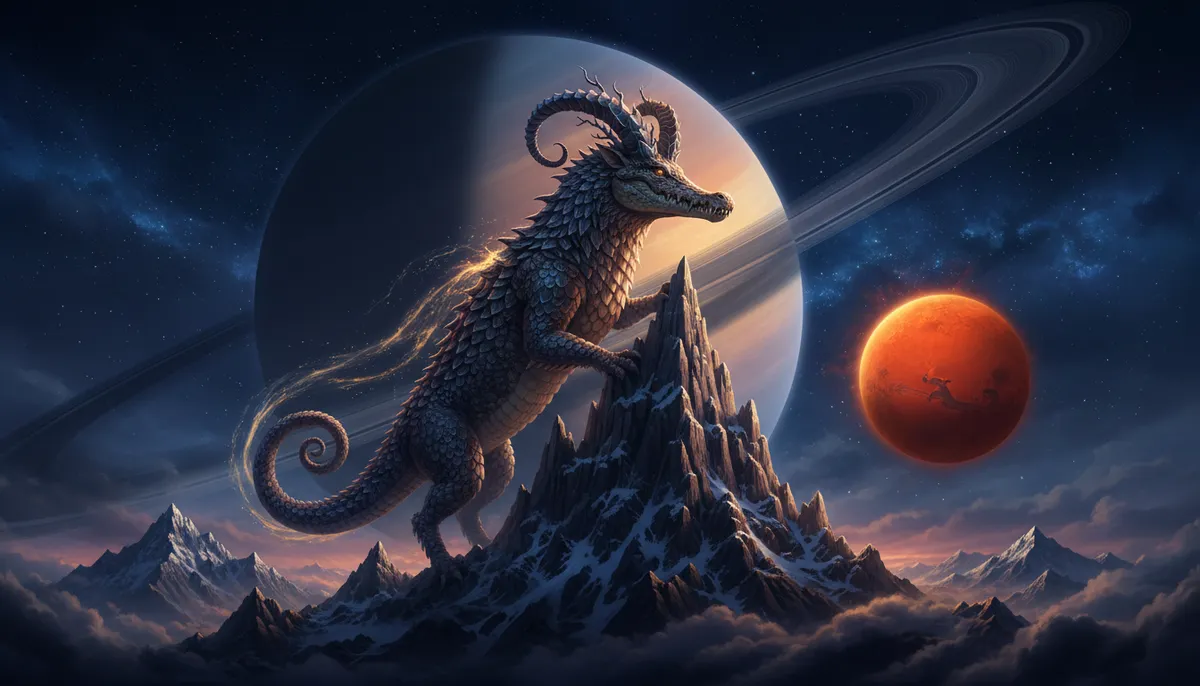
Quick Reference
| Attribute | Value |
|---|---|
| Sanskrit Name | Makara (मकर) |
| English Name | Capricorn |
| Position | 10th sign (270°-300°) |
| Ruler | Saturn (Shani) |
| Element | Earth (Prithvi Tattva) |
| Modality | Cardinal/Movable (Chara) |
| Gender | Feminine (Stri) |
| Body Part | Knees |
| Direction | South |
| Color | Variegated |
| Guna | Tamasic |
| Classification | Quadruped (1st half) / Footless-Aquatic (2nd half) |
| Rising Type | Prishthodaya (Back-rising) |
Introduction
Makara (Capricorn) stands as the tenth sign of the Vedic zodiac—the zenith of worldly achievement where discipline, structure, and karmic effort reach their apex. As Saturn’s earth sign, Capricorn represents the material expression of time’s lessons, the rewards of sustained effort, and the structure that supports lasting success.
In Jyotish, Makara holds profound significance as the sign where Mars is exalted and Jupiter is debilitated—a polarity that emphasizes action over faith, karma over grace, disciplined effort over optimistic expansion.
Classical Description
The ancient sages provided detailed characterizations of Makara’s nature:
Capricorn is lorded by Saturn, has predominance of Tamoguna, is an earthy sign, represents the southern direction, is strong in nights, rises with back, has a large body, its complexion is variegated, resorts to both forests and lands, its first half is quadruped and second half footless moving in water
This comprehensive portrait reveals:
- Saturn-lorded: Discipline, time, karma, restriction
- Tamasic guna: Dense, material, worldly focus
- Earthy element: Practical, grounded, substantial
- South direction: Associated with Yama, death, and endings
- Night-strong (Nishabhali): Gains power during nocturnal hours
- Prishthodaya (back-rising): Rises with its back, instinctive nature
- Large body: Substantial, imposing presence
- Variegated color: Complex, multi-faceted appearance
- Dual terrain: Forests, lands, and waters
- Dual classification: Quadruped first half, footless-aquatic second half
Capricorn produces natives troubled by windy diseases, who have knowledge of Sastras, Vedas, fine arts, music
Core Nature and Qualities
Makara represents the achieving principle in the zodiac—the force that builds structures, climbs mountains, and accomplishes lasting works through patient effort. As a feminine earth sign with cardinal quality, Capricorn initiates material achievement with quiet determination.
The Saturn Connection
Saturn as ruler bestows:
- Discipline and structure: Systematic approach to goals
- Patience and persistence: Long-term orientation
- Karmic awareness: Understanding of cause and effect
- Material mastery: Skill in worldly affairs
- Time consciousness: Awareness of mortality and legacy
The Knees of Kalapurusha
As the knee region of the Cosmic Being, Capricorn governs:
- Support and structure: The joints that enable standing
- Flexibility under pressure: Ability to bend without breaking
- Movement and progress: Enabling forward motion
- Humility: The capacity to kneel
The Sea-Goat Symbolism
The Makara—half goat, half fish—represents:
- Dual mastery: Success on land (material) and in water (emotional/spiritual)
- Adaptability: Navigating different environments
- Depth beneath surface: Hidden dimensions beneath worldly success
- Transformation: The journey from earthly to aquatic realms
Planetary Dignities
Capricorn serves as the stage for a significant polarity—Mars exalted where Jupiter is debilitated—emphasizing karma over grace.
Mars’ Exaltation (Uccha)
Mars reaches its exaltation in Capricorn, with the deepest point at 28 degrees. Mars finds supreme expression in Capricorn because:
- Disciplined action: Mars’ energy channeled through Saturn’s structure
- Sustained effort: Impulsive energy becomes persistent work
- Strategic warfare: Aggression becomes calculated planning
- Karmic accomplishment: Effort yields lasting results
Mars at 28° Capricorn achieves maximum productive power—the warrior who becomes the builder, the fighter who constructs empires.
Jupiter’s Debilitation (Neecha)
Jupiter reaches its debilitation in Capricorn, with the deepest point at 5 degrees. Jupiter struggles in Capricorn because:
- Expansion restricted: Saturn’s limits constrain Jupiterian growth
- Faith challenged: Material focus undermines optimism
- Grace supplanted: Karma replaces divine favor
- Teaching constrained: Wisdom limited by practicality
| Planet | Dignity | Degrees | Significance |
|---|---|---|---|
| Mars | Exaltation | 28° | Disciplined action succeeds |
| Jupiter | Debilitation | 5° | Faith challenged by materialism |
| Saturn | Own Sign | 0° - 30° | Full karmic authority |
The Mars-Jupiter Polarity
This dignity pattern teaches a profound lesson:
In Capricorn’s realm, effort (Mars) achieves what faith (Jupiter) cannot.
| Mars Exalted | Jupiter Debilitated |
|---|---|
| Action succeeds | Faith struggles |
| Discipline rewarded | Optimism challenged |
| Karma manifests | Grace limited |
| Effort produces | Expansion constrained |
Cosmic Correspondences
Beyond basic characteristics, classical texts assign specific cosmic mappings to Makara:
| Correspondence | Value | Significance |
|---|---|---|
| Direction | South | Yama, endings, karma |
| Rising Type | Prishthodaya | Back-first, instinctive |
| Day/Night | Nocturnal strength | Power at night |
| Guna | Tamas | Dense, material |
| Terrain | Forests, lands, waters | Multi-environment |
| Realm | Suvarloka | Celestial tier |
Capricorn Ascendant Characteristics
When Makara (Capricorn) is rising, the person will be weak in the lower limbs, will have exceeding strength or courage, will carry out the task he has undertaken, will be indolent, will be attached to old women of the prohibited class, will be a religious hypocrite, will be fortunate, will be always on his legs, will suffer from wind-disease and will be devoid of all shame
Key Capricorn Ascendant traits from classical sources:
- Physical: Weak lower limbs, but overall strength
- Character: Exceeding courage, carries out undertaken tasks
- Nature: Fortunate, always active (“on his legs”)
- Challenges: Indolence, wind diseases
- Shadow: Religious hypocrisy, unconventional attachments
Nakshatras in Makara
Three lunar mansions span Capricorn, each contributing unique qualities:
Uttara Ashadha (26°40’ Sagittarius - 10° Capricorn)
The latter three-quarters of Uttara Ashadha (0° - 10° Capricorn) fall within Makara.
| Attribute | Value |
|---|---|
| Ruling Planet | Sun (Surya) |
| Deity | Vishve Devas (Universal Gods) |
| Symbol | Elephant’s Tusk |
| Quality | Final victory, leadership, universal appeal |
Uttara Ashadha in Capricorn combines solar authority with Saturnine discipline—leadership through sustained effort, victory through persistence.
Shravana (10° - 23°20’ Capricorn)
The “listening” nakshatra falls entirely within Capricorn—the ear of the cosmos.
| Attribute | Value |
|---|---|
| Ruling Planet | Moon (Chandra) |
| Deity | Vishnu (Preserver) |
| Symbol | Ear / Three Footprints |
| Quality | Listening, learning, preservation |
Shravana in Capricorn creates exceptional:
- Receptive learning: Listening as the path to mastery
- Traditional knowledge: Preserving ancient wisdom
- Organizational skill: Vishnu’s preserving function
- Connection to fame: Three footprints spanning the cosmos
Dhanishtha (23°20’ Capricorn - 6°40’ Aquarius)
The first half of Dhanishtha (23°20’ - 30° Capricorn) resides in Makara.
| Attribute | Value |
|---|---|
| Ruling Planet | Mars (Mangala) |
| Deity | Vasus (Eight Elemental Gods) |
| Symbol | Drum / Flute |
| Quality | Wealth, music, rhythm, abundance |
Dhanishtha in Capricorn blends Mars’ exalted energy with Saturnine structure—rhythm as discipline, music as organized sound, wealth through sustained effort.
Significations and Terrain
Classical texts associate Makara with specific environments, beings, and activities:
Places and Environments
- Mountains: High, difficult terrain
- Government buildings: Centers of authority
- Corporate offices: Places of organized work
- Forests and lands: Wild and cultivated areas
- Water margins: Where land meets sea (sea-goat symbolism)
Living Beings
- Goats and deer: Quadruped mountain creatures
- Sea creatures: Fish, aquatic beings
- Elders: Those who embody time’s wisdom
- Authority figures: Those in positions of power
Professions and Activities
- Government service: Public administration
- Management: Organizational leadership
- Construction: Building lasting structures
- Mining: Extracting earth’s resources
- Traditional crafts: Time-honored skills
- Music: Especially percussion (Dhanishtha)
The Dual Nature
Capricorn’s classification as quadruped (first half) and footless-aquatic (second half) reveals profound symbolism:
| Half | Degrees | Nature | Expression |
|---|---|---|---|
| First Half | 0° - 15° | Quadruped | Earthly, climbing, material |
| Second Half | 15° - 30° | Footless/Aquatic | Spiritual, flowing, transcendent |
This duality manifests as:
- Material + Spiritual: Worldly success with inner depth
- Climbing + Flowing: Ascending mountains, navigating waters
- Structure + Surrender: Building systems, releasing control
- Land + Sea: Mastering multiple environments
The sea-goat symbol captures this perfectly—the creature that climbs the highest peaks and swims the deepest waters.
Saturn’s Two Signs
Saturn rules both Capricorn (earth) and Aquarius (air), with different expressions:
| Saturn’s Sign | Element | Expression |
|---|---|---|
| Capricorn | Earth | Material discipline, worldly achievement, karmic structure |
| Aquarius | Air | Mental discipline, humanitarian service, detachment |
In Capricorn, Saturn focuses on:
- Building tangible structures
- Achieving worldly success
- Paying karmic debts
- Establishing lasting legacy
Summary
Makara (Capricorn) represents the zodiac’s supreme domain of worldly achievement, disciplined effort, and karmic accomplishment. As Saturn’s earth sign, Capricorn offers the structure and patience necessary for lasting success.
The cardinal earth nature creates initiative in material matters—ambitious pursuit of tangible goals through sustained effort. The three nakshatras—Uttara Ashadha, Shravana, and Dhanishtha—each contribute unique qualities from solar leadership to lunar receptivity to Martian rhythm.
The Mars-Jupiter polarity defines Capricorn’s essential teaching—in this realm, effort succeeds where faith alone cannot. Disciplined action (Mars exalted) achieves what optimistic expansion (Jupiter debilitated) merely hopes for.
For the Vedic astrologer, understanding Capricorn means appreciating the power of persistent effort, the virtue of disciplined structure, and the significance of karma as the path to lasting accomplishment.
Classical Sources Referenced
- Brihat Parashara Hora Shastra (BPHS): Chapters 4, 46
- Jataka Parijata: Chapters 1, 8
- Saravali: Chapter 48
- Phaladeepika: Chapter 9
Related Articles
Zodiac Series
- Dwadasha Rashi: Complete Guide to the 12 Zodiac Signs
- Dhanu (Sagittarius): The Ninth Sign
- Kumbha (Aquarius): The Eleventh Sign
- Karka (Cancer): The Opposite Sign
Planetary Guides
- Saturn (Shani): The Ruler of Capricorn
- Mars (Mangala): Exalted in Capricorn
- Jupiter (Guru): Debilitated in Capricorn
Nakshatra Guides
Related Articles
Kanya (Virgo) in Vedic Astrology: Complete Guide to the Sixth Rashi
Discover Kanya (Virgo), the sixth sign of the Vedic zodiac. Learn why Mercury is exalted here, Venus is debilitated, the three nakshatras within, and classical insights on this mutable earth sign.

Kumbha (Aquarius) in Vedic Astrology: Complete Guide to the Eleventh Rashi
Discover Kumbha (Aquarius), the eleventh sign of the Vedic zodiac. Learn about Saturn's Mooltrikona here, Rahu's connection, the three nakshatras within, and classical insights on this fixed air sign.
Vrishabha (Taurus) in Vedic Astrology: Complete Guide to the Second Rashi
Discover Vrishabha (Taurus), the second sign of the Vedic zodiac. Learn why the Moon is exalted here, the significance of Venus rulership, the three nakshatras within, and classical insights on this fixed earth sign.