Vrishchika (Scorpio) in Vedic Astrology: Complete Guide to the Eighth Rashi
Discover the mysterious depths of Vrishchika (Scorpio) in Vedic astrology. Learn why Moon is debilitated here, its Kalapurusha significance, the three nakshatras within, and classical insights on this transformative eighth sign.
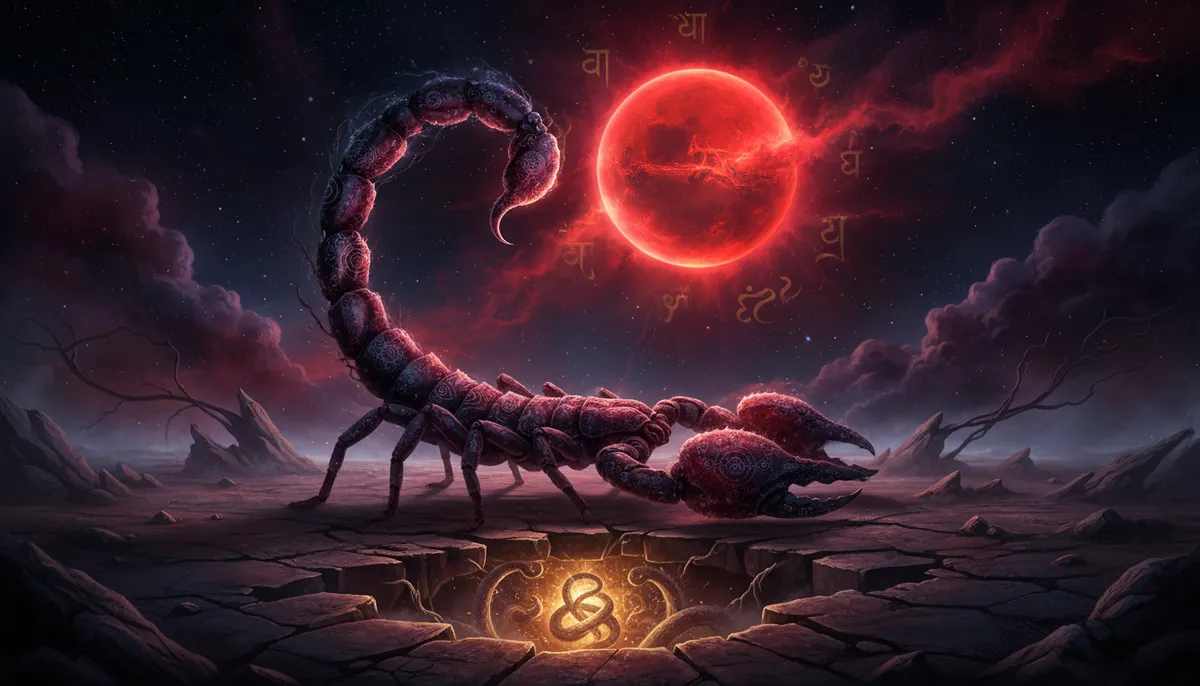
Quick Reference
| Attribute | Value |
|---|---|
| Sanskrit Name | Vrishchika (वृश्चिक) |
| English Name | Scorpio |
| Position | 8th sign (210°-240°) |
| Ruler | Mars (Mangala) |
| Element | Water (Jala Tattva) |
| Modality | Fixed (Sthira) |
| Gender | Feminine (Stri) |
| Body Part | Generative Organs |
| Direction | North |
| Color | Reddish-brown |
| Guna | Sattvic |
| Classification | Keeta (Centipede/Insect) |
| Caste | Brahmin |
Introduction
The eighth sign of the zodiac, Vrishchika (Scorpio), holds dominion over transformation, secrets, and the hidden dimensions of existence. As the second sign ruled by Mars, Scorpio channels martial energy not outward like fiery Aries, but deep within—into the waters of emotion, investigation, and profound change.
Where Aries represents Mars as the open warrior, Scorpio embodies Mars as the strategist, the investigator, the one who transforms through destruction. This is the sign of death and rebirth, of endings that create new beginnings, of the phoenix rising from ashes.
Classical Description
The ancient sages provided remarkably detailed descriptions of Vrishchika’s nature:
Scorpio has a slender physique, is a centipede sign, denotes Brahmins, resides in holes, its direction is north, is strong in day time, is reddish-brown, resorts to water and land, has a hairy physique, is very sharp or passionate, ruled by Mars.
This classical portrait reveals several key attributes:
- Slender physique: Unlike the robust Aries, Scorpio suggests a more compact, intense form
- Centipede (Keeta) classification: Many-footed, complex, dwelling in hidden places
- Brahmin caste: Surprisingly priestly orientation despite martial rulership
- Hole-dwelling: Affinity for hidden, underground, or secretive places
- North direction: The realm of ancestors and hidden knowledge
- Day-strong (Shirshodaya): Rises head-first, gaining power in daylight hours
- Sharp/passionate: Intensity as a fundamental trait
Core Nature & Qualities
Fundamental Temperament
Scorpio natives embody a paradox: water ruled by fire’s planet. This creates the metaphor of steam—intense emotional power that can transform or destroy. The fixed modality ensures that Scorpio energy, once directed, remains unwavering until its purpose is achieved.
Scorpio produces natives who are clever, valorous, firm, fierce, troubled by bilious complaints.
The Martian influence grants courage and determination, while the water element adds depth, intuition, and emotional complexity. This combination produces individuals capable of profound research, investigation, and penetration into hidden truths.
Strengths
Classical texts highlight these positive Scorpio qualities:
- Cleverness and investigation: Natural researchers and detectives
- Valor and courage: The warrior spirit directed inward
- Firmness and determination: Fixed sign persistence
- Occult aptitude: Understanding of hidden dimensions
- Transformative power: Ability to facilitate deep change
Challenges
The shadow aspects emerge from the same intensity:
They have harsh tongue, are revengeful and vindictive, love to criticize others and establish superiority.
The classical texts also note:
- Vindictive tendencies: Long memories for perceived wrongs
- Harsh speech: Stinging words that wound
- Secretiveness: Difficulty with transparency
- Bilious health issues: Liver and digestive troubles
- Early life difficulties: Often facing challenges in youth
If a person be born when sign Vrischika (Scorpio) is rising, he will have round thighs and knees, broad and expansive eyes and chest, suffer from diseases at a very early age, will be separated from his parents and preceptors.
Planetary Dignities in This Sign
Mars: Own Sign
Mars finds one of its homes in Scorpio, but expresses differently than in Aries. In Aries, Mars is the direct warrior; in Scorpio, Mars becomes the strategist who transforms through controlled destruction. Mars here is powerful but operates through subtlety, investigation, and psychological intensity rather than open confrontation.
Ketu: Own Sign
Scorpio also belongs to Ketu, the south lunar node. This Ketu connection explains Scorpio’s orientation toward liberation through transformation, past-life wisdom, and detachment from material concerns. Ketu in Scorpio feels at home, amplifying occult interests and spiritual transformation.
Moon: Debilitated at 3°
The Moon reaches its weakest point in Scorpio at exactly 3 degrees. Why does the nurturing Moon suffer in Scorpio? The Moon represents peace, comfort, emotional stability, and contentment. Scorpio’s waters are not the calm, nurturing waters of Cancer (Moon’s own sign), but churning depths of transformation and intensity. The Moon cannot find rest here—the Martian influence disturbs its natural serenity.
Other Planetary Positions
- Sun: Neutral, but gains warrior-like qualities
- Mercury: Functions adequately; adds mental depth
- Jupiter: Expands occult interests and investigative abilities
- Venus: Creates intense desires and passionate attractions
- Saturn: Deepens research abilities but may create obsessiveness
Cosmic Correspondences
Kalapurusha Body Part
In the cosmic man (Kalapurusha), Scorpio governs the generative organs—the seat of creative and procreative power, transformation, and the mysteries of life and death.
The signs Aries etc., represent the limbs of Kalapurusha: Aries-head, Taurus-face, Gemini-arms, Cancer-heart, Leo-stomach, Virgo-hip, Libra-space below navel and private parts, Scorpio-private parts, Sagittarius-thighs, Capricorn-knees, Aquarius-ankles, Pisces-feet.
This placement explains Scorpio’s association with:
- Sexuality and reproduction: Life’s creative-destructive power
- Hidden matters: What is private, secret, concealed
- Transformation: The processes of death and rebirth
- Regeneration: Healing and renewal of vital forces
Health vulnerabilities may manifest in reproductive organs, elimination systems, and venereal conditions.
Direction
Scorpio’s direction is North, associated with:
- The realm of ancestors and the departed
- Hidden knowledge and occult wisdom
- The pole star and cosmic mysteries
Classification: Keeta (Centipede)
Scorpio belongs to the Keeta (centipede/insect) classification, shared only with Cancer. This indicates:
- Many-layered, complex nature
- Ability to navigate hidden spaces
- Protective outer shell with vulnerable interior
- Connection to underground, hidden realms
Day/Night Strength
As a Shirshodaya (head-rising) sign, Scorpio gains strength during daytime hours. Charts with Scorpio prominent benefit from diurnal births.
Guna and Caste
Scorpio is classified as Sattvic in nature—pure, spiritual, harmonious despite its intense surface appearance. Its Brahmin caste assignment suggests priestly wisdom focused on:
- Hidden and esoteric knowledge
- Transformative spiritual practices
- Understanding of death and liberation
- Tantric and occult sciences
Nakshatras in Vrishchika
Three nakshatras span Scorpio, each adding distinct flavoring:
1. Vishakha (Final Pada: 0°-3°20’)
| Attribute | Value |
|---|---|
| Ruler | Jupiter (Guru) |
| Deity | Indra-Agni |
| Symbol | Triumphal Arch |
| Degrees | 0°-3°20’ Scorpio |
Only the fourth pada of Vishakha falls in Scorpio, bringing Jupiter’s expansion and wisdom to Mars’ domain. This zone combines the achievement orientation of Vishakha with Scorpio’s transformative intensity.
2. Anuradha (3°20’-16°40’)
| Attribute | Value |
|---|---|
| Ruler | Saturn (Shani) |
| Deity | Mitra (God of Friendship) |
| Symbol | Lotus Flower |
| Degrees | 3°20’-16°40’ Scorpio |
Anuradha adds Saturn’s discipline and focus to Scorpio’s intensity. The lotus symbolism suggests beauty emerging from muddy depths—transformation yielding wisdom. Mitra’s influence brings capacity for deep friendship and loyalty despite Scorpio’s secretive nature.
3. Jyeshtha (16°40’-30°)
| Attribute | Value |
|---|---|
| Ruler | Mercury (Budha) |
| Deity | Indra (King of Gods) |
| Symbol | Earring/Umbrella |
| Degrees | 16°40’-30° Scorpio |
Jyeshtha means “eldest” or “chief,” conferring leadership and protective qualities. Mercury’s rulership adds intellectual acuity to Scorpio’s investigative nature. The umbrella symbol suggests protection and authority; the earring suggests adornment and refinement.
The Pasa (Noose) Decanate
A unique feature of Scorpio rarely discussed elsewhere:
The middle decanate of Vrischika is called Pasa (noose) decanate.
The middle 10 degrees (10°-20°) of Scorpio carry the “noose” symbolism, suggesting:
- Binding karma or circumstances
- Situations that entrap or restrict
- The need to work through entanglements
- Potential for liberation through accepting bonds
Planets placed in this decanate may indicate areas where the native experiences karmic binding before eventual release.
Significations & Terrain
Places Ruled
Scorpio governs:
- Holes and hidden places: Caves, underground locations
- Water-land interfaces: Swamps, marshes, riverbanks
- Occult spaces: Tantric sites, cremation grounds
- Investigative settings: Research facilities, detective offices
- Medical facilities: Especially for surgery and regenerative medicine
Creatures Associated
Should Scorpio ascend with a biped Navamsa, births of snakes, rats, insects, mongoose, scorpions, snakes without poison, deers, cows etc., will take place.
Scorpio-associated creatures include scorpions, snakes, insects, and creatures that dwell in hidden places or possess protective mechanisms (stingers, venom).
Scorpio Ascendant (Vrishchika Lagna)
When Scorpio rises at birth, Jupiter becomes the most benefic planet as lord of the 2nd and 5th houses. The Moon as 9th lord also brings fortune. Venus, Mercury, and Saturn are considered challenging.
Water Triplicity
Scorpio shares the water element with Cancer and Pisces, but each expresses water differently:
- Cancer (Moon): Nurturing, protective, maternal waters
- Scorpio (Mars): Transformative, intense, probing depths
- Pisces (Jupiter): Expansive, dissolving, spiritual ocean
Scorpio represents water at its most concentrated and powerful—still waters that run deep, capable of dissolving all that enters them.
Opposite Sign: Taurus
Scorpio’s opposite, Taurus, represents:
- Accumulation vs. Transformation
- Material security vs. Hidden wealth
- Venus (comfort) vs. Mars (intensity)
- Visible resources vs. Occult resources
The Taurus-Scorpio axis represents the 2nd-8th house dynamic: personal resources vs. shared resources, physical pleasures vs. transformative experiences.
Summary & Classical Sources
Vrishchika stands as one of the most complex and misunderstood signs of the zodiac. Its Mars rulership provides courage and determination; its water element grants emotional depth and intuitive power; its fixed modality ensures unwavering focus once committed.
The classical texts reveal Scorpio not merely as intense or secretive, but as fundamentally transformative—the sign where endings become beginnings, where hidden knowledge emerges, where the soul confronts its depths and rises renewed.
Key Takeaways
- Eighth sign: Natural connection to transformation, death/rebirth, inheritance, occult
- Mars in water: Intensity directed inward creates steam-like transformative power
- Moon debilitated at 3°: Emotional intensity overwhelms lunar peace
- Ketu’s own sign: Liberation through transformation, past-life wisdom
- Keeta (centipede): Complex, multi-layered nature dwelling in hidden realms
- Brahmin caste: Priestly orientation toward hidden, esoteric wisdom
- Pasa decanate: Middle degrees carry “noose” symbolism of karmic binding
Classical Sources
The information in this guide derives primarily from:
- Brihat Parashara Hora Shastra (BPHS) — foundational Jyotish text
- Saravali by Kalyana Varma
- Phaladeepika by Mantreswara
Continue Your Study
Same Ruler (Mars):
Water Triplicity:
Fixed Signs:
Opposite Sign:
Related Guides:
Related Articles
Mesha (Aries) in Vedic Astrology: Complete Guide to the First Rashi
Discover Mesha (Aries), the first sign of the Vedic zodiac. Learn why the Sun is exalted here, the significance of Mars rulership, the three nakshatras within, and classical insights on this fiery cardinal sign.
Meena (Pisces) in Vedic Astrology: Complete Guide to the Twelfth Rashi
Discover Meena (Pisces), the final sign of the Vedic zodiac. Learn why Venus is exalted here, the significance of Jupiter's rulership, the three nakshatras within, and classical insights on this spiritual water sign.
Karka (Cancer) in Vedic Astrology: Complete Guide to the Fourth Rashi
Discover Karka (Cancer), the fourth sign of the Vedic zodiac. Learn why Jupiter is exalted here, the significance of Moon rulership, the three nakshatras within, and classical insights on this cardinal water sign.