The Moon (Chandra): Sovereign of the Mind, Keeper of the Tides
In the ancient sky-map of Jyotisha, Chandra rises as the luminous reflection of the soul - the mind's mirror, ever waxing and waning with the pulse of creation.

Essential Attributes at a Glance
| Attribute | Chandra’s Nature |
|---|---|
| Sanskrit Name | Chandra (also Sasi) |
| Cosmic Role | The Mind (Kalapurusha) |
| Cabinet Status | Royal — King/Queen |
| Nature | Benefic (waxing/Shukla Paksha); Malefic (waning/Krishna Paksha) |
| Gender | Female |
| Caste | Vaisya (Merchant class) |
| Guna | Sattvic (Pure, soft) |
| Element | Water (via Varuna) |
| Deity | Varuna (Lord of Waters) |
| Color | White / Tawny |
| Taste | Saline (Salty) |
| Dosha (Humour) | Kapha (Phlegm) & Vata (Wind) |
| Directional Strength | North / North-West |
| Temporal Strength | Night |
| Natural Strength | 2nd Strongest among Grahas |
| Exaltation | Taurus (3°) |
| Moolatrikona | Taurus (3°–30°) |
| Own Sign | Cancer |
| Time Unit | Muhurtha (48 minutes) |
| Season | Varsha (Monsoon/Rainy) |
| Abode | Watery places, water-resorts |
| Apparel | Silken robes, new/clean/white garments |
| Substance | Gems; Dhatu (Metals/Minerals) |
| Tree | Milky trees (rubber-yielding) |
| Friends | Sun, Mercury |
| Enemies | None |
| Neutral | Mars, Jupiter, Venus, Saturn |
Astronomical Overview
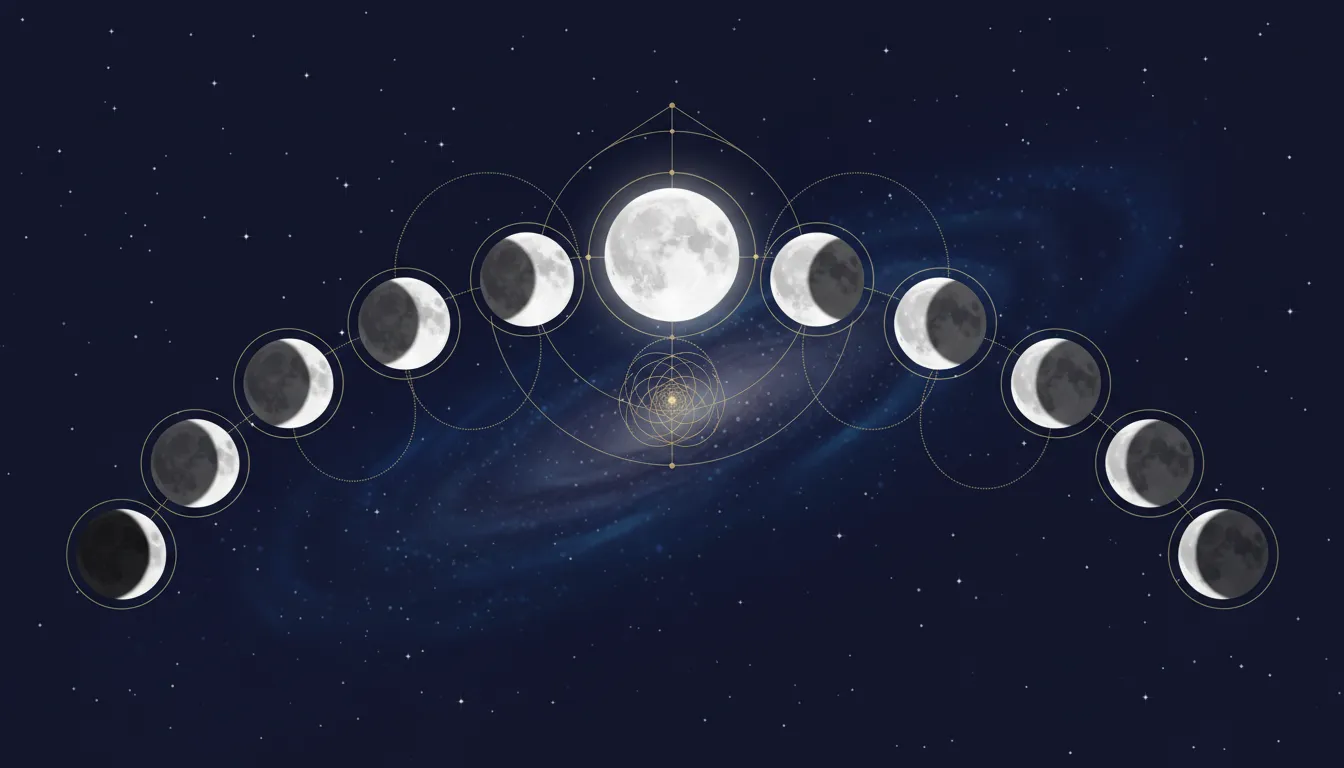
The Moon is Earth’s sole natural satellite, a companion that has measured human time since the earliest civilizations. Its orbital dance around our planet takes approximately 27.3 days (sidereal month), while the synodic month—from new moon to new moon—spans roughly 29.5 days. This difference creates the ever-shifting phases that Jyotisha so carefully observes.
The Moon’s distance from Earth averages 384,400 kilometers, close enough that its gravitational pull governs our ocean tides—a fitting correspondence to its rulership over Varuna’s watery realm. With a diameter of 3,474 kilometers, the Moon appears nearly the same size as the Sun from our vantage point, creating the phenomenon of perfect solar eclipses—moments of profound astrological significance.
The lunar surface reflects sunlight with varying intensity depending on its phase. This waxing and waning cycle—from the brilliant fullness of Purnima to the hidden darkness of Amavasya—forms the foundation of Chandra’s dual nature in classical texts: benefic when growing in light, malefic when diminishing.
Mythological Origins: The Beloved of Twenty-Seven Brides
The mythology of Chandra weaves through multiple Puranic traditions, each thread revealing different aspects of the Moon’s nature—from his luminous origins to the famous curse that explains his eternal waxing and waning.
Birth and Lineage
Two origin stories illuminate Chandra’s divine nature. In the Markandeya Purana, Chandra emerges as the son of the great sage Atri and his devoted wife Anasuya. Born through the grace of Brahma, this lineage connects the Moon to the contemplative wisdom of the rishis—the same meditative stillness that characterizes the lunar mind at its best.
An older tradition places Chandra’s emergence during the Samudra Manthan, the cosmic churning of the ocean of milk. When devas and asuras churned the primordial waters seeking the nectar of immortality, many treasures arose from the depths—among them the radiant Moon, fully formed and luminous. This origin connects Chandra to Soma, the sacred drink of the gods, and explains the Moon’s association with the nourishing, milky essence that sustains life.
The Twenty-Seven Wives and Daksha’s Curse
The most celebrated lunar myth concerns Chandra’s marriage to the twenty-seven daughters of Prajapati Daksha—each daughter representing one of the twenty-seven nakshatras through which the Moon travels during its monthly journey. When Daksha gave his daughters in marriage, he extracted a promise: Chandra must love all twenty-seven equally, spending equal time with each.
But Chandra’s heart was captured by one wife above all others—Rohini, the most beautiful and brilliant of the lunar mansions. Night after night, he lingered in her embrace, neglecting his other wives. The scorned sisters complained to their father, and Daksha, furious at the broken promise, cursed Chandra with kshaya—a wasting disease that would consume his luminous body entirely.
As the curse took hold, Chandra began to fade. The world darkened, crops withered, and all beings dependent on lunar light began to suffer. The other gods intervened, pleading with Daksha to relent. Though the curse could not be withdrawn, it was modified: Chandra would wane for fifteen days, approaching dissolution, then wax for fifteen days, returning to fullness. The eternal cycle of Shukla Paksha and Krishna Paksha was born from a lover’s excess and a father’s wrath.
Refuge in Shiva
In his desperation, Chandra sought the protection of Lord Shiva, performing intense penance at Prabhas Patan (in present-day Gujarat). Pleased by his devotion, Shiva placed the crescent Moon upon his own head, granting Chandra eternal refuge. The famous Somnath Jyotirlinga—one of the twelve most sacred Shiva temples—marks this site of lunar salvation.
This mythological connection explains why the Moon is so intimately linked with Shiva, who bears the crescent as his ornament. The Moon found protection not through his own power but through surrender to a greater consciousness—a fitting symbol for the lunar principle of receptivity and reflection.
Soma: The Divine Essence
In Vedic literature, Soma and Chandra interweave as related concepts. Soma is both a sacred plant, a ritual drink that grants divine vision, and a deity associated with the Moon. The Soma juice, pressed during Vedic sacrifices, was believed to confer immortality on the gods themselves. This identification connects the Moon to nourishment, intoxication, inspiration, and the subtle essence that flows through all living things—the rasa or vital fluid that the Moon governs in the body and in nature.
Classical Description
The ancient sages describe Chandra with remarkable consistency across the foundational texts. Both Brihat Parashara Hora Shastra and Saravali portray the Moon as possessing a fair complexion—Saravali specifically uses the term Gauravarna (fair-skinned)—while Parashara adds a tawny quality to this luminous appearance.
The Moon’s physical form is described as round-bodied yet also thin or emaciated, tall in stature, with beautiful and auspicious features. The hair is noted as curly and short. There is something youthful about Chandra’s appearance—a perpetual freshness that mirrors the monthly renewal of the lunar cycle itself. The eyes are particularly emphasized as beautiful, and the overall appearance is described as auspicious or fortunate to behold.
Temperamentally, the classical sources agree on several key traits: the Moon is learned and possesses sweet speech. Yet beneath this gentle exterior lies a restless quality—the texts use terms suggesting fickleness of mind, a nature that shifts like the phases themselves. The Moon is described as lustful and, in Saravali, notably fond of old ladies—perhaps a reference to the nurturing, maternal wisdom that Chandra seeks and embodies.
Essential Qualities
Element & Cosmic Association
Though not explicitly assigned an element in certain verses, the Moon’s association with Water runs deep through its governing deity Varuna, lord of the cosmic waters, and its natural abode in watery places. This aquatic connection extends to Chandra’s significations: water-born products, milk, salt, flowers, and all things that flow and nourish.
Guna: Sattvic Nature
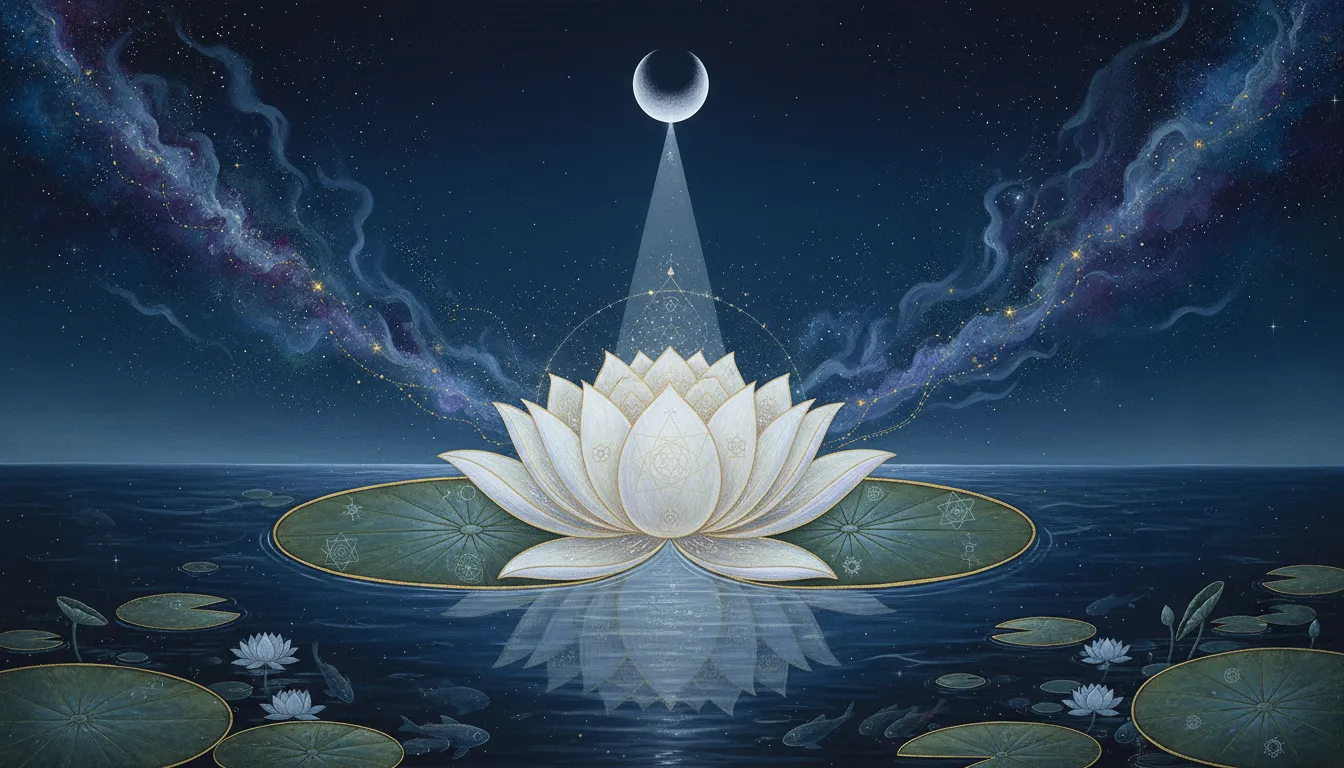
Chandra embodies Sattva—the quality of purity, luminosity, and gentle receptivity. This sattvic nature manifests as softness, kindness, and an amicable disposition toward friends. The Moon does not impose or assert; it reflects, receives, and nurtures. Its purity is that of still water mirroring the sky.
Dosha: Kapha-Vata Constitution
The Moon carries a dual humoral nature—Kapha (the phlegmatic, watery principle) combined with Vata (the windy, airy principle). This creates a constitution prone to both the cool, moist qualities of Kapha and the changeable, restless qualities of Vata. The classical texts describe Chandra as both “phlegmatic” and “windy,” reflecting this mixed temperament that can be both nurturing and unsettled.
Temperament & Character
The Moon governs the mind in the cosmic body (Kalapurusha), making mental and emotional patterns its primary domain. The classical texts emphasize learning and wisdom alongside sweet, pleasing speech. Yet this same mind is described as fickle—shifting, wandering, easily moved by circumstance. This is not a flaw but rather the Moon’s essential nature: responsive, impressionable, and cyclically changing.

Physical, Emotional & Psychological Traits
Physical Characteristics
Individuals strongly influenced by Chandra often display the Moon’s physical signatures: a fair or pale complexion with possible tawny undertones, rounded features or body type (though the frame may also appear thin or delicate), and notably attractive or expressive eyes. The hair tends toward curly or wavy textures, kept short. There is typically a youthful quality to the appearance that persists regardless of age—a certain softness and approachability in the features.
Emotional Nature
The Moon’s emotional landscape is one of sensitivity, receptivity, and fluctuation. Like the tides governed by lunar gravity, feelings rise and fall in natural rhythms. There is a deep capacity for kindness and genuine warmth toward friends and loved ones. However, the emotional nature can also be impressionable, easily influenced by environment and company. The “fickleness” noted in classical texts reflects not superficiality but rather a mind that responds authentically to each moment’s changing conditions.
Psychological Patterns
The Moon rules the mind itself—not the discriminating intellect, but the feeling-mind that experiences, remembers, and dreams. Those under strong lunar influence possess natural learning abilities and often communicate with sweetness and charm. The psychological life tends toward introspection and imagination. There may be a particular affinity for wisdom traditions, nurturing roles, and connection with maternal or elder feminine figures.
Symbolism & Mythic Archetypes
The Sovereign of Night
Chandra holds royal status in the celestial cabinet—a sovereign of the inner realm, the Queen or King of the night sky. This royal dignity connects to the Moon’s role as face and countenance in human experience; just as a monarch represents their kingdom, the face represents the self. In every chart, the Moon reveals how we present ourselves emotionally, how we appear to those closest to us, and what expressions naturally flow across our features.
Varuna’s Vessel
The Moon’s deity Varuna rules over waters both cosmic and terrestrial—the primordial ocean, rainfall, rivers, and the unseen waters within all living beings. Through Varuna, Chandra connects to ancient themes of cosmic order, oaths, and the mysteries of the night. The association with milky trees (rubber-yielding plants) extends this symbolism: like the Moon’s soft white light, these trees exude a nourishing, protective substance. Varuna was also the guardian of rita—cosmic truth and moral order—connecting the Moon to the deeper currents of conscience and natural law that flow beneath surface appearances.
The Divine Mother
As mother-karaka, Chandra embodies the maternal principle—nurturing, protective, instinctive, and unconditionally present. The rainy season (Varsha) further emphasizes themes of fertility, growth, and the waters of life descending from heaven to earth. In Hindu culture, the Moon is so intimately connected with the mother that traditional birthday celebrations follow the lunar calendar, honoring the Moon’s position at birth rather than the solar date. This maternal symbolism extends beyond biological motherhood to encompass all forms of emotional nourishment and the instinctive wisdom that cares without calculation.
The Mind’s Mirror
Western astrology assigns mind to Mercury, but Vedic wisdom recognizes a crucial distinction: Mercury governs buddhi (intellect, discrimination, analysis), while the Moon governs manas (the feeling-mind, the experiential awareness that receives impressions before thought arises). The Moon is the mirror that reflects the Sun’s light of consciousness, just as the mind reflects the soul’s awareness. This is why mental health, emotional stability, and the general quality of inner experience depend so heavily on lunar strength in the birth chart. A afflicted Moon disturbs the mirror itself, distorting every perception that passes through it.
Shiva’s Ornament
The crescent Moon adorning Shiva’s matted locks—earning him the name Chandrashekara, “crowned with the Moon”—represents one of Hinduism’s most profound symbols. When Chandra sought refuge from Daksha’s curse, Shiva placed him upon his own head, granting protection and permanence to that which was doomed to fade. This image suggests that the restless, changing mind finds peace only when it rests in pure consciousness; that emotional fluctuations, rather than being problems to eliminate, can become ornaments of awakened awareness. The Moon does not cease its phases on Shiva’s head—it continues to wax and wane—but it does so within the embrace of the unchanging witness.
The Keeper of Time
Through its rulership over the muhurtha (the 48-minute period that forms the basis of Hindu time-keeping) and its governance of the monthly cycle, Chandra serves as the intimate timekeeper of human life. While the Sun measures the great rhythms of years and seasons, the Moon tracks the finer pulse of days and hours. The Hindu calendar is fundamentally lunar, with months named after the nakshatra where the full Moon occurs. Religious observances, auspicious timings, and the rhythm of fasting and feasting all follow lunar cycles. In this way, Chandra weaves sacred time into daily existence.
Significations (Karakatvas)
The Moon serves as karaka—natural significator—for numerous aspects of life and the material world:
Primary Domain
The Mind (Manas): all mental functions, emotional processing, memory, imagination, and the general state of psychological well-being.
Relationships
- Mother: the birth mother and maternal figures generally
- Queen: consort, spouse, or significant feminine authority
Body & Health
- The Face: features, complexion, and expression
- Pure Blood: healthy circulation and blood quality
- Bodily fluids generally
Substances & Materials
- Water and all water-born products
- Milk and dairy
- Salt
- Flowers
- Gems and precious stones
- Pearl specifically
- Metals including Lead and Zinc
- Silken fabrics
- White or new garments
Places & Settings
- Watery places: rivers, lakes, oceans, wells, water-resorts
- Gardens and places where flowers grow
- The North and North-West directions
Professions & Activities
- Commerce and trade (Vaisya caste association)
- Nurturing professions
- Work involving liquids, dairy, or maritime industries
- Roles requiring public presence and emotional connection
Temporal Rulership
- Night hours (especially midnight)
- Monday (Somavar)
- Muhurtha (48-minute periods)
- Monsoon season (Varsha)
Nakshatra Rulership
The Moon governs three nakshatras, each expressing lunar themes of nurturing, receptivity, and emotional intelligence in distinct ways:
Rohini (10° – 23°20’ Taurus) The “red one” or “the growing one”—Rohini is Chandra’s most beloved wife, the nakshatra where the Moon finds its deepest exaltation. Ruled by the Moon and placed entirely within Venus-ruled Taurus, Rohini combines lunar receptivity with Venusian beauty and fertility. Its symbol is the chariot or ox-cart, representing growth, cultivation, and the journey of creation. The presiding deity is Brahma Prajapati, the creator, emphasizing Rohini’s connection to fertility and materialization. Those with strong Rohini placements often possess remarkable beauty, creative talents, and the ability to attract abundance—though like Chandra himself, they may struggle with the consequences of being too alluring.
Hasta (10° – 23°20’ Virgo) Meaning “the hand,” Hasta expresses lunar energy through skill, dexterity, and craftsmanship. Ruled by the Moon but placed in Mercury’s sign Virgo, this nakshatra bridges emotional intelligence with practical application. Its symbol is the open hand or fist, representing the power to grasp, create, and heal through touch. The presiding deity is Savitar, the solar deity of the early morning who bestows creative power. Hasta natives are often skilled artisans, healers, or counselors—those who use their hands and their sensitivity to serve others. The combination of lunar receptivity and Mercurial precision creates individuals who can translate emotional understanding into tangible results.
Shravana (10° – 23°20’ Capricorn) “The ear” or “the one who listens”—Shravana represents the culmination of lunar wisdom through deep listening and the transmission of knowledge. Ruled by the Moon but placed in Saturn’s sign Capricorn, this nakshatra combines emotional depth with patient endurance and the capacity to learn from experience. Its symbol is three footprints or an ear, representing the journey of knowledge and the power of listening. The presiding deity is Vishnu, the preserver, who maintains cosmic order through compassionate awareness. Shravana natives often excel in counseling, teaching, media, or any field requiring the ability to truly hear what others are saying—and sometimes what they cannot say.
Common Thread: All three Moon-ruled nakshatras share the capacity to attract, nurture, and connect—yet each expresses this gift differently. Rohini attracts through beauty and fertility, Hasta through skillful service, and Shravana through wisdom and deep listening. Together, they trace the Moon’s journey from creative attraction through practical manifestation to mature understanding.
Strengths & Challenges
Inherent Strengths
Chandra ranks as the second strongest of the nine Grahas, possessing natural luminosity and influence. The Moon gains directional strength (Dig Bala) in the North and North-West, and temporal strength during night hours. When waxing—particularly in the Shukla Paksha bright half—Chandra’s benefic qualities fully manifest: nurturing warmth, emotional intelligence, popular appeal, and mental clarity.
A remarkable quality sets Chandra apart from all other Grahas: the Moon considers no planet an enemy. This universal friendliness reflects the Moon’s sattvic, receptive nature—open to all influences, resistant to none. Even when waning, the Moon can recover benefic status if conjunct or aspected by a benefic planet.
The Yavana teaching offers additional nuance: the Moon is considered auspicious or full when positioned 120°–240° from the Sun, medium in strength at 0°–120°, and bereft of strength at 240°–360° (approaching conjunction).
Potential Challenges
The Moon’s primary challenge lies in its cyclical nature—the waning phase (Krishna Paksha) diminishes Chandra’s benefic capacity, potentially bringing mental unrest, emotional volatility, or reduced vitality. The described fickleness of mind can manifest as indecision, inconsistency, or excessive impressionability.
The Kapha-Vata constitution carries its own challenges: excess Kapha may bring lethargy, attachment, or emotional heaviness, while Vata imbalance can create anxiety, restlessness, or scattered thinking. The lustful quality mentioned in classical texts points to potential issues with desire, attachment, or difficulty maintaining boundaries.
Planetary Relationships
| Relationship | Planets |
|---|---|
| Friends | Sun, Mercury |
| Enemies | None |
| Neutrals | Mars, Jupiter, Venus, Saturn |
The Moon’s friendship with the Sun—despite their fundamental opposition as day and night luminaries—reflects the cosmic marriage of masculine and feminine, consciousness and mind. Mercury’s friendship connects Chandra to intellect, communication, and commerce. The absence of enemies in the Moon’s relational schema is unique among the Grahas, embodying pure receptivity without opposition.
Classical Reference Notes
The portrait of Chandra presented here synthesizes descriptions from the Brihat Parashara Hora Shastra, the Saravali, and the Phaladeepika—the three foundational pillars of classical Jyotisha. All sources agree on the Moon’s fundamental characteristics: sattvic nature, rulership over the mind, association with water and watery places, and the unique quality of having no planetary enemies.
Brihat Parashara Hora Shastra
Parashara describes Chandra as windy and phlegmatic in constitution (Vata-Kapha), learned, with a round body and auspicious appearance. Notes sweet speech alongside a fickle and lustful nature. Assigns the Moon to watery abodes, the Muhurtha time unit, saline taste, and rulership over milky trees. Specifies exaltation at Taurus 3°, Moolatrikona in Taurus 3°–30°, and own sign Cancer. BPHS uniquely states that Moon has no enemies—a quality shared by no other graha—reflecting the lunar principle of pure receptivity.
Saravali
Kalyana Varma provides the synonym Sasi and assigns the Moon to the Mind in the cosmic body (Kalapurusha). Describes fair complexion (Gauravarna), beautiful eyes, thin and tall body with curly short hair, and youthful appearance. Notes sattvic guna, white color, association with gems, the rainy season, and new/clean apparel. Lists karakatvas including pure blood, Queen, Mother, Face, water-born products, flowers, salt, milk, lead, pearl, and zinc.
Phaladeepika
Mantreswara’s Phaladeepika confirms the essential lunar attributes while providing additional predictive context. It emphasizes the Moon’s significance as karaka for the mother and for the general mental disposition. The text elaborates on the effects of lunar phases on planetary strength, establishing the important principle that the Moon’s benefic or malefic nature depends primarily on its phase at birth—waxing Moon (Shukla Paksha) being benefic, waning Moon (Krishna Paksha) tending toward malefic results unless supported by benefic aspects.
Consistency Across Texts
The classical sources show remarkable agreement on lunar characteristics. Unlike some planets where texts diverge on key attributes, the Moon’s essential nature—sattvic guna, mental rulership, no enemies, Cancer ownership, Taurus exaltation—remains consistent across all traditions. This unanimity reflects the Moon’s central importance in Vedic astrology, where it often rivals or exceeds the Sun in interpretive significance.
Closing Reflection
The Moon reminds us that change itself is constant—that waxing and waning are not failures but the natural rhythm of all living things. In Chandra’s gentle light, the ancient seers saw the mirror of the mind: sometimes full and radiant, sometimes hidden in shadow, yet always present, always cycling toward renewal.
The myths of Chandra illuminate our own lunar nature. Like the Moon lingering too long with beautiful Rohini, we too may favor certain pleasures or attachments to the neglect of our other responsibilities. Like Chandra seeking refuge in Shiva, we may find that our restless minds settle only when they rest in something greater than themselves. And like the Moon emerging from Daksha’s curse—diminished but not destroyed, waning but always returning—we learn that even our darkest phases contain the seed of renewal.
To know the Moon in your chart is to know where your emotions run deepest, where your mother’s legacy lives, where your mind finds peace or agitation. It marks the inner sanctum of your experience—the private self that the world rarely sees, the feeling-tone that colors everything you perceive, and the instinctive wisdom that knows before the mind can think.
Explore the Navagraha
This article is part of our comprehensive series on the nine celestial powers of Vedic astrology. Discover how all the grahas work together in the cosmic parliament:
The Complete Guide to Navagraha: Nine Planets of Vedic Astrology →
References
This article synthesizes knowledge from the following classical Vedic astrology texts:
-
Brihat Parashara Hora Shastra - The foundational text of Vedic astrology attributed to Sage Parashara, detailing planetary characteristics, significations, and interpretive principles.
-
Saravali - A comprehensive classical text by Kalyana Varma, providing detailed descriptions of planetary qualities, physical appearances, and astrological effects.
-
Phaladeepika - A classical text by Mantreswara offering insights into planetary dignities, strengths, and predictive techniques.
These ancient texts form the bedrock of Vedic astrological wisdom, passed down through generations of practitioners and scholars.
Want to discover how the Moon influences your personal birth chart? Join our waitlist for personalized Vedic astrology insights when Lopamudra launches.
Related Articles
Mars (Mangala): The Crimson Warrior of the Celestial Realm
In the vast architecture of Jyotisha, Mars rises like a flame against the dark sky—fierce, unrelenting, and alive with the pulse of action.
Surya: The Radiant Soul of the Cosmos
In the celestial parliament of the Navagrahas, the Sun reigns as sovereign—a cosmic monarch whose very presence illuminates both heaven and earth, embodying the eternal principle of consciousness itself.
Budha: The Awakened Messenger, Prince of Intellect and Speech
Born of cosmic scandal yet blessed with divine wit—Mercury stands as the chameleon among planets, a neutral prince whose nature mirrors those who surround him, awakening the mind to language, logic, and the mercurial dance of thought.