Vrishabha (Taurus) in Vedic Astrology: Complete Guide to the Second Rashi
Discover Vrishabha (Taurus), the second sign of the Vedic zodiac. Learn why the Moon is exalted here, the significance of Venus rulership, the three nakshatras within, and classical insights on this fixed earth sign.
Quick Reference
| Attribute | Value |
|---|---|
| Sanskrit Name | Vrishabha (वृषभ) |
| English Name | Taurus |
| Position | 2nd sign (30°-60°) |
| Ruler | Venus (Shukra) |
| Element | Earth (Prithvi Tattva) |
| Modality | Fixed (Sthira) |
| Gender | Feminine (Stri) |
| Body Part | Face/Mouth |
| Direction | South |
| Color | White |
| Guna | Rajasic |
| Classification | Chatushpada (Quadruped) |
| Rising Type | Prishthodaya (Back-rising) |
Introduction
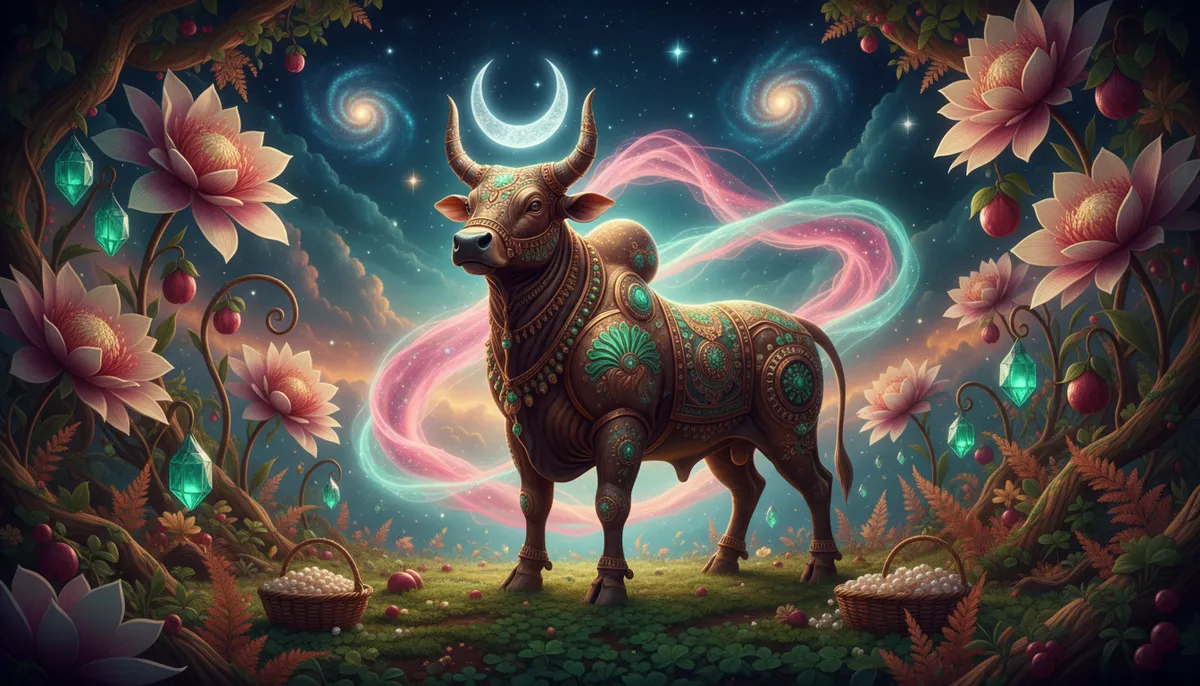
Vrishabha (Taurus) stands as the second sign of the Vedic zodiac—the domain where cosmic energy stabilizes and seeks material expression. As the first earth sign ruled by Venus, Taurus embodies wealth accumulation, sensory pleasure, aesthetic beauty, and the deep contentment that comes from security.
In Jyotish, Vrishabha holds extraordinary significance as both the exaltation and Mooltrikona sign of the Moon—the only sign in the zodiac where a planet enjoys such complete dignity. Combined with Venus’ rulership, this creates a sign of supreme material comfort and emotional stability.
Classical Description
The ancient sages provided detailed characterizations of Vrishabha’s nature:
Taurus is white in complexion, lorded by Venus, is long, is a quadruped sign, has strength in night, resides in the south, represents villages and businessmen, is an earthy sign, rises with its back
This comprehensive portrait reveals:
- White color: Venusian purity and lunar luminosity
- Long form: Extended, substantial physical structure
- Quadruped (Chatushpada): Bovine nature, slow and steady
- Night-strong: Gains power during nocturnal hours
- South direction: Associated with stability and grounding
- Villages and businessmen: Agricultural prosperity and commerce
- Earthy: Practical, material, grounded orientation
- Prishthodaya (back-rising): Rises with its back, methodical nature
The fixed nature of Taurus grants exceptional persistence and determination. Unlike movable signs that initiate or dual signs that adapt, Sthira rashis consolidate and maintain—building wealth, preserving traditions, and sustaining what has been established.
Core Nature and Qualities
Vrishabha represents the stabilizing principle in the zodiac—the force that takes raw initiative (Aries) and gives it form, substance, and lasting value. As a feminine earth sign, Taurus receives, accumulates, and preserves rather than projecting or dispersing energy.
The Venus Connection
Venus as ruler bestows:
- Material appreciation: Love of luxury, beauty, and comfort
- Artistic sensibility: Natural affinity for music, art, and aesthetics
- Wealth accumulation: Strong desire to build financial security
- Sensory pleasure: Enjoyment of food, touch, and physical comforts
- Relationship orientation: Loyal, devoted, and affectionate nature
The Kalapurusha Connection
The signs Aries etc., represent the limbs of Kalapurusha: Aries-head, Taurus-face, Gemini-arms, Cancer-heart, Leo-stomach, Virgo-hip, Libra-space below navel and private parts, Scorpio-private parts, Sagittarius-thighs, Capricorn-knees, Aquarius-ankles, Pisces-feet.
As the face and mouth of the Cosmic Being (Kalapurusha), Taurus governs:
- Speech and voice: Communication, singing ability
- Food and taste: Dietary preferences, oral pleasures
- Facial beauty: Attractiveness, pleasant features
- Resource intake: How one acquires and consumes wealth
Planetary Dignities
Taurus serves as one of the most significant signs for planetary dignity—particularly for the Moon, which achieves its highest expression here.
Moon’s Exaltation (Uccha)
The Moon reaches exaltation in Taurus with deep exaltation at 3 degrees. The Moon finds supreme comfort in Taurus because:
- Stability: Fixed earth sign provides emotional grounding
- Material security: Venus’ wealth-giving nature satisfies lunar need for safety
- Nurturing environment: Agricultural, fertile sign supports Moon’s nourishing quality
- Sensory contentment: Venusian pleasures calm the fluctuating mind
Moon’s Mooltrikona
The Moon’s exaltation portion spans 0-3 degrees, while Mooltrikona covers 3-30 degrees. This makes Taurus uniquely significant—the only sign where a planet holds both exaltation AND Mooltrikona:
| Dignity | Degrees | Strength |
|---|---|---|
| Exaltation | 0° - 3° | Highest (Deepest at 3°) |
| Mooltrikona | 3° - 30° | Very Strong |
The Moon in any degree of Taurus enjoys exceptional dignity, making this the “lunar paradise” of the zodiac.
Venus’ Own Sign (Swakshetra)
Venus owns both Taurus (earth) and Libra (air), but expresses differently:
| Venus Sign | Element | Expression |
|---|---|---|
| Taurus | Earth | Material wealth, physical beauty, sensory pleasure |
| Libra | Air | Relationships, harmony, aesthetic balance |
In Taurus, Venus focuses on tangible, earthly manifestations of beauty and comfort.
Cosmic Correspondences
Beyond basic characteristics, classical texts assign specific cosmic mappings to Vrishabha:
| Correspondence | Value | Significance |
|---|---|---|
| Direction | South | Associated with Yama, stability |
| Rising Type | Prishthodaya | Night-strong, rises with back |
| Day/Night | Nocturnal strength | Gains power at night |
| Caste | Vaishya (Merchant) | Trade, commerce, agriculture |
| Classification | Quadruped | Bovine nature, cattle, farming |
| Terrain | Villages, agricultural lands | Rural prosperity |
Taurus Ascendant Characteristics
If Vrishabha (Taurus) be rising at birth, the person will have plumpy thighs and a big face, will be engaged in agriculture, will be happy in the middle and concluding portions of life, will be fond of young women, will be liberal in gifts, will be of a forgiving disposition, will endure hardships, possess cattle, and will have marks or moles on the back, face and sides
Person born in Taurus Lagna will own many cows, pay homage to elders and Brahmanas, be fond of learned disputations, inclined to wandering, fortunate, lustful, calm-minded with few sons
Key Taurus Ascendant traits from classical sources:
- Physical: Plump thighs, large face, marks on face/back
- Profession: Agriculture, cattle-rearing, commerce
- Timing: Happiness increases in middle and later life
- Nature: Forgiving, generous, patient, enduring
- Wealth: Prosperity through land and livestock
Nakshatras in Vrishabha
Three lunar mansions span Taurus, each contributing unique qualities:
Krittika (26°40’ Aries - 10° Taurus)
The final three-quarters of Krittika (0° - 10° Taurus) fall within Vrishabha.
| Attribute | Value |
|---|---|
| Ruling Planet | Sun (Surya) |
| Deity | Agni (Fire God) |
| Symbol | Razor/Flame |
| Quality | Purifying, transformative fire |
Person born with Moon in Krittika will be energetic, lord-like in status, not dull but with valuable learning
Krittika in Taurus combines solar fire with Venusian earth—purification of material attachments, refining beauty through discipline.
Rohini (10° - 23°20’ Taurus)
The most auspicious nakshatra for wealth and beauty falls entirely within Taurus.
| Attribute | Value |
|---|---|
| Ruling Planet | Moon (Chandra) |
| Deity | Prajapati/Brahma (Creator) |
| Symbol | Cart/Chariot |
| Quality | Creativity, fertility, growth |
Person with Moon in Rohini will know weak points of others, be lean, enlightened but addicted to women not his own
Rohini is considered the most beautiful nakshatra—Moon-ruled within Moon’s exaltation sign. This creates exceptional:
- Physical beauty: Attractive features, magnetic presence
- Artistic talent: Creative expression, aesthetic sense
- Material prosperity: Wealth accumulation, agricultural success
- Fertility: Creative potential, progeny
Mrigashira (23°20’ Taurus - 6°40’ Gemini)
The first half of Mrigashira (23°20’ - 30° Taurus) resides in Vrishabha.
| Attribute | Value |
|---|---|
| Ruling Planet | Mars (Mangala) |
| Deity | Soma (Moon God) |
| Symbol | Deer’s Head |
| Quality | Searching, curious, gentle |
Mrigashira in Taurus blends Mars’ drive with Venus’ pleasures—the gentle hunt for beauty, the pursuit of comfort, searching for perfect satisfaction.
Significations and Terrain
Classical texts associate Vrishabha with specific environments, beings, and activities:
Places and Environments
- Villages: Rural communities and settlements
- Agricultural lands: Farms, fields, cultivated areas
- Dairies: Places of milk production
- Gardens: Beautiful, cultivated natural spaces
- Banks: Places where wealth is stored
Living Beings
- Bulls and cows: Primary bovine association
- Cattle: All domesticated livestock
- Quadrupeds: Four-footed creatures generally
Professions and Activities
- Agriculture: Farming, land cultivation
- Cattle-rearing: Dairy farming, livestock
- Banking: Finance, wealth management
- Art and music: Creative, aesthetic pursuits
- Commerce: Trading, business, merchants
Summary
Vrishabha (Taurus) represents the zodiac’s supreme domain of material stability, sensory pleasure, and emotional contentment. As Venus’ earth sign and the Moon’s place of both exaltation and Mooltrikona, Taurus offers unparalleled dignity for lunar and Venusian expression.
The fixed earth nature creates persistence, determination, and the capacity to build lasting wealth. The three nakshatras—Krittika, Rohini, and Mrigashira—each contribute unique qualities from solar purification to lunar beauty to Martian pursuit.
For the Vedic astrologer, understanding Taurus means appreciating the power of stability, the virtue of patience, and the spiritual significance of material contentment as a foundation for higher development.
Classical Sources Referenced
- Brihat Parashara Hora Shastra (BPHS): Chapters 3, 4, 43, 46
- Jataka Parijata: Chapters 1, 9
- Saravali: Chapters 3, 27, 28
- Phaladeepika: Chapter 9
Related Articles
Zodiac Series
- Dwadasha Rashi: Complete Guide to the 12 Zodiac Signs
- Mesha (Aries): The First Sign
- Mithuna (Gemini): The Third Sign
- Vrishchika (Scorpio): The Opposite Sign
- Tula (Libra): Venus’ Other Sign
Planetary Guides
Nakshatra Guides
Related Articles
Kanya (Virgo) in Vedic Astrology: Complete Guide to the Sixth Rashi
Discover Kanya (Virgo), the sixth sign of the Vedic zodiac. Learn why Mercury is exalted here, Venus is debilitated, the three nakshatras within, and classical insights on this mutable earth sign.
Makara (Capricorn) in Vedic Astrology: Complete Guide to the Tenth Rashi
Discover Makara (Capricorn), the tenth sign of the Vedic zodiac. Learn why Mars is exalted here, Jupiter is debilitated, the three nakshatras within, and classical insights on this cardinal earth sign.
Tula (Libra) in Vedic Astrology: Complete Guide to the Seventh Rashi
Discover Tula (Libra), the seventh sign of the Vedic zodiac. Learn why Saturn is exalted here, the Sun is debilitated, the three nakshatras within, and classical insights on this cardinal air sign.