Budha: The Awakened Messenger, Prince of Intellect and Speech
Born of cosmic scandal yet blessed with divine wit—Mercury stands as the chameleon among planets, a neutral prince whose nature mirrors those who surround him, awakening the mind to language, logic, and the mercurial dance of thought.
Essential Attributes at a Glance
| Attribute | Budha’s Nature |
|---|---|
| Sanskrit Name | Budha (Synonyms: Hemna, Vid, Gna, Bodhana) |
| Cosmic Role | Speech/Voice (Kalapurusha) |
| Cabinet Status | Prince-apparent |
| Nature | Benefic (alone/with benefics); Malefic (with malefics) |
| Gender | Neuter/Neutral |
| Caste | Vaisya (Commercial) |
| Guna | Extremely Rajasic (Passion, Activity) |
| Element | Earth (Prithvi) |
| Deity | Maha Vishnu |
| Color | Green (Durva-Shyama, grass-like) |
| Taste | Mixed |
| Dosha (Humour) | Tridosha (Vata, Pitta, Kapha combined) |
| Directional Strength | East |
| Direction | North |
| Temporal Strength | Always strong (Day and Night) |
| Natural Strength | 3rd Weakest among Grahas |
| Exaltation | Virgo (15°) |
| Moolatrikona | Virgo (15°–20°) |
| Own Signs | Gemini; Virgo (20°–30°) |
| Time Unit | Ritu (Season / 2 months) |
| Season | Sarat (Autumn) |
| Abode | Sport-grounds, Playgrounds |
| Apparel | Black silk; Water-soaked; Green robes |
| Substance | Metal Alloy (Mixed Metals) |
| Tree Type | Fruitless trees |
| Classification | Jeeva (Living Beings) |
| Friends | Sun, Venus |
| Enemies | Moon |
| Neutrals | Mars, Jupiter, Saturn |
Astronomical Overview
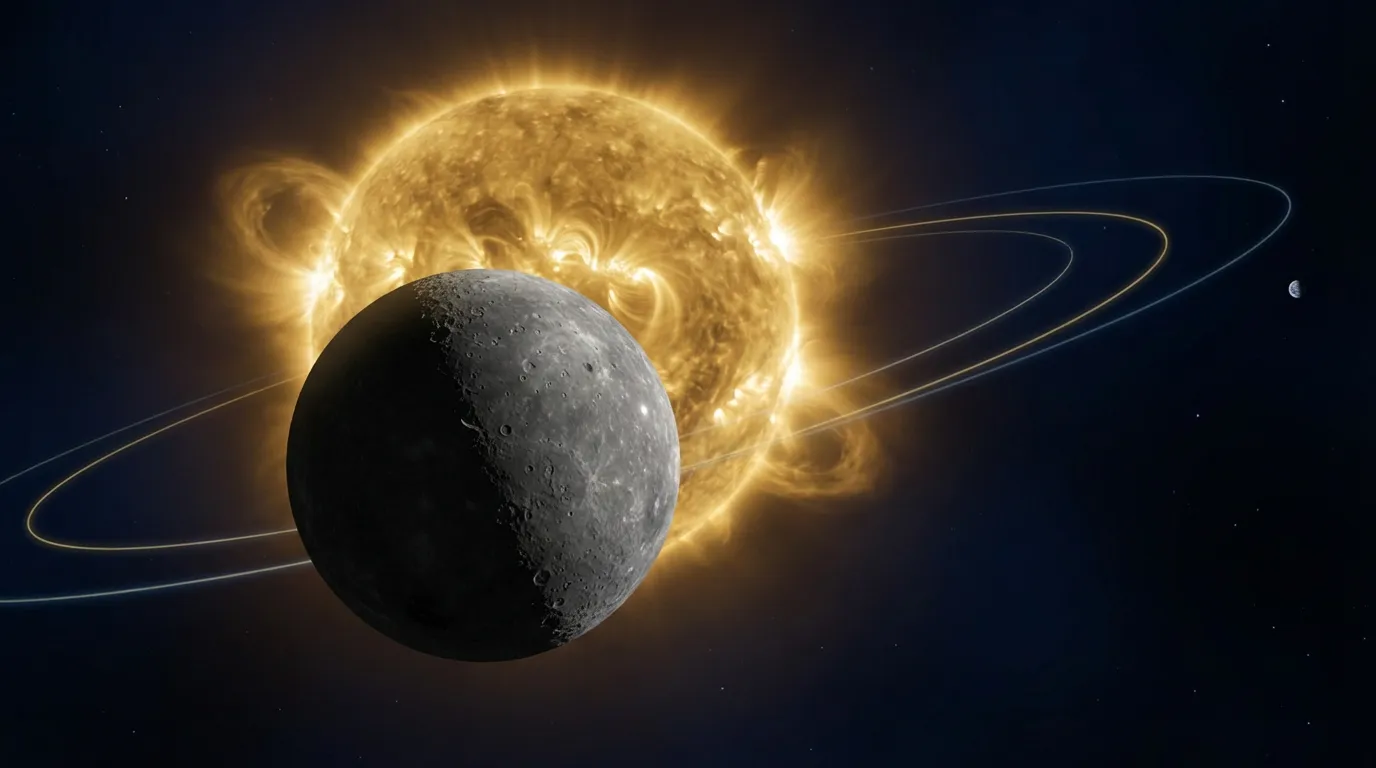
Mercury holds the distinction of being the smallest planet in our solar system and the closest to the Sun, racing through space at speeds that dwarf all other planets. With a diameter of approximately 4,880 kilometers—only slightly larger than Earth’s Moon—Mercury completes its orbit around the Sun in just 88 Earth days, earning its reputation as the swiftest of celestial wanderers.
This speed mirrors Mercury’s astrological nature: quick-thinking, adaptable, and ever-moving. The planet’s highly elliptical orbit carries it from 47 million kilometers to 70 million kilometers from the Sun, a variance that ancient observers noted as Mercury’s tendency to appear now as a morning star, now as an evening star, always elusive, always transforming.
Mercury’s surface experiences the most extreme temperature variations of any planet—soaring to 430°C during the day and plunging to -180°C at night. Without an atmosphere to moderate these extremes, Mercury embodies pure reactivity to its environment. This astronomical fact resonates with Budha’s astrological signature: the chameleon planet that takes on the character of whatever surrounds it, neither inherently benefic nor malefic, but infinitely adaptable.
The ancients, observing Mercury’s rapid, unpredictable appearances near the horizon, recognized in this planet the quality of budh—awakening, knowing, understanding. It moves too fast to be captured, yet returns again and again, like thought itself.
Mythological Origins: The Tale of Tara and Chandra
Unlike the other Grahas, Budha enters cosmic existence through scandal—a birth story that marks him as fundamentally different, neither wholly of one lineage nor another. This mythological origin illuminates why Mercury alone among planets carries a neuter nature, why he bears enmity toward his own father, and why adaptability defines his essential character.
The tale begins with Tara, the radiant wife of Brihaspati (Jupiter), the preceptor of the Devas. Despite her exalted position, Tara became captivated by Chandra (the Moon), whose beauty and romantic charm proved irresistible. She left her husband’s home to live with Chandra, an act of cosmic impropriety that sent shockwaves through the celestial realms.
Brihaspati, outraged by this betrayal, demanded Tara’s return. When Chandra refused, war erupted—the Tarakamaya War, the war fought over Tara. The Asuras, ever seeking advantage against the Devas, joined Chandra’s side under Shukracharya’s command, while the Devas rallied behind Brihaspati. The conflict threatened to tear the universe apart.
Finally, Brahma himself intervened, persuading Tara to return to her rightful husband. But she returned pregnant with Chandra’s child. When the boy was born, radiant and beautiful, the question of paternity hung over the celestial court. Even the child himself, still in the womb, is said to have asked: “Mother, whose seed gave me life?”
Tara, breaking her silence, acknowledged that the child belonged to Chandra, not Brihaspati. Enraged by this confirmation, Brihaspati cursed the infant Budha with a genderless existence—neither fully male nor female, but neuter, belonging to neither world completely.
Growing up under this curse, Budha developed a hatred for his father Chandra, blaming the Moon for his ambiguous state. This mythological enmity finds its astrological expression: Mercury considers the Moon its only enemy among the planets. The son born of passion resents the passionate father who caused his suffering.
Yet Budha’s story does not end in bitterness. He married Ila, a being who lived as Sudyumna when male and Ila when female, changing gender with each month. In this union of two beings who transcended ordinary categories, Budha found partnership and peace. Their son Pururavas became the founder of the Chandravanshi (Lunar) dynasty, the royal lineage that would eventually produce the heroes of the Mahabharata.
Thus Mercury, born of scandal and cursed to difference, becomes the progenitor of kings—the outsider whose very outsiderness becomes the source of new creation.

Classical Description
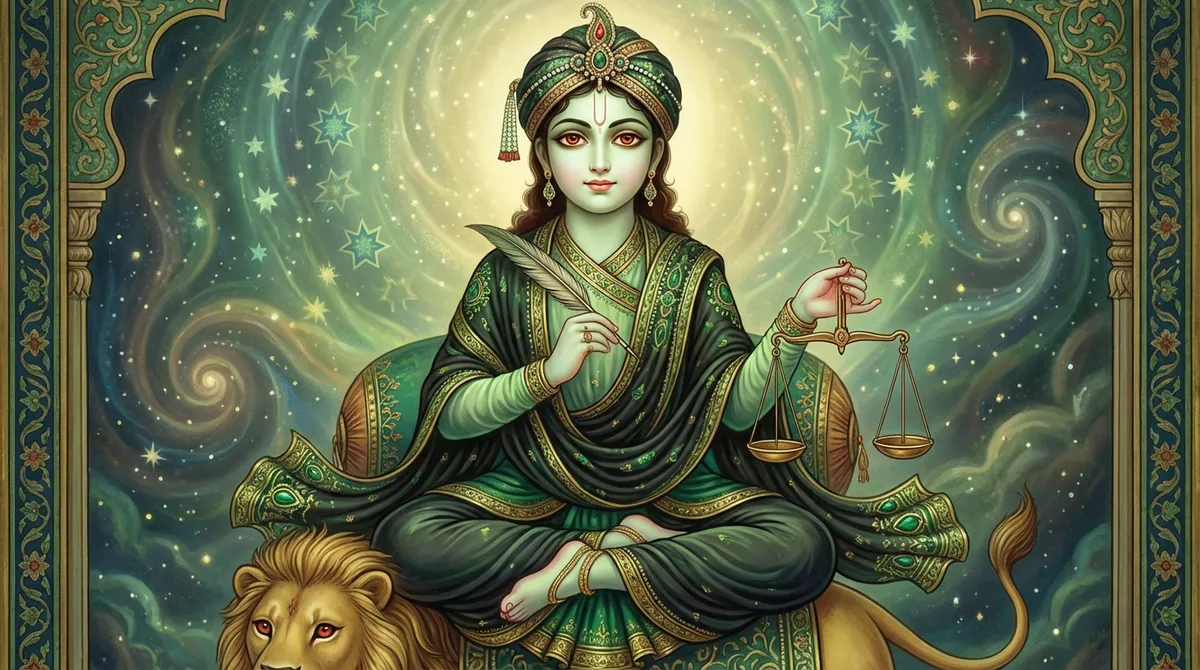
The ancient seers describe Budha with remarkable consistency, painting a portrait that differs markedly from the other Grahas. Where the Sun blazes with copper-red intensity and the Moon shimmers with tawny softness, Mercury carries the verdant hue of living grass—Durva-Shyama, the complexion of sacred kusha grass, green and vital.
Both the Brihat Parashara Hora Shastra and Phaladeepika emphasize Budha’s attractive physique and moderate beauty—not the overwhelming radiance of the luminaries, but an accessible, agreeable pleasantness. The eyes are described as reddish and broad, suggesting alertness and wide-ranging perception. The skin is strong and sinewy, with visible veins indicating a certain nervous vitality, the physical manifestation of an ever-active mind.
Most distinctively, the classical texts note Budha’s mastery of language. He uses words with double meanings—puns, wordplay, the clever manipulation of meaning that delights and instructs simultaneously. He is described as fond of jokes, possessing sweet and clear speech, pure in temperament, and jovial in disposition. The seers emphasize his agreeableness, his skill in navigating social situations, his capacity to please diverse audiences.
The Phaladeepika calls him Bodhana—the Awakener—while listing among his synonyms Vid, the Knower. These names reveal Mercury’s essential function: not merely to communicate, but to bring understanding, to kindle the light of knowledge in minds ready to receive it.
Perhaps most remarkable is Budha’s humoral constitution. While the Sun carries pure Pitta and the Moon combines Kapha with Vata, Mercury alone possesses Tridosha—an equal mixture of all three humors. This balanced constitution mirrors his neutral planetary nature, his capacity to adapt and blend, his refusal to be defined by any single quality.
Essential Qualities
Element & Cosmic Association
Mercury belongs to the realm of Earth (Prithvi), the element of grounding, practicality, and tangible manifestation. This may seem paradoxical for a planet associated with the airy realm of thought—yet consider how Mercury’s true gift lies in bringing ideas into communicable form, translating the abstract into the concrete, making the invisible visible through speech and writing.
The presiding deity Maha Vishnu reinforces this function. Vishnu preserves the cosmic order, maintains what exists, and ensures continuity across time. Mercury, as the planet of speech and commerce, serves this preservative function—language transmits knowledge across generations, trade sustains civilization, communication maintains the fabric of society.
Guna: Extremely Rajasic Nature
Mercury embodies Rajas in its most concentrated form—the quality of activity, passion, and dynamic motion. Where the Sun and Moon are Sattvic (pure, still, luminous), Mercury is all movement, all exchange, all transaction. This Rajasic nature explains why Mercury never rests: the mind it governs is always thinking, always processing, always seeking new information.
This is not the destructive activity of Tamas nor the serene stillness of Sattva, but the creative turbulence that generates commerce, art, learning, and connection. Rajas builds civilizations, writes books, negotiates treaties, solves problems. Mercury’s extremely Rajasic nature makes it the planet of worldly engagement par excellence.
Dosha: Tridosha Constitution
Unique among the Grahas, Budha carries a Tridosha constitution—equal parts Vata (air/movement), Pitta (fire/transformation), and Kapha (water/stability). This balanced mixture reflects Mercury’s chameleon nature:
- Vata contributes mental agility, quick thinking, and the capacity for rapid change
- Pitta provides sharp intellect, discriminating awareness, and analytical power
- Kapha offers memory, retention, and the stability needed to learn and preserve knowledge
This triple constitution allows Mercury to adapt to any situation, to work with any type of person, to communicate across all boundaries. The Tridosha nature is both Mercury’s greatest strength and its potential weakness—without the grounding influence of other planets, this adaptability can become instability.
Temperament & Character
The classical texts describe Budha as pure, jovial, skillful, and agreeable to all. This is the temperament of the diplomat, the merchant, the teacher—one who must work with diverse people and find common ground. Mercury’s humor and wit serve social functions, easing tensions and building rapport.
Yet there is depth beneath the jovial surface. The name Bodhana means “Awakener”—one who brings consciousness, who kindles understanding. Mercury’s wit is not mere entertainment but a teaching tool; the pun that makes you laugh also makes you think.

Physical, Emotional & Psychological Traits
Physical Characteristics
Those born under strong Mercurial influence often display the planet’s distinctive signatures:
- A greenish or olive undertone to the complexion, or simply a fresh, youthful appearance
- Reddish, broad, alert eyes that seem to take in everything
- Strong skin with visible veins, suggesting nervous energy near the surface
- A moderate build—neither imposing nor diminutive—with an agile, quick-moving frame
- Perpetual youthfulness in the features, regardless of actual age
- Restless hands, expressive gestures, bodies that communicate
There is something of the eternal student in Mercury-dominant individuals, a quality of curiosity and openness that keeps them young in spirit even as years pass.
Emotional Nature
Emotionally, Mercury natives exhibit remarkable adaptability—sometimes too much. Like the planet that becomes benefic with benefics and malefic with malefics, those under strong Mercurial influence can be highly impressionable, taking on the emotional coloring of their environment.
The positive expression of this includes genuine curiosity about others, the capacity to understand multiple perspectives, and a light-hearted approach to life’s difficulties. The shadow side involves emotional superficiality, difficulty with deep intimacy, and a tendency to intellectualize feelings rather than experience them fully.
Mercury’s children are often described as jovial and delighted—they find pleasure in learning, in clever conversation, in the play of ideas. Yet this lightness can mask a certain restlessness, a difficulty sitting with darker emotions that don’t yield to rational analysis.
Psychological Profile
Psychologically, Mercury governs the discriminating intellect—the faculty that analyzes, categorizes, and communicates. This differs from the Sun’s conscious will or the Moon’s feeling-mind; Mercury’s intelligence is specifically the capacity to think in words, to reason logically, to make fine distinctions.
Mercury-dominant individuals typically display:
- Sharp analytical abilities and quick comprehension
- Excellent memory, particularly for facts, words, and patterns
- Linguistic aptitude—often multilingual, always articulate
- Mathematical and logical reasoning abilities
- A preference for versatility over depth, breadth over specialization
- The trickster quality: clever, adaptive, sometimes cunning
The shadow of Mercury’s psychological profile includes scattered thinking, difficulty focusing, nervous anxiety, and the tendency to manipulate through words. The gift of speech can become the curse of deception when Mercury’s energy is poorly integrated.
Symbolism & Mythic Archetypes
The Prince-Diplomat
In the celestial cabinet, Mercury holds the status of Prince-apparent—youthful, not yet burdened with ultimate authority, free to move between factions and mediate disputes. This is not the commanding presence of the Sun-King or the nurturing authority of the Moon-Queen, but the nimble intelligence that serves both.
The prince-diplomat archetype appears across cultures: Hermes in Greek mythology, the messenger of the gods who moves freely between Olympus and the underworld; Narada in Hindu tradition, the divine sage who carries news and stirs events through strategic communication. Mercury’s role is to connect, to translate, to facilitate exchange.
The Awakener (Bodhana)
The Sanskrit root budh means to awaken, to know, to understand—the same root that gives us the word Buddha, the Awakened One. Mercury’s deepest function is not mere information transfer but the kindling of consciousness, the moment when scattered data becomes coherent understanding.
This awakening function explains Mercury’s rulership over learning and education. Teachers are Mercurial figures, translating knowledge into forms students can receive, using words to spark inner recognition. Commerce itself serves this awakening—exchange of goods and ideas broadens perspectives and challenges assumptions.
The Chameleon
Most fundamentally, Mercury embodies the chameleon archetype—the being that takes on the colors of its environment. This is not weakness but supreme adaptability, not deception but responsive authenticity. The chameleon survives by becoming part of whatever surrounds it.
This nature makes Mercury uniquely sensitive to context. A Mercury conjunct Jupiter will express wisdom and expansion; conjunct Saturn, discipline and precision; conjunct Mars, argumentative force. Alone, Mercury tends toward benefic expression, but its essential nature is to amplify and articulate whatever it touches.
Significations (Karakatvas)
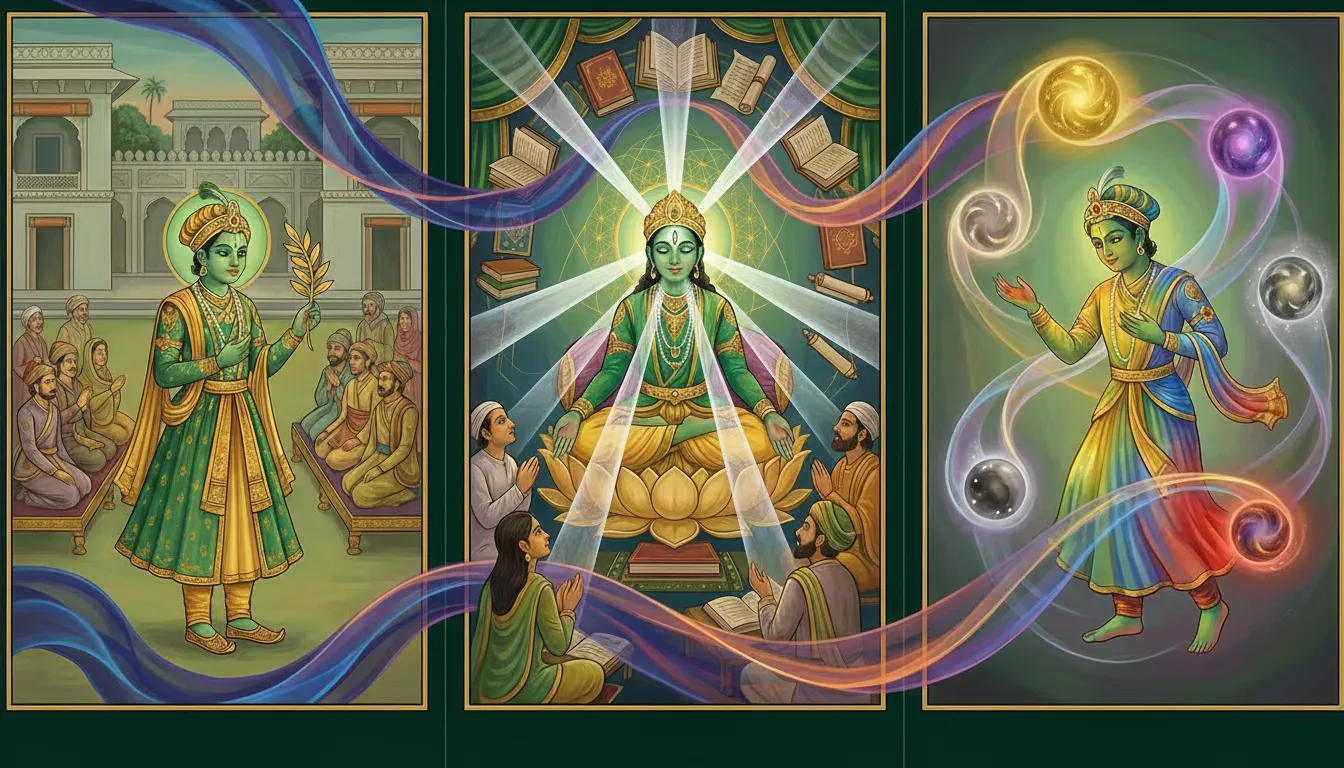
Mercury serves as karaka—natural significator—for numerous aspects of life, all connected by the common thread of communication, exchange, and mental activity.
Primary Domains
- Speech (Vak): All forms of verbal and written expression, from casual conversation to formal oration to published literature
- Intellect (Buddhi): The discriminating faculty that reasons, analyzes, and formulates understanding
- Commerce: Trade, business, transactions, the exchange of value between parties
Relationships
- Maternal grandmother: An interesting signification that connects Mercury to accumulated feminine wisdom
- Friends: The bonds formed through shared interests and communication
- Younger siblings: In some traditions, those who learn from us as we learned from elders
Body & Health
- Skin: The boundary between self and world, also the organ of touch
- Nervous system: The body’s communication network, carrying signals throughout
- Respiratory system: Breath, the vehicle of speech
- Hands and arms: The instruments of gesture and writing
- Tongue: The organ of speech itself
Substances & Materials
- Pearl oyster: Producing gems through patient layering
- Metal alloys: Mixed substances, neither one thing nor another
- Emerald: Mercury’s gemstone, green like the planet’s complexion
- Green items generally: Connecting to Mercury’s verdant nature
Places & Settings
- Sport-grounds and playgrounds: Places of recreational activity and games
- Schools and libraries: Centers of learning and knowledge preservation
- Markets and trading floors: Sites of commercial exchange
- Communication centers: Posts, media houses, internet hubs
- Northern direction: Mercury’s directional association
Professions & Activities
- Mathematics and accounting: The manipulation of abstract symbols
- Fine arts: Especially those involving craft and technique
- Writing and journalism: Communication as vocation
- Commerce and trade: Exchange as livelihood
- Diplomacy and negotiation: Professional mediation
- Teaching and education: Transmission of knowledge
- Technology and computing: Modern extensions of Mercury’s domain
- Astrology itself: The science of reading cosmic patterns
Strengths & Challenges
Inherent Strengths
Mercury possesses several unique advantages in the planetary hierarchy:
Directional Strength (Dig Bala) Mercury gains maximum strength in the East, the direction of new beginnings and fresh starts. This placement amplifies all Mercurial functions—clarity of thought, eloquence of speech, success in learning and commerce.
Temporal Strength Uniquely among the planets, Mercury maintains strength both day and night. While the Sun rules the day and the Moon the night, Mercury transcends this division, always active, always available. This perpetual strength reflects the mind’s capacity to work at any hour, the possibility of insight at any moment.
Exaltation in Virgo At 15 degrees of Virgo, Mercury reaches its point of exaltation—maximum refinement and power. Virgo’s discriminating, analytical qualities perfectly suit Mercury’s intellectual nature, producing extraordinary precision in thought and expression.
Own Sign Dignity Mercury rules both Gemini and Virgo, providing two signs where it operates with natural authority. Gemini emphasizes communication, versatility, and social intelligence; Virgo emphasizes analysis, precision, and practical application.
Special Rule: Moon-Mercury Conjunction The classical texts note a remarkable exception to normal planetary rules: when Moon and Mercury are together, both function as benefics regardless of other factors. This special relationship suggests that mind (Moon) and intellect (Mercury), properly integrated, produce beneficial results.
Challenges & Weaknesses
Natural Strength Despite temporal and directional advantages, Mercury ranks as the third weakest planet in natural strength. This means Mercurial matters often require support from other planetary factors to manifest fully.
Debilitation in Pisces Mercury falls in Pisces, where intuition, imagination, and spiritual dissolution overwhelm logical structures. In this sign, Mercury’s precision blurs, its categories dissolve, its distinctions fade into oceanic oneness. While this can produce poetic and mystical expression, it challenges practical intellect.
Chameleon Vulnerability The very adaptability that serves Mercury well can also prove dangerous. Conjunction with malefic planets twists Mercurial energy toward harmful ends—deception instead of communication, manipulation instead of mediation, cunning instead of wisdom.
Physical Vulnerabilities When Mercury is afflicted in a chart, certain health challenges tend to manifest:
- Nervous system disorders, anxiety, tremors
- Skin conditions, particularly stress-related
- Respiratory problems, allergies
- Speech impediments or difficulties
- Memory problems, particularly in advancing age
Psychological Risks Poorly integrated Mercury can produce scattered thinking, chronic indecision, nervousness, and superficiality. The quick mind becomes a restless mind; adaptability becomes instability; cleverness becomes mere trickery.
Planetary Relationships
| Relationship | Planets |
|---|---|
| Friends | Sun, Venus |
| Enemies | Moon |
| Neutrals | Mars, Jupiter, Saturn |
Mercury’s relationship pattern reveals its unique position in the cosmic order:
The friendship with Sun connects intellect to consciousness, speech to will. When Mercury serves the Sun’s illuminating purpose, communication becomes a vehicle for truth rather than mere information.
The friendship with Venus links Mercury to beauty, art, and refined expression. This alliance produces aesthetic sensibility, artistic skill, and the capacity to communicate about matters of the heart.
The enmity with Moon reflects the mythological conflict between Budha and his father Chandra. On a psychological level, this represents the tension between feeling-mind and thinking-mind, between intuition and logic. Mercury’s analytical nature can discount or dismiss the Moon’s emotional wisdom.
Neutrality toward Mars, Jupiter, and Saturn reflects Mercury’s diplomatic nature—the prince who maintains working relationships with all parties without deep alliance or antagonism. This neutrality preserves Mercury’s essential adaptability.
Classical Reference Notes
This portrait of Budha synthesizes descriptions from the principal texts of Jyotisha, which show remarkable agreement on Mercury’s essential characteristics while offering complementary details:
Brihat Parashara Hora Shastra establishes Mercury’s cabinet status as Prince-apparent, assigns the Earth element and Maha Vishnu as deity, and notes the unique Tridosha constitution. It specifies exaltation at 15° Virgo, Moolatrikona from 15°–20° Virgo, and own sign rulership of both Gemini and Virgo. The text emphasizes Mercury’s directional strength in the East and its perpetual temporal strength.
Phaladeepika provides the synonyms Hemna, Vid (Knower), Gna, and Bodhana (Awakener), connecting Mercury to the root budh—to awaken, to know. It details the physical appearance: green grass complexion, reddish broad eyes, sinewy skin, and moderate beauty. The text notes the extremely Rajasic guna, the association with autumn season, and the rulership over sport-grounds.
Saravali corroborates these descriptions while adding details about Mercury’s significations, including mathematics, fine arts, maternal grandmother, skin, pearl oyster, and friends. It confirms Mercury’s karakatva for speech and the classification as Jeeva (living beings).
Notable discrepancies between texts include:
- Direction: Phaladeepika assigns North as Mercury’s direction, while BPHS gives East as the direction of strength
- Caste: BPHS specifies Vaisya (commercial class), while some Phaladeepika commentaries note Sudra (service class)
These variations reflect different lineages of transmission and regional emphases rather than fundamental disagreement about Mercury’s nature.
Closing Reflection
Mercury asks us to consider the miracle of language itself—the capacity to encode thought in sound and symbol, to transmit understanding across space and time, to awaken in another mind what exists in our own. In this gift of speech, the ancients recognized something divine, something that participates in the creative power of the cosmos itself.
Born of scandal yet blessed with wit, cursed to difference yet founder of dynasties, Mercury embodies the principle that what marks us as outsiders can become our greatest contribution. The chameleon who takes on all colors becomes indispensable; the neutral prince who serves all factions keeps the kingdom intact.
To know Mercury in your chart is to know where your adaptability lies, where your words carry power, where your mind seeks stimulation. It marks the playground of your intellect—sometimes scattered, sometimes brilliant, but always moving, always seeking the next insight, the next connection, the next awakening.
The Awakener reminds us that every conversation can be a teaching, every transaction an exchange of more than goods, every thought a potential seed of understanding. Mercury’s green light signals: be curious, be clever, be open to what surrounds you. The mind that awakens others awakens itself in the process.
Explore the Navagraha
This article is part of our comprehensive series on the nine celestial powers of Vedic astrology. Discover how all the grahas work together in the cosmic parliament:
The Complete Guide to Navagraha: Nine Planets of Vedic Astrology →
References
This article synthesizes knowledge from the following classical Vedic astrology texts:
-
Brihat Parashara Hora Shastra - The foundational text of Vedic astrology attributed to Sage Parashara, detailing planetary characteristics, significations, and interpretive principles.
-
Phaladeepika - A classical text by Mantreshwara offering detailed descriptions of planetary qualities, physical appearances, and predictive techniques.
-
Saravali - A comprehensive classical text by Kalyana Varma, providing detailed descriptions of planetary qualities, physical appearances, and astrological effects.
These ancient texts form the bedrock of Vedic astrological wisdom, passed down through generations of practitioners and scholars.
Want to discover how Mercury influences your personal birth chart? Join our waitlist for personalized Vedic astrology insights when Lopamudra launches.
Related Articles

Surya: The Radiant Soul of the Cosmos
In the celestial parliament of the Navagrahas, the Sun reigns as sovereign—a cosmic monarch whose very presence illuminates both heaven and earth, embodying the eternal principle of consciousness itself.
The Moon (Chandra): Sovereign of the Mind, Keeper of the Tides
In the ancient sky-map of Jyotisha, Chandra rises as the luminous reflection of the soul - the mind's mirror, ever waxing and waning with the pulse of creation.
Mars (Mangala): The Crimson Warrior of the Celestial Realm
In the vast architecture of Jyotisha, Mars rises like a flame against the dark sky—fierce, unrelenting, and alive with the pulse of action.