Rahu: The Insatiable Shadow, Master of Illusion and Worldly Desire
Born from the severed head of an immortal demon, Rahu embodies the ego's endless hunger for experience, recognition, and transcendence through worldly engagement. As the North Lunar Node, this shadow planet drives ambition, creates illusion, and compels the soul toward its destined experiences.
Essential Attributes at a Glance
| Attribute | Rahu’s Nature |
|---|---|
| Sanskrit Name | Rahu (Synonyms: Tamas, Pata, Svarbhanu, Agu) |
| Cosmic Role | Ego (Kalapurusha) |
| Cabinet Status | Planetary Army |
| Nature | Natural Malefic (Chhaya Graha / Shadow Planet) |
| Gender | Masculine |
| Caste | Outcaste (Mlechcha) |
| Guna | Tamasic (Darkness, Confusion, Transformation) |
| Element | Air (Vayu) |
| Deity | Durga / Varaha |
| Color | Smoky / Black / Multi-colored |
| Taste | Tastelessness (loss of taste) |
| Dosha (Humour) | Vata (Windy) |
| Directional Strength | South-West |
| Temporal Strength | Strong at sunset |
| Exaltation | Taurus (traditional) / Gemini (some authorities) |
| Debilitation | Scorpio (traditional) / Sagittarius (some authorities) |
| Moolatrikona | Gemini |
| Own Sign | Aquarius (co-ruler with Saturn) |
| Orbital Cycle | 18 years (approximately 18 months per sign) |
| Time Unit | One Muhurta |
| Abode | Forests, anthills |
| Apparel | Multi-colored |
| Substance | Lead |
| Gemstone | Hessonite (Gomed) / Lapis Lazuli |
| Classification | Dhatu (Metals/Minerals) |
| Friends | Jupiter, Venus, Saturn |
| Enemies | Sun, Moon, Mars |
| Neutrals | Mercury |
| Special Note | Functions like Saturn; indicates anthills; strong in upachaya houses (3, 6, 10, 11) |
Astronomical Overview
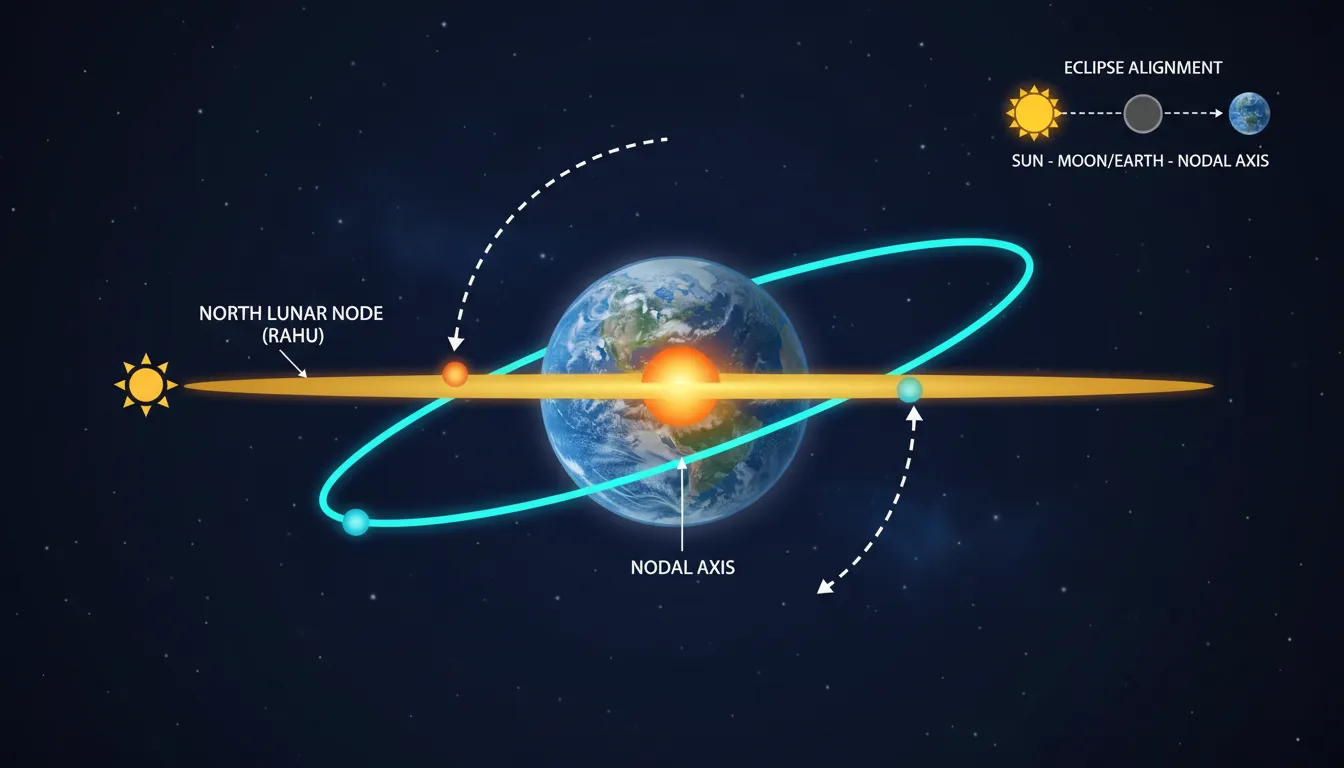
Rahu represents one of the most fascinating intersections of observational astronomy and astrological philosophy—a point in space where no physical body exists, yet whose influence shapes the destiny of countless lives. As the North Lunar Node, Rahu marks the ascending point where the Moon’s orbital path crosses the ecliptic, the apparent path of the Sun through the heavens.
This invisible yet powerful point completes its cycle through all twelve signs of the zodiac in approximately 18 years, spending roughly 18 months in each sign. Unlike the visible planets that move in apparent direct motion through the zodiac, Rahu travels in constant retrograde motion—always moving backward against the natural flow of signs, as if swimming against the current of cosmic time.
The astronomical phenomenon that gives Rahu its fearsome reputation is the eclipse. When the Sun or Moon aligns with Rahu’s position, the North Node creates the conditions for eclipses—solar eclipses when the Sun is near Rahu, and lunar eclipses when the Moon occupies this point. Ancient seers, observing the luminaries being “swallowed” during these dramatic celestial events, encoded this phenomenon into the mythology of Rahu perpetually pursuing and devouring the Sun and Moon.
The term Chhaya Graha (Shadow Planet) captures Rahu’s essential nature—it casts shadows, obscures light, and operates through what remains hidden rather than what is revealed. Having no physical body, Rahu represents pure potentiality, the hunger of consciousness without the means of satisfaction, the head severed from the body that would process and integrate experience.
Rahu always opposes Ketu, the South Lunar Node, maintaining an exact 180-degree relationship. Together they form the karmic axis—Rahu pointing toward future experiences the soul must embrace, Ketu representing past patterns that must be released. This axis rotates backward through the chart, creating the nodal return every 18 years that marks major karmic inflection points in life.
Mythological Origins: The Severed Immortal
The birth of Rahu emerges from one of Hindu mythology’s most magnificent narratives—the Samudra Manthan, the Great Churning of the Cosmic Ocean. This story illuminates not only Rahu’s nature but the fundamental dynamics of desire, deception, and the consequences of transgressing cosmic law.
The Churning of the Ocean of Milk
In the cosmic drama of creation, the Devas (celestial beings) and Asuras (anti-gods) found themselves locked in perpetual conflict. The Devas, weakened by a curse, sought the nectar of immortality—Amrita—which lay hidden in the depths of the Kshirasagara, the Ocean of Milk. Unable to churn this vast ocean alone, they formed an uneasy alliance with the Asuras, both sides agreeing to share whatever treasures emerged.
Mount Mandara served as the churning rod, and Vasuki, the great serpent king, became the churning rope. Lord Vishnu, incarnating as the tortoise Kurma, supported the mountain on his back while the Devas pulled one end of Vasuki and the Asuras the other. For eons they churned, and from the cosmic waters emerged wonders and terrors alike—the deadly Halahala poison (consumed by Shiva, turning his throat blue), the divine elephant Airavata, the celestial wish-fulfilling tree Kalpavriksha, the goddess Lakshmi, and finally, Dhanvantari bearing the pot of Amrita.
Swarbhanu’s Lineage
Among the Asuras who labored at this cosmic task was Swarbhanu, a being of formidable power and cunning intelligence. He was the son of Viprachitti, a mighty Danava king, and Simhika, whose lineage connected to Hiranyakashipu—the infamous demon king slain by Vishnu’s Narasimha avatar. From birth, Swarbhanu possessed an extraordinary form: the head of a demon mounted upon the body of a great serpent, appearing dark and terrifying to all who beheld him.
Swarbhanu had participated in the churning with singular focus. While other Asuras grew distracted by the treasures that emerged, his eyes remained fixed on the ultimate prize—immortality itself.
The Great Deception
When the Amrita finally appeared, conflict immediately erupted. The Asuras attempted to seize the nectar, unwilling to share with their celestial rivals. To restore order and protect cosmic dharma, Lord Vishnu assumed the form of Mohini—an enchantress of such devastating beauty that all present fell under her spell. Both Devas and Asuras agreed to let this divine beauty distribute the nectar.
Mohini, with deliberate grace, served the Amrita exclusively to the Devas while keeping the Asuras mesmerized by her form. But Swarbhanu, whose intelligence matched his ambition, perceived the deception. He disguised himself as a Deva, assuming a celestial form, and took his place in the line of gods.
When Mohini approached and poured the precious nectar between his lips, Swarbhanu knew his gambit had succeeded. The Amrita touched his tongue, flowed down his throat—
And in that instant, Surya the Sun and Chandra the Moon recognized the impostor.
The Sudarshana Chakra
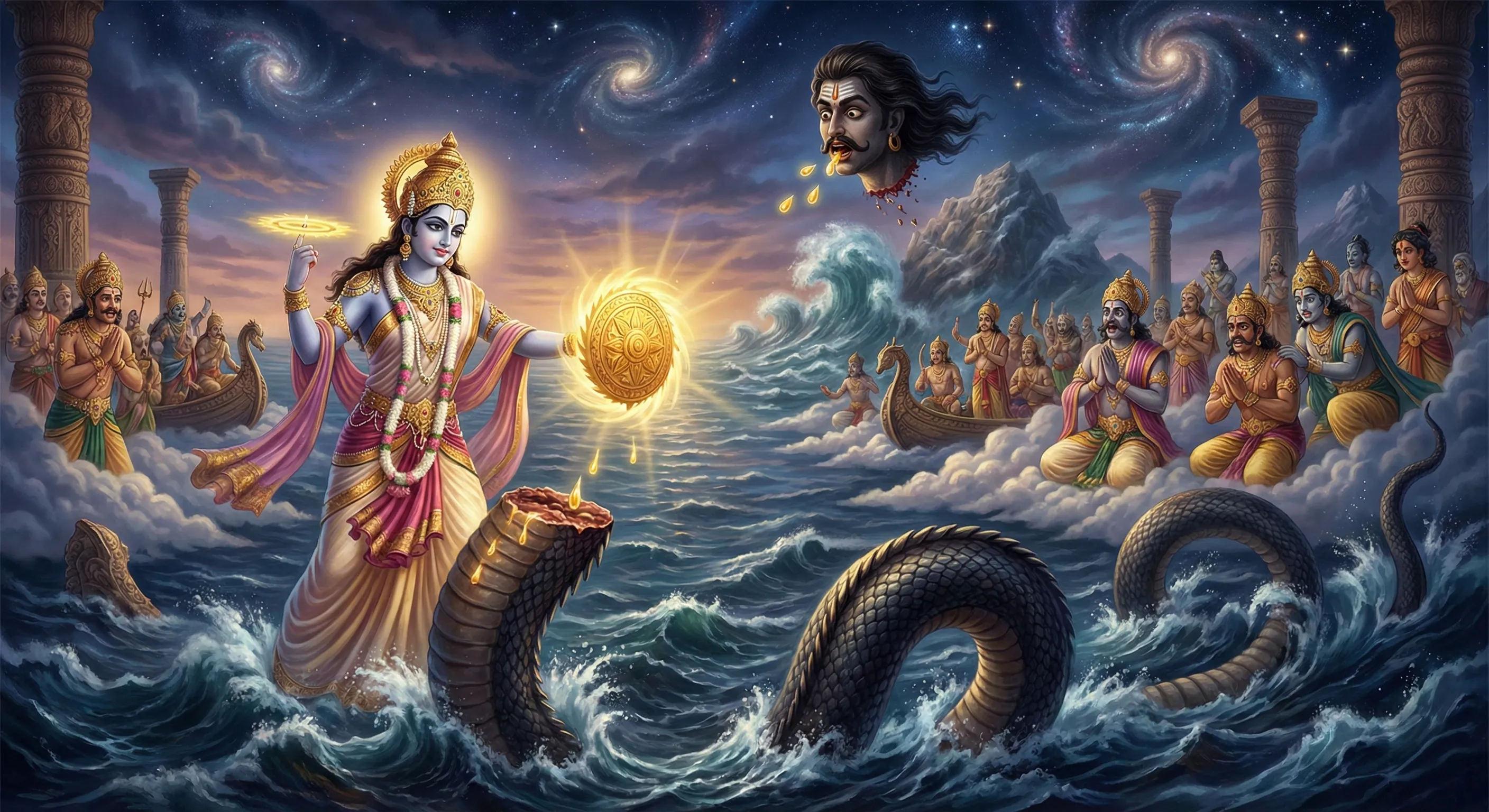
Their warning cry split the air. Lord Vishnu, without hesitation, raised his Sudarshana Chakra—the divine discus that represents time itself, the wheel that cuts through all illusion. The blazing weapon severed Swarbhanu’s head from his serpentine body.
But the cosmic law admits no exception: what receives the nectar of immortality cannot die. The Amrita had already passed Swarbhanu’s throat, conferring immortality upon both the separated parts. The head, burning with intelligence, ambition, and the rage of betrayal, became Rahu—forever seeking to consume, yet never able to digest. The body, headless yet immortal, became Ketu—forever possessing the capacity for experience, yet lacking the awareness to direct it.
The Eternal Eclipse
From that moment forward, Rahu has pursued the Sun and Moon across the heavens—the very luminaries who exposed his deception and caused his severing. When Rahu catches them, he swallows them whole, creating the darkness of eclipse. Yet because he is only a head without a body, the luminaries pass through his throat and emerge unharmed on the other side, making the eclipse temporary.
This cosmic chase encodes profound astrological meaning. Rahu’s periodic “swallowing” of the Sun and Moon represents the ego’s capacity to temporarily eclipse our core identity (Sun) and emotional security (Moon). During Rahu periods, the boundaries between self and desire, between need and obsession, become obscured—just as the boundary between day and night blurs during an eclipse.
The Deeper Symbolism
The mythology of Rahu’s creation contains multiple layers of meaning:
The Severed Head symbolizes desire without the means of fulfillment—the eternal hunger of the ego that consumes but never satisfies. Rahu can taste but not digest, acquire but not integrate, experience but not process. This is the essential nature of material desire: it promises completion yet delivers only the compulsion to desire again.
The Deception reflects Rahu’s fundamental relationship to illusion. Swarbhanu succeeded through disguise, through appearing as what he was not. So too does Rahu function in our lives—amplifying what it touches, creating illusions of grandeur or fear, magnifying the apparent importance of worldly achievement.
The Immortality reveals that certain forces cannot be destroyed, only transformed. The karmic patterns Rahu represents persist across lifetimes. The ego’s hunger for experience continues until the soul completes its evolutionary journey.
Sun and Moon’s Role establishes why Rahu’s enmity with the luminaries runs so deep—they represent the forces of clarity and illumination that expose illusion. Rahu thrives in shadow; the luminaries bring light.
Classical Description
The ancient seers describe Rahu with an appearance that reflects his shadowy domain and malefic nature. The Phaladeepika portrays a figure of fearsome intensity: black in complexion, with a body that appears smoky, as if composed of darkness made partially visible. This smoky, blue-mixed appearance suggests something not quite material—a being that exists at the threshold between substance and shadow.
The Brihat Parashara Hora Shastra adds further details: Rahu is tall in stature, with prominent features that disturb rather than attract. His caste is designated as outcaste (Mlechcha)—one who exists outside the boundaries of conventional society. This designation reflects not moral judgment but functional description: Rahu operates beyond established norms, through unconventional means, in foreign territories both geographical and psychological.
The texts describe Rahu as residing in forests—places where civilization’s order gives way to nature’s chaos—and particularly noting an association with anthills, those mysterious structures that represent hidden kingdoms, patient construction, and the transformation of earth itself.
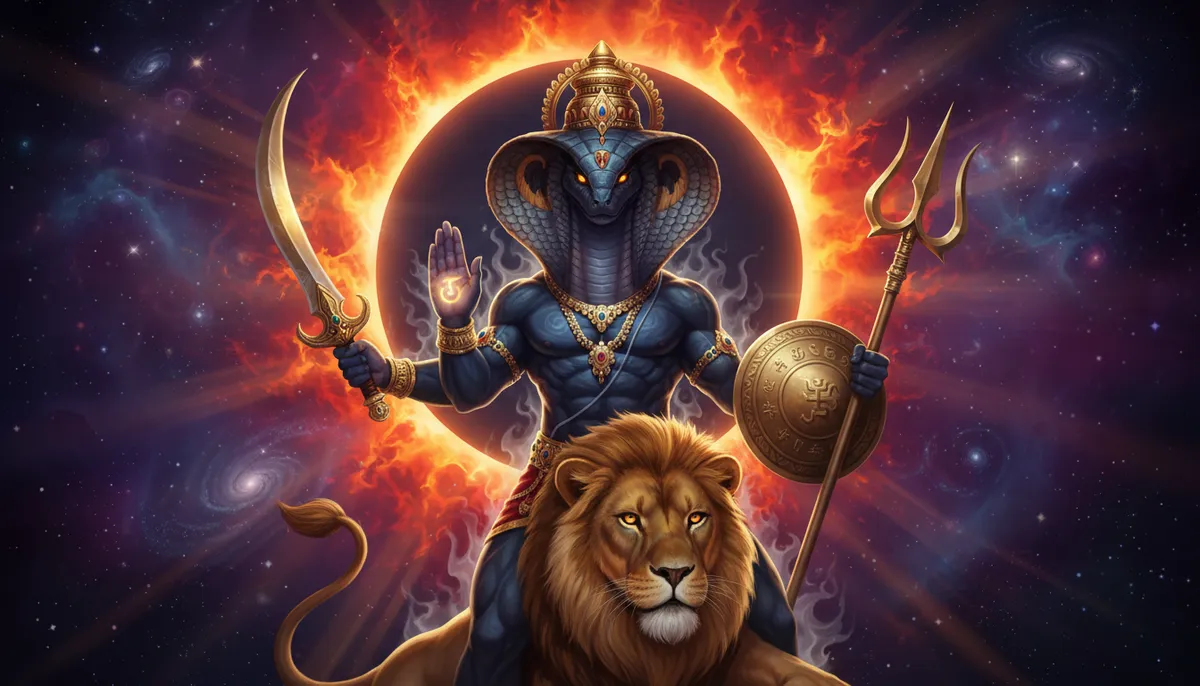
The classical iconographic description presents Rahu with a hideous face bearing four arms that carry:
- A sword—representing cutting through obstacles (or cutting one off from truth)
- A shield—for protection and concealment
- A shoola (trident)—power over the three worlds
- A vara (boon-giving gesture)—the capacity to grant worldly desires
He is depicted as blue-colored and mounted upon a lion, suggesting that despite his shadowy nature, Rahu possesses tremendous force and royal ambition. The lion mount connects him to solar symbolism—paradoxically, the enemy rides the symbol of the one he opposes.
Temperamentally, the texts characterize Rahu as:
- Intelligent (despite being listed as “devoid of intelligence” in some translations, this refers to divine wisdom rather than cunning)
- Frightening or horrible in appearance and effect
- Thievish in disposition—working through stealth and cunning
- Speaking falsehood—associated with deception and misdirection
- Afflicted with skin diseases—particularly leprosy in classical descriptions
- Heretic—outside orthodox religious boundaries
- Cunning—achieving through indirect means what force cannot accomplish
The Vata (windy) constitution dominates Rahu’s nature, bringing qualities of restlessness, unpredictability, and the capacity to disturb settled conditions. Like wind, Rahu’s influence moves without being seen, scatters what was ordered, and reaches places that seem impenetrable.
Essential Qualities
Element: Air (Vayu)
Rahu belongs to the Air element, but his expression of Vayu differs markedly from Mercury’s quicksilver adaptability. Rahu’s Air is restless, invisible, expansive, and difficult to contain. Just as air moves without boundaries and fills every space it touches, Rahu’s influence knows no limits—it expands whatever it contacts, magnifies both desire and fear, and creates a sense of urgency around worldly achievement.
The Air element governs the spaces between things—the gaps, the connections across distance, the invisible medium through which influence travels. Rahu creates connections across boundaries: between cultures, between social classes, between the permitted and the forbidden. This element also rules the nervous system, and Rahu’s afflictions often manifest as anxiety, obsessive thoughts, and conditions where the mind cannot find rest.
Guna: Tamasic Nature
Among the three gunas—Sattva (purity), Rajas (passion), and Tamas (inertia)—Rahu embodies Tamas in both its challenging and transformative aspects. Tamas is the quality of darkness, heaviness, confusion, and the obscuring of truth.
Yet Tamas serves essential functions in creation. It provides the darkness necessary for seeds to germinate, the confusion that forces deeper questioning, the dissolution of false certainties that precedes genuine wisdom. Rahu’s Tamasic nature forces confrontation with shadow—the denied aspects of self, the suppressed desires, the unconscious drives that shape behavior from below.
The spiritual traditions recognize that transformation often requires descent before ascent. Rahu’s Tamasic force compels engagement with aspects of existence that Sattvic approaches might avoid—the material world’s seductions, the ego’s demands, the ancestral patterns that bind until consciously addressed.
Dosha: Vata Constitution
Rahu’s Vata (windy) constitution creates experiences marked by:
- Restlessness and inability to find contentment
- Sudden changes and unexpected events
- Anxiety, fear, and disturbances of the mind
- Irregular patterns in health, wealth, and relationships
- Sensitivity to environmental influences
- The sense of being driven by forces one cannot control
- Dryness and depletion following periods of excess
Those under strong Rahu influence often exhibit Vata imbalances: mental restlessness, irregular sleep, nervous conditions, and difficulty maintaining stable routines. Rahu’s periods bring Vata-related challenges that require grounding, routine, and practices that calm the restless mind.
The Shadow Planet (Chhaya Graha)
Rahu’s designation as a shadow planet carries profound implications. Having no physical body, Rahu operates entirely through influence—through the power to magnify, obscure, and transform whatever it touches. A shadow exists only in relation to something else; similarly, Rahu’s effects depend entirely on the planets it conjoins, the houses it occupies, and the signs it traverses.
This shadowlike nature means Rahu:
- Amplifies the characteristics of associated planets
- Takes on the qualities of the house lord where it resides
- Creates effects that seem larger than their actual substance
- Operates through what is hidden, foreign, or unconventional
- Produces illusions that seem completely real until they dissipate
Relationship to Saturn
The classical texts note that “Rahu functions like Shani (Saturn),” a statement with profound interpretive significance. Both planets are natural malefics; both govern limitation and difficulty; both rule Aquarius. But their methods differ fundamentally.
Saturn works through time—slow, inexorable, patient. Rahu works through sudden intensity—magnification, obsession, eclipse. Saturn teaches through restriction and denial; Rahu teaches through overwhelming experience that reveals the emptiness of what was sought. Saturn’s lessons take years; Rahu’s revelations come in sudden flashes of insight following periods of intense delusion.
The friendship between Rahu and Saturn reflects their shared governance of Aquarius and their complementary roles in karmic education. Both serve evolution through difficulty—Saturn through the slow grind of time, Rahu through the intense fire of worldly experience.
Physical, Emotional & Psychological Traits
Physical Characteristics
Those born under strong Rahu influence often display the planet’s signature features:
- Tall, often lanky build with prominent bone structure
- Dark or smoky complexion—or simply an unusual, memorable appearance
- Large, intense eyes that seem to see beyond surface reality
- Features that others find difficult to classify or forget
- Skin conditions, particularly those involving discoloration or irregularity
- Physical vitality that fluctuates dramatically between excess and depletion
- An appearance that changes notably with circumstance—seeming different in different contexts
- Unusual beauty or unusual plainness—rarely ordinary
There is a magnetic quality to Rahu-dominant individuals—they attract attention even when seeking to avoid it. Their presence creates ripples, generates reactions, and rarely leaves observers neutral.
Emotional Nature
Emotionally, Rahu natives experience intensity that can overwhelm conventional containment. The positive expression includes:
- Passionate engagement with life’s experiences
- Ambition that drives achievement against all odds
- Capacity to reinvent oneself completely
- Emotional fearlessness—willingness to venture where others hesitate
- Intense attachments that create powerful bonds
- The ability to channel desire into focused accomplishment
The shadow aspects of Rahu’s emotionality include:
- Obsession that consumes rational judgment
- Insatiability—nothing is ever quite enough
- Emotional manipulation to achieve desired ends
- Addictive patterns in substances, relationships, or behaviors
- Chronic dissatisfaction despite apparent success
- The sense of being driven by forces beyond conscious control
- Jealousy and the fear of being exposed or surpassed
Psychological Profile
Psychologically, Rahu governs the ego in its worldly expression—the part of self that seeks recognition, achievement, and validation through external accomplishment:
- Powerful ambition and the drive for success
- Unconventional thinking and attraction to foreign ideas
- Capacity to see opportunities others miss
- Willingness to break rules that obstruct desired outcomes
- Strong identification with image, status, and public perception
- Fascination with mystery, taboo, and hidden knowledge
- The sense of having a special destiny or unique purpose
- Difficulty distinguishing between genuine intuition and wishful thinking
Rahu-dominant individuals often achieve remarkable worldly success precisely because they want it so intensely. They sense the shortcuts, perceive the leverage points, and pursue goals with a focus that less driven personalities cannot match. Yet the very intensity that produces success can also produce spectacular collapse when the foundations prove illusory.
Symbolism & Mythic Archetypes
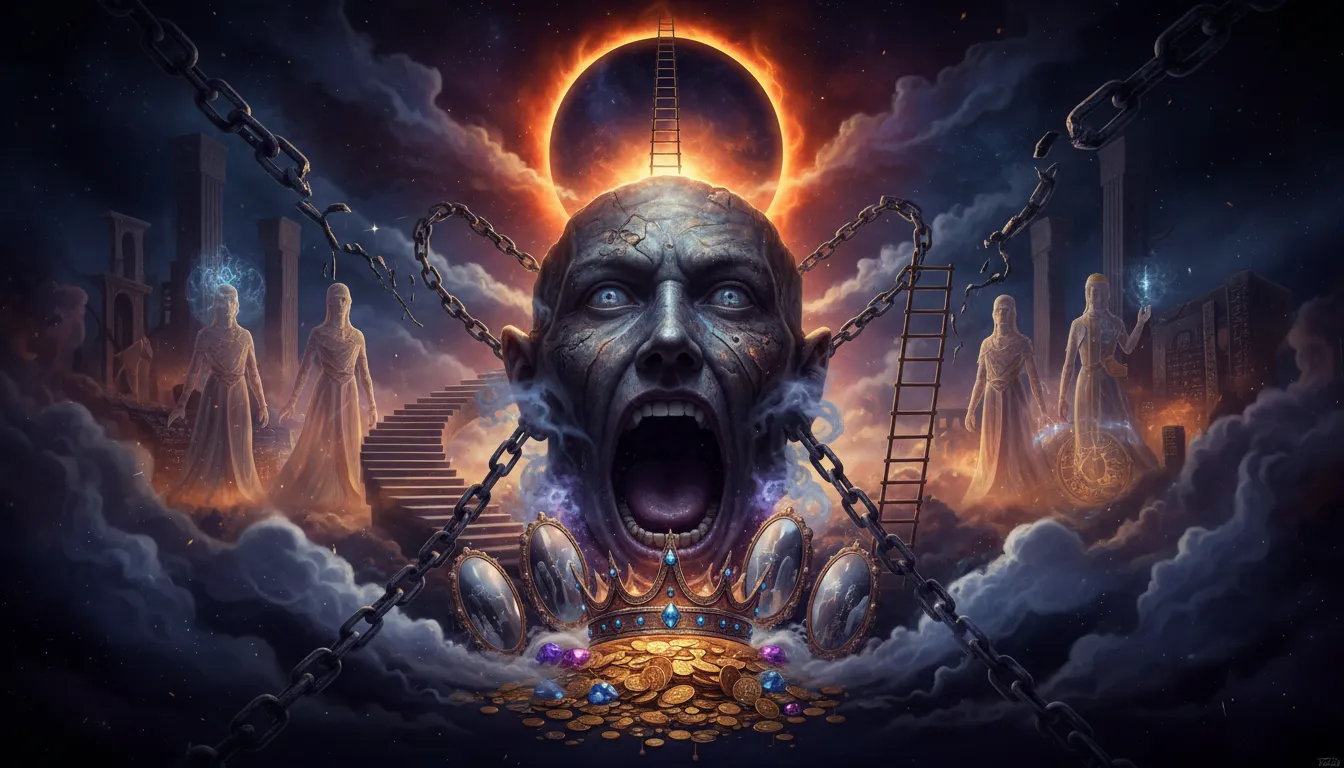
The Insatiable Head
Rahu’s most fundamental symbol is the severed head that swallows but cannot digest. This image illuminates the nature of desire itself: the hunger that is never satisfied, the acquisition that produces only the need to acquire more, the experience that intensifies longing rather than completing it.
The head without body represents:
- Intellect without grounding
- Desire without the capacity for fulfillment
- Consumption without integration
- Knowledge without wisdom
- Ambition without satisfaction
This archetype teaches that worldly experience, however intense, cannot ultimately satisfy the soul’s deeper hunger. The head must eventually reunite with Ketu—the body of spiritual experience—for genuine completion.
The Outsider and Rebel
As an outcaste (Mlechcha), Rahu occupies space outside conventional boundaries. This outsider status grants both limitation and freedom—exclusion from established privileges, but also exemption from established constraints.
The rebel archetype appears when Rahu:
- Drives attraction to foreign cultures, ideas, and people
- Creates success through unconventional means
- Grants immunity to conventions that bind others
- Produces the reformer, the revolutionary, the one who changes systems by refusing to accept them
- Manifests as the immigrant, the exile, the one who makes their way in foreign territory
The Master of Illusion
As the eclipse-maker, Rahu governs the realm of Maya—cosmic illusion. This archetype operates through:
- Creating appearances that diverge from reality
- Magnifying the apparent importance of worldly success
- Generating fear through exaggeration of threats
- Producing the glamour of fame, power, and recognition
- Manifesting as smoke and mirrors—impressive presentation without substance
The illusion archetype teaches that what appears overwhelming usually isn’t, and what seems permanently achieved can dissolve in a moment. Rahu’s illusions serve evolution by demonstrating the nature of Maya through direct experience.
The Worldly Achiever
Despite his malefic classification, Rahu grants substantial worldly success to those through whom he operates strongly. This archetype manifests as:
- The entrepreneur who builds empires from nothing
- The celebrity who captures public imagination
- The politician who rises through cunning and charisma
- The innovator who transforms industries
- Anyone who achieves recognition, fame, or power through unconventional means
The worldly achiever archetype reminds us that spiritual evolution often requires worldly engagement. The soul that never experiences the fulfillment and emptiness of material success may retain unconscious attraction to it across lifetimes.
The Eclipse Maker
When Rahu obscures the luminaries, he creates temporary darkness that serves multiple purposes:
- Revealing the stars that are always present but invisible in daylight
- Demonstrating that even the greatest lights can be temporarily obscured
- Creating conditions for transformation that require darkness
- Teaching non-attachment to illumination itself
The eclipse archetype governs all experiences of temporary obscuration—periods when clarity fails, when identity becomes uncertain, when emotional security dissolves. These periods, though challenging, often precede significant evolution.
The Evolutionary Force
Ultimately, Rahu serves evolution by driving the soul toward experiences it needs but might otherwise avoid. The karmic force archetype operates through:
- Creating compelling desire for specific experiences
- Placing opportunities and temptations in life’s path
- Generating the intensity required to break through resistance
- Propelling consciousness toward its destined developments
- Ensuring that necessary lessons cannot be indefinitely postponed
Significations (Karakatvas)
Rahu serves as karaka—natural significator—for aspects of life united by themes of desire, illusion, foreign influence, and unconventional experience.
Primary Domains
- Obsession and Compulsion: The overwhelming desires that capture consciousness
- Illusion and Deception: Maya in all its forms—both deceiving and being deceived
- Foreign Lands and Cultures: Immigration, international connections, cross-cultural experience
- Sudden Events: Unexpected changes, windfalls, and disruptions
- Technology and Innovation: Modern machinery, computers, cutting-edge developments
- Materialism: The pursuit of wealth, status, and worldly achievement
- The Ego: Self-image, public persona, the constructed identity
- Amplification: Whatever Rahu touches becomes magnified, for better or worse
Relationships
- Maternal Grandfather: The mother’s father falls under Rahu’s signification
- Outcasts and Foreigners: Those outside conventional social boundaries
- Unconventional Partners: Relationships that cross cultural, social, or other boundaries
- Widows: Those touched by separation and loss (shared with Saturn)
- Step-relations: Non-biological family connections
- People of Different Cultures: Foreign nationals, immigrants, those from distant lands
Body & Health
- Skin: Particularly conditions involving discoloration, unusual growths, or leprosy
- Breathing: Respiratory conditions, particularly those with psychological components
- Nervous System: Anxiety, phobias, and disorders of the nerves
- Hidden Ailments: Conditions difficult to diagnose, mysterious symptoms
- Poisoning: Toxicity from substances, snake bites, food contamination
- Infectious Diseases: Epidemics, contagious conditions
- Mental Health: Fits, obsessive disorders, psychological disturbances
- Tumors: Hidden growths, particularly malignant ones
- Chronic Fatigue: Depletion following periods of excessive activity
Substances & Materials
- Lead: Rahu’s primary metal—heavy, toxic, useful in specific applications
- Hessonite (Gomed): The honey-colored garnet prescribed for Rahu
- Lapis Lazuli: The blue gem associated with Rahu in some traditions
- Multi-colored Items: Objects combining multiple colors or patterns
- Smoke and Incense: Substances that create visible yet insubstantial forms
- Intoxicants: Substances that alter perception and create illusion
- Garlic: Mythologically born from Rahu’s blood when severed
Places & Settings
- Foreign Countries: Nations other than one’s birthplace
- Forests and Wilderness: Places beyond civilization’s reach
- Anthills: Mysterious structures of hidden industry (specifically noted in classical texts)
- Gambling Houses: Places of risk, speculation, and uncertain outcome
- Airports and Seaports: Transit points between territories
- Technology Centers: Locations where innovation concentrates
- Underground Locations: Mines, tunnels, basements—hidden spaces
- Border Regions: Transitional zones between defined territories
Professions & Activities
- Technology and Engineering: Software, electronics, modern machinery
- Foreign Trade: Import/export, international business, diplomacy
- Medicine: Particularly toxicology, addiction treatment, and unconventional healing
- Media and Entertainment: Film, television, celebrity culture
- Politics: Especially positions requiring diplomacy and strategic cunning
- Research: Investigation into hidden matters, detective work
- Speculation: Stock trading, gambling, venture capital
- Aviation: Pilots, flight attendants, aerospace professionals
Temporal Rulership
- One Muhurta: Rahu’s time unit—approximately 48 minutes
- Sunset: Rahu gains particular strength at twilight
- Eclipse Periods: Times of heightened Rahu influence
- 18-Year Cycle: The complete transit through all signs
Nakshatra Rulership
Rahu rules three nakshatras, each expressing different dimensions of Rahu’s nature through their unique symbolism and deity:
Ardra (6°40’ – 20°00’ Gemini) “The Moist One” — In Mercury’s sign of communication, Rahu expresses through intellectual intensity and emotional storms.
- Symbol: Teardrop, diamond, or human head
- Deity: Rudra (the fierce, howling form of Shiva who brings destruction that precedes renewal)
- Meaning: The nakshatra of storms, tears, and transformation through crisis
- Rahu Expression: Here Rahu manifests through powerful intellect, sharp communication, and the capacity to perceive what others miss. Ardra natives often experience life-changing events that destroy old structures and force profound growth. The tears of Ardra water the seeds of future wisdom.
- Qualities: Research ability, critical thinking, emotional intensity, transformative intelligence, the capacity to destroy illusion through piercing insight
Swati (6°40’ – 20°00’ Libra) “The Independent One” or “The Sword” — In Venus’s sign of relationship, Rahu expresses through diplomatic skill and the capacity for independence within connection.
- Symbol: Young plant swaying in the wind, coral, sword
- Deity: Vayu (the Wind God, representing movement, breath, and life force)
- Meaning: The nakshatra of flexibility, independence, and self-propelled movement
- Rahu Expression: This represents Rahu’s most comfortable placement—success in business, diplomatic relations, and building networks across boundaries. Swati natives bend without breaking, adapt to circumstances, and achieve through flexibility rather than force.
- Qualities: Business acumen, diplomatic skill, independence, adaptability, the ability to thrive in diverse environments, success through networking and relationship-building
Shatabhisha (6°40’ – 20°00’ Aquarius) “The Hundred Physicians” or “The Hundred Stars” — In Rahu’s own sign of Aquarius, the shadow planet reaches its fullest expression of healing, mysticism, and unconventional wisdom.
- Symbol: Empty circle, hundred stars or flowers
- Deity: Varuna (God of Cosmic Waters, keeper of cosmic law and hidden knowledge)
- Meaning: The nakshatra of healing, secrecy, and penetrating insight into hidden matters
- Rahu Expression: Here Rahu manifests as the healer, the researcher into hidden causes, the one who works with mysterious forces for beneficial ends. Shatabhisha natives often possess natural healing abilities, interest in alternative medicine, and capacity to perceive subtle dimensions of reality.
- Qualities: Healing ability, interest in mysticism and occult, capacity for research, tendency toward secrecy, humanitarian concerns, unconventional approaches to conventional problems
Common Thread: All three of Rahu’s nakshatras share themes of transformation, working with hidden forces, and achieving through unconventional means. Ardra transforms through intellectual destruction, Swati through flexible adaptation, Shatabhisha through healing and hidden knowledge. Each represents a different face of Rahu’s evolutionary function.
Strengths & Challenges
Inherent Strengths
The Exaltation Debate Unlike the seven visible planets whose exaltation points are clearly established, Rahu’s exaltation remains debated among classical authorities:
- Taurus is cited by many traditional sources as Rahu’s exaltation sign, where the shadow planet’s desire nature finds maximum expression through Venus’s domain of pleasure, beauty, and material security
- Gemini is considered by other authorities as Rahu’s place of strength, where his intellectual and communicative capacities reach full expression through Mercury’s sign of intelligence and exchange
Both positions have classical support, and practical observation suggests Rahu functions powerfully in both signs. The Moolatrikona is generally placed in Gemini (0°-20°), indicating this sign’s particular importance for Rahu’s optimal function.
Own Sign: Aquarius Rahu co-rules Aquarius with Saturn, and in this sign expresses his themes of unconventionality, humanitarian concern, technological innovation, and working for collective benefit. Rahu in Aquarius operates with authority and natural dignity.
Upachaya House Strength Classical texts specifically note Rahu’s strength in the upachaya houses—3rd, 6th, 10th, and 11th from the Ascendant. In these “growing” houses, Rahu’s natural tendency toward expansion and increase produces beneficial results:
- 3rd House: Courage, initiative, communication skills, success through effort
- 6th House: Victory over enemies, health resilience, service capacity
- 10th House: Career success, public recognition, professional achievement
- 11th House: Gains, fulfilled desires, beneficial connections, income growth
10th House Prominence Rahu receives special mention for strength in the 10th house—the house of career, status, and public role. Here, Rahu’s ambition and capacity for achievement find appropriate expression, often producing individuals who rise to prominence in their chosen fields.
Association with Yogakaraka Planets When Rahu conjoins or receives aspects from yogakaraka planets (planets ruling both kendra and trikona houses for a given ascendant), his results become substantially benefic, channeling his intensity toward positive achievement.
Challenges & Weaknesses
Natural Malefic Status Rahu is classified as a natural malefic—his influence creates difficulty regardless of house position. Even when well-placed, Rahu brings his nature of illusion, intensity, and eventual disillusionment to whatever he touches.
The Debilitation Debate As with exaltation, Rahu’s debilitation sign is debated:
- Scorpio is cited by many as Rahu’s fall, where the shadow planet’s desires become entangled with Scorpio’s intensity, creating obsessive patterns that prove self-destructive
- Sagittarius is considered by other authorities as debilitating for Rahu, where the shadow planet’s materialism conflicts with Jupiter’s sign of dharma and higher truth
Both positions have observational support, and in practice Rahu tends toward excess in both signs.
Maraka Effects The classical texts specifically warn of danger when Rahu occupies the 2nd or 7th houses from the Ascendant—the maraka (death-inflicting) positions. In these houses, Rahu can indicate:
- Financial instability and loss of accumulated wealth
- Challenges in partnerships and marriage
- Physical distress and health vulnerabilities
- Difficulties with speech, family, and domestic harmony
Rahu Mahadasha Rahu’s major period lasts 18 years—among the longest of the planetary dashas. This extended period can bring tremendous worldly achievement but also:
- Chronic dissatisfaction despite success
- Obsessive pursuit of goals that prove empty upon achievement
- Deception by others or self-deception about circumstances
- Health challenges, particularly mental and nervous conditions
- Foreign residence or feeling foreign in one’s own land
- Intense experiences that only reveal their meaning in retrospect
Eclipse Effects When Rahu conjoins or opposes the natal Sun or Moon (or transits these points), eclipse-like conditions manifest in consciousness:
- Temporary obscuration of clarity (Sun) or emotional security (Moon)
- Identity confusion or emotional turbulence
- Major life transitions often marked by endings and beginnings
- Events that force confrontation with shadow material
Physical Vulnerabilities When afflicted, Rahu produces characteristic health patterns:
- Skin conditions, particularly those difficult to diagnose or treat
- Nervous disorders, anxiety, and psychological disturbances
- Breathing difficulties with psychological components
- Mysterious symptoms that evade conventional diagnosis
- Poisoning or adverse reactions to medications
- Addictive patterns requiring sustained effort to overcome
Planetary Relationships
| Relationship | Planets |
|---|---|
| Friends | Jupiter, Venus, Saturn |
| Enemies | Sun, Moon, Mars |
| Neutrals | Mercury |
Rahu’s relationship pattern reveals the cosmic dynamics between worldly desire and spiritual illumination:
Friendship with Jupiter may seem paradoxical—the shadow planet befriending the great benefic. Yet Jupiter represents expansion, and Rahu’s nature is precisely to expand whatever he touches. Jupiter also governs wisdom, and Rahu’s intense worldly experience ultimately generates the wisdom of disillusionment—understanding the nature of desire through having desired fully. Jupiter’s protective grace can mitigate Rahu’s excesses while allowing his evolutionary function.
Friendship with Venus connects two planets concerned with desire and experience. Venus rules pleasure, beauty, and material enjoyment—domains that Rahu intensely magnifies. This alliance explains Rahu’s capacity to produce material success and his particular strength in Taurus and Libra (Venus’s signs). Together they govern the attractions that pull consciousness into worldly engagement.
Friendship with Saturn reflects their shared rulership of Aquarius and complementary karmic functions. Both are malefics; both teach through difficulty; both govern the shadow dimensions of existence. Saturn’s slow, patient karma and Rahu’s intense, sudden karma work in concert to ensure that necessary lessons cannot be avoided indefinitely.
Enmity with the Sun originates in mythology—Surya exposed Swarbhanu’s deception, leading to his severing. Astrologically, Sun represents the soul’s core identity, while Rahu represents the ego’s constructed self-image. These principles exist in fundamental tension. Sun-Rahu combinations create identity challenges, father-related difficulties, and the ongoing tension between authentic selfhood and the masks we wear for worldly success.
Enmity with the Moon also traces to mythology—Chandra joined Surya in exposing the deception. Astrologically, Moon governs emotional security, contentment, and inner peace—precisely what Rahu’s restless desire nature disturbs. Moon-Rahu combinations create emotional turbulence, difficulties with mother or mothering, and the sense that contentment remains perpetually just out of reach.
Enmity with Mars pits ambition against aggression, cunning against force. Mars seeks direct confrontation; Rahu prefers indirect approach. Mars builds through discipline; Rahu achieves through leverage. When these two combine, the result can be either strategic brilliance (force directed by cunning) or self-destructive intensity (desire inflamed to dangerous levels).
Neutrality toward Mercury reflects the shared Air element and intellectual focus. Mercury’s adaptability can work with Rahu’s unconventionality; Mercury’s communication skills serve Rahu’s ambitions. Neither aids nor obstructs the other significantly—they simply operate in parallel domains.
Classical Reference Notes
This portrait of Rahu synthesizes descriptions from the principal texts of Jyotisha:
Brihat Parashara Hora Shastra establishes Rahu’s cabinet status as Planetary Army (Sainya), assigns the Air element and outcaste status, and notes the Vata constitution. It specifies Rahu’s special signification of anthills, maternal grandfather, and the forest-dwelling nature. BPHS states that Rahu “functions like Saturn,” establishing the functional relationship between these two malefics. The text notes Rahu’s strength at sunset and in the upachaya houses.
Phaladeepika provides extensive significations including: umbrella, chowrie, acquiring a kingdom, faulty logic, harsh speech, outcaste status, gambling, falsehood, emerald, south-west direction, serpents, reptiles, interpretation of dreams, travels, maternal grandfather, breathing, great valor, worship of Vana-Durga, and association with animals. It describes the physical appearance as black, tall, afflicted with skin disease, cunning, speaking falsehood, and heretic in disposition.
The iconographic tradition describes Rahu with a hideous face, four arms carrying sword, shield, trident, and boon-giving gesture, blue-colored body, and mounted upon a lion—imagery that captures both his fearsome nature and his capacity to grant worldly boons.
Notable Agreements: The texts consistently agree on:
- Rahu’s malefic nature and shadow planet status
- The Air element and Vata constitution
- Association with foreign elements, outcaste status, and unconventional domains
- Friendship with Jupiter, Venus, and Saturn
- Enmity with Sun, Moon, and Mars
- Strength in upachaya houses, particularly the 10th
- Signification of sudden events, illusion, and worldly ambition
Areas of Variation: Classical sources differ on:
- The precise exaltation sign (Taurus vs. Gemini)
- The precise debilitation sign (Scorpio vs. Sagittarius)
- Specific gemstone recommendations (Hessonite vs. other stones)
- Whether certain yogas apply to shadow planets as they do to physical planets
Closing Reflection
Rahu invites us to consider the hidden purpose within desire itself—the evolutionary function of the very ambitions and attachments that spiritual traditions often dismiss as obstacles. The severed head that eternally pursues what it can never digest embodies the paradox of worldly experience: we must engage fully to discover that engagement alone cannot complete us.
As the North Node, Rahu points toward the experiences this lifetime demands. His position in the chart reveals where the soul must venture, what it must taste, which illusions it must inhabit before it can transcend them. This is not failure but function—the ego’s insatiable hunger serves evolution by ensuring that no soul can bypass the education of experience.
The mythology reminds us that Rahu achieved what he sought—immortality—yet in a form that transforms the gift into perpetual incompletion. So too with worldly success: we may achieve our desires only to discover they cannot satisfy the deeper hunger that drove the pursuit. This revelation, earned through experience rather than taught through doctrine, constitutes Rahu’s profound teaching.
To know Rahu in your chart is to know where intensity will arise, where worldly engagement cannot be avoided, where the ego’s ambitions will drive you toward experiences both exhilarating and eventually humbling. It marks the sphere where desire teaches through fulfillment’s inability to complete, where achievement reveals the next horizon of longing, where the soul progresses precisely by discovering what it is not.
The enmity with Sun and Moon—the luminaries of consciousness and emotion—reveals that Rahu’s path runs through shadow. Periods of eclipse, confusion, and identity dissolution accompany his transits and dashas. Yet these shadows serve: they reveal the stars hidden by daylight, demonstrate that even the greatest lights have periods of obscuration, and create the darkness necessary for certain transformations.
May Rahu’s relentless hunger drive you toward the experiences your soul requires, and may the eventual emptiness of achievement become the doorway to that which achievement can never provide.
Explore the Navagraha
This article is part of our comprehensive series on the nine celestial powers of Vedic astrology. Discover how all the grahas work together in the cosmic parliament:
The Complete Guide to Navagraha: Nine Planets of Vedic Astrology →
References
This article synthesizes knowledge from the following classical Vedic astrology texts:
-
Brihat Parashara Hora Shastra - The foundational text of Vedic astrology attributed to Sage Parashara, detailing planetary characteristics, significations, dignities, and interpretive principles for all nine grahas including the shadow planets.
-
Phaladeepika - A classical text by Mantreshwara offering detailed descriptions of planetary qualities, physical appearances, synonyms, and extensive lists of significations for Rahu’s domains.
-
Saravali - The comprehensive treatise by Kalyana Varma providing additional perspectives on planetary nature and predictions, particularly valuable for understanding the shadow planets’ effects.
These ancient texts form the bedrock of Vedic astrological wisdom, passed down through generations of practitioners and scholars.
Want to discover how Rahu influences your personal birth chart? Join our waitlist for personalized Vedic astrology insights when Lopamudra launches.
Related Articles
Shani: Lord of Karma, The Slow-Moving Teacher of Patience and Justice
Son of the Sun and Shadow, Saturn embodies karmic justice and the patient accumulation of wisdom through experience. As the slowest of the visible planets, Shani teaches that time reveals all truth and rewards those who persist with humility and discipline.
Ketu: The Headless Liberator, Doorway to Spiritual Freedom
The immortal body of a severed demon, Ketu embodies detachment, past-life wisdom, and the soul's journey toward liberation. As the South Lunar Node, this shadow planet dissolves worldly attachments and reveals the path to moksha.
Surya: The Radiant Soul of the Cosmos
In the celestial parliament of the Navagrahas, the Sun reigns as sovereign—a cosmic monarch whose very presence illuminates both heaven and earth, embodying the eternal principle of consciousness itself.