Agastya: The Vedic Sage Who Conquered Oceans and Civilized the South
Discover the complete story of Maharishi Agastya—Rigveda hymn composer, ocean drinker, Vindhya subduer, father of Tamil language and Siddha medicine, and the sage who blessed Lord Rama with divine weapons. His wisdom shaped both North and South India.
Introduction: The Sage Who Shaped Two Civilizations
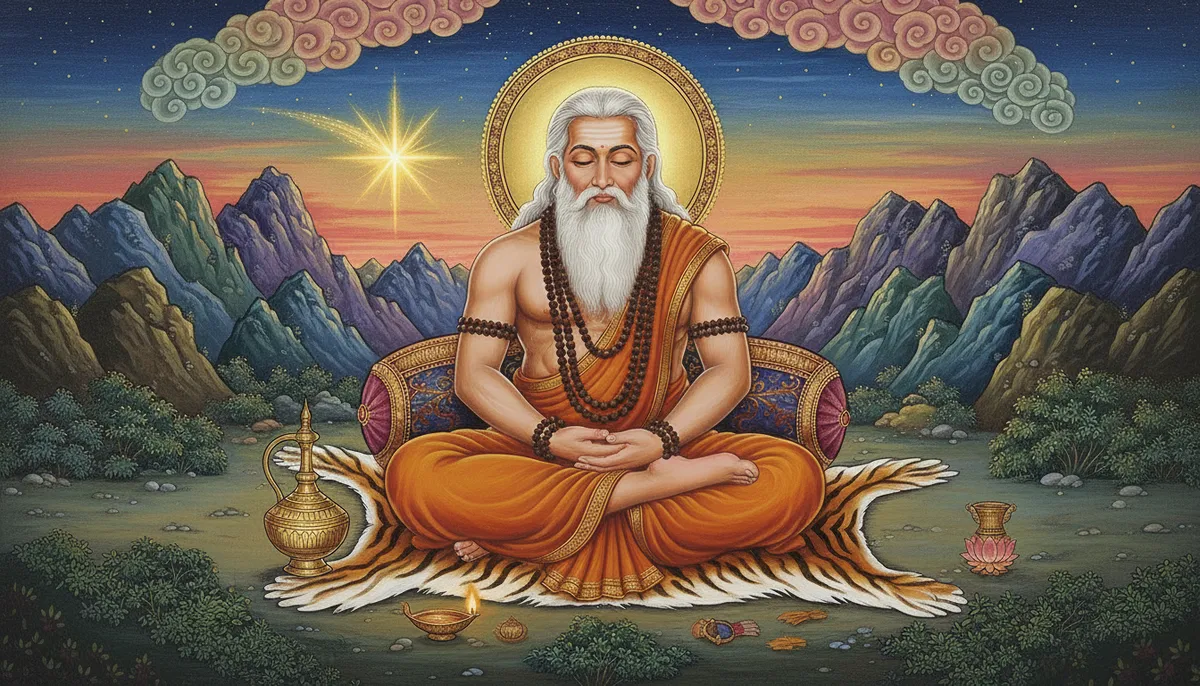
Among the Saptarishis—the seven great sages who illuminate Hindu tradition like the seven stars of Ursa Major—Agastya stands apart. While other rishis achieved greatness within the bounds of the known world, Agastya transcended those bounds entirely. He drank oceans, subdued mountains, crossed the barriers between North and South India, and became the father of an entire civilization’s language and medicine.
His story spans the full arc of Hindu sacred literature. He composes hymns in the Rigveda, digests demons in the Mahabharata, arms Lord Rama in the Ramayana, and continues to guide seekers in the Puranas. The star Canopus bears his name across the southern skies. The Tamil language claims him as its first grammarian. The Siddha medical tradition reveres him as its founder. Temples in Java honor his memory alongside those in Tamil Nadu.
No other sage bridges so many worlds: Vedic and Puranic, North and South Indian, Sanskrit and Tamil, astronomy and medicine, myth and geography. Agastya is not merely a sage to be studied but a force that shaped the very landscape—cultural and physical—of the Indian subcontinent.
Etymology: The Many Names of the Sage
The Name “Agastya”
Several etymologies have been proposed for “Agastya”:
- “Aga” + “gam” (mountain + mover): “Mover of mountains,” referring to his famous subduing of the Vindhyas. This folk etymology appears in Ramayana 2.11.
- “A” + “gasta” (not + sin): From Iranian linguistic roots, meaning “the sinless one” or “the pure.”
- “Agati gandiflora”: Some scholars link the name to the Agati tree (called Akatti in Tamil), suggesting Dravidian origins.
- “Brighten/effulgent”: The root aj or anj connotes brightness, linking Agastya to his stellar association—Canopus, the second-brightest star visible from India.
Birth Names: Kumbhayoni and Related Epithets
Agastya’s miraculous birth gave him several distinctive names:
- Kumbhayoni (कुम्भयोनि) — “He whose womb was a pot”
- Kumbhajanma/Kumbha Sambhava — “Born from a pot”
- Kalashayoni/Kalasaja — “Born from a water vessel”
- Ghatodbhava — “Arisen from a jar”
- Maitravaruni — “Son of Mitra and Varuna”
Epithets from His Deeds
- Vindhyakuta — “Subduer of the Vindhyas”
- Samudrachuluka — “He who sipped the ocean”
- Pitamahamuni — “Grandfather sage” (reflecting his antiquity)
- Agathiyar/Agasthiyar — Tamil forms of his name
The Miraculous Birth: Son of Two Gods
Unlike most Vedic sages, Agastya has no human parents. His origin story, preserved in the Matsya Purana and other texts, combines divine intervention with cosmic imagery.
The Gods Mitra and Varuna
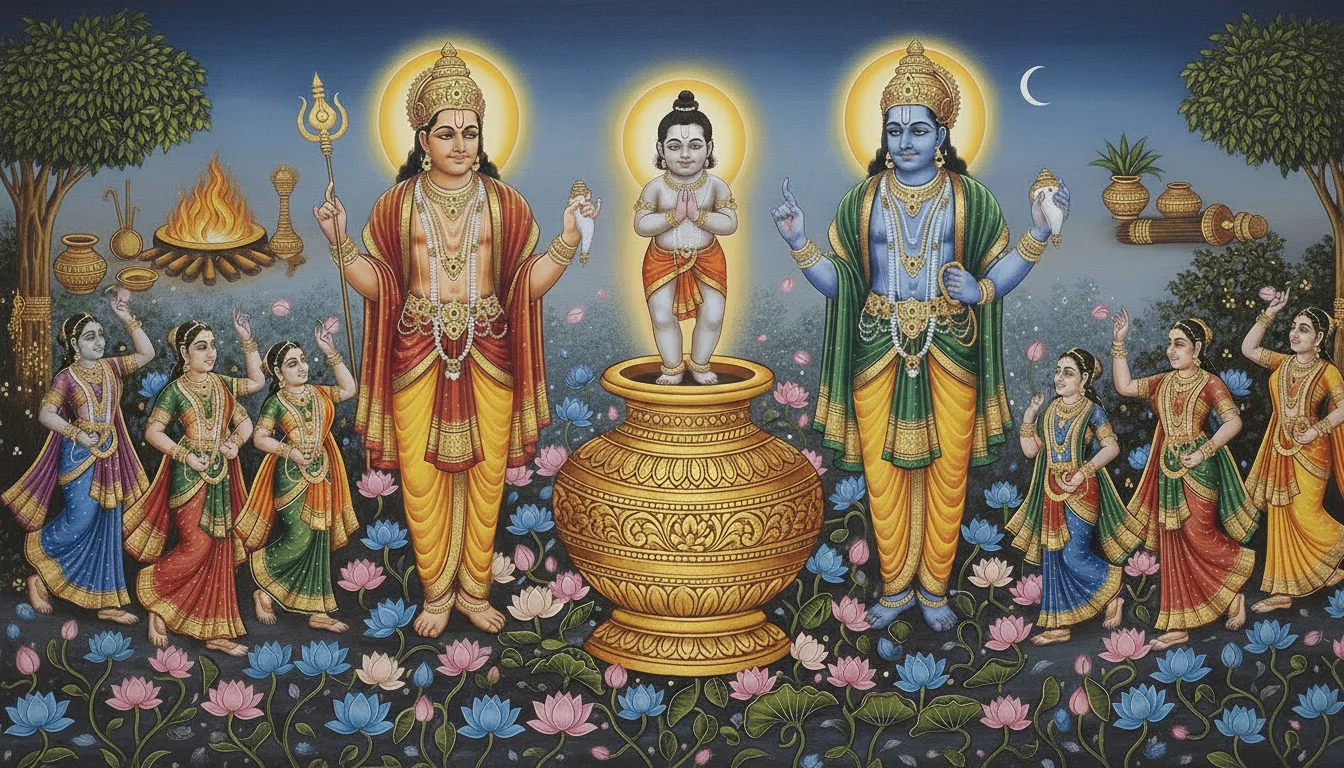
The devas Mitra and Varuna—gods of contracts/friendship and cosmic order/waters respectively—were performing a yajna (sacred fire ritual). During the ceremony, the celestial apsara Urvashi appeared. Her extraordinary beauty overwhelmed the two gods, and their seed fell forth.
In some versions, the seed fell into a water pot (kumbha or kalasha). In others, part fell into a pot and part into water. From the pot-born portion arose Agastya; from the water-born portion arose the sage Vasishtha.
This dual parentage earned both sages the name “Maitravaruni” (sons of Mitra and Varuna), though their paths would diverge—Vasishtha remaining associated with the northern Vedic tradition while Agastya would carry that tradition southward.
The Symbolism of the Birth
The jar-birth carries multiple meanings:
- Cosmic Womb: The pot (kumbha) represents the containing vessel of creation, linking Agastya to cosmogonic power.
- Dual Divine Lineage: Having two divine fathers (both gods) places Agastya outside ordinary genealogy.
- Association with Water: Born from a vessel, Agastya would later drink oceans and become associated with rivers—the Kaveri flows from his kamandalu (water pot).
- The Alchemical Vessel: In later Siddha tradition, the pot becomes the alchemist’s crucible, connecting to Agastya’s role as founder of that system.
Rigveda Contributions: The Poet-Sage
Hymns 1.165–1.191
Agastya composed hymns 1.165 through 1.191 of the Rigveda, placing him among the most prolific contributors to Mandala 1. These 27 hymns address various deities, particularly:
- Indra — The king of gods receives extensive praise
- Maruts — The storm gods and Indra’s companions
- Agni — The sacred fire
- Mitra-Varuna — His divine fathers
The hymns display Agastya’s characteristic style: verbal play, riddles and puns, striking imagery, and profound spiritual insight embedded within poetic beauty.
The Dialogue with the Maruts (1.165-1.171)
A famous sequence shows Agastya mediating between Indra and the Maruts. The dramatic tension—Indra’s jealousy of the worship offered to the Maruts, the sage’s diplomatic intervention—reveals Agastya as peacemaker even among gods.
Hymn 1.179: The Voice of Lopamudra
Though attributed to Agastya’s household, Hymn 1.179 credits his wife Lopamudra as composer of the opening verses. The Vedic anukramani (indices) identify her as a “mantra drashta” (seer of mantras). This dialogue hymn—exploring tension between asceticism and marital duty—would spark the adventures that define much of Agastya’s later mythology.
Descendants and Legacy
Agastya’s descendants continued the poetic tradition:
- 27 hymns in Mandala 1
- 1 hymn each in Mandalas 5 and 8
- 2 hymns in Mandala 9
- 4 hymns in Mandala 10
This transmission across generations established the Agastya family as one of the great Vedic lineages.
Marriage to Lopamudra: The Sage Meets His Match
The Creation of the Perfect Wife
When Agastya observed his ancestors (Pitris) suspended between worlds, suffering because no descendants performed their rites, he recognized the need for progeny. But his complete dedication to asceticism had left no room for marriage.
Rather than marry an ordinary woman, Agastya created his ideal partner. Gathering the most graceful features from various creatures—the eyes of a deer, the grace of a panther, the elegance of palm trees, the fragrance of flowers—he fashioned a being of incomparable beauty and placed her with the childless King of Vidarbha.
The princess Lopamudra grew to be accomplished in every royal art, yet something set her apart. When Agastya claimed her as his wife, she accepted—recognizing that his spiritual wealth exceeded any material kingdom.
The Transition and the Challenge
Lopamudra abandoned silks for bark cloth, leaving behind palace life for the hermitage. She performed austere duties faithfully. Yet after years of deprivation, she spoke:
“Through many autumns have I toiled and laboured, at night and morn, through age-inducing dawnings. Old age impairs the beauty of our bodies. Let husbands still come near unto their spouses.” — Rigveda 1.179.1
She would not bear children in poverty. If Agastya wanted progeny, he must provide appropriate support. This challenge—arising from the dialogue in Rigveda 1.179—launched Agastya on adventures that would defeat demons and acquire wealth.
The Quest and Return
Agastya approached three kings for assistance; each had revenues exactly matching obligations. He then confronted the demons Ilvala and Vatapi, digesting the shape-shifting Vatapi when Ilvala attempted his murderous trick. The terrified demon granted Agastya the requested wealth.
Returning to Lopamudra, Agastya fulfilled his marital duties. Their son Dridhasyu (also called Idhmavaha) gestated for seven years, emerging reciting Vedic hymns—a child born knowing scripture from womb-learning.
The Great Legends: Ocean, Mountain, and Demons
Drinking the Ocean (Samudra Mathana)
The Mahabharata’s Vana Parva preserves one of Agastya’s most famous deeds. The demon Kalakeyas, followers of the defeated Vritra, hid in the ocean to escape divine retribution. From this sanctuary, they emerged at night to massacre sages and threaten cosmic order.
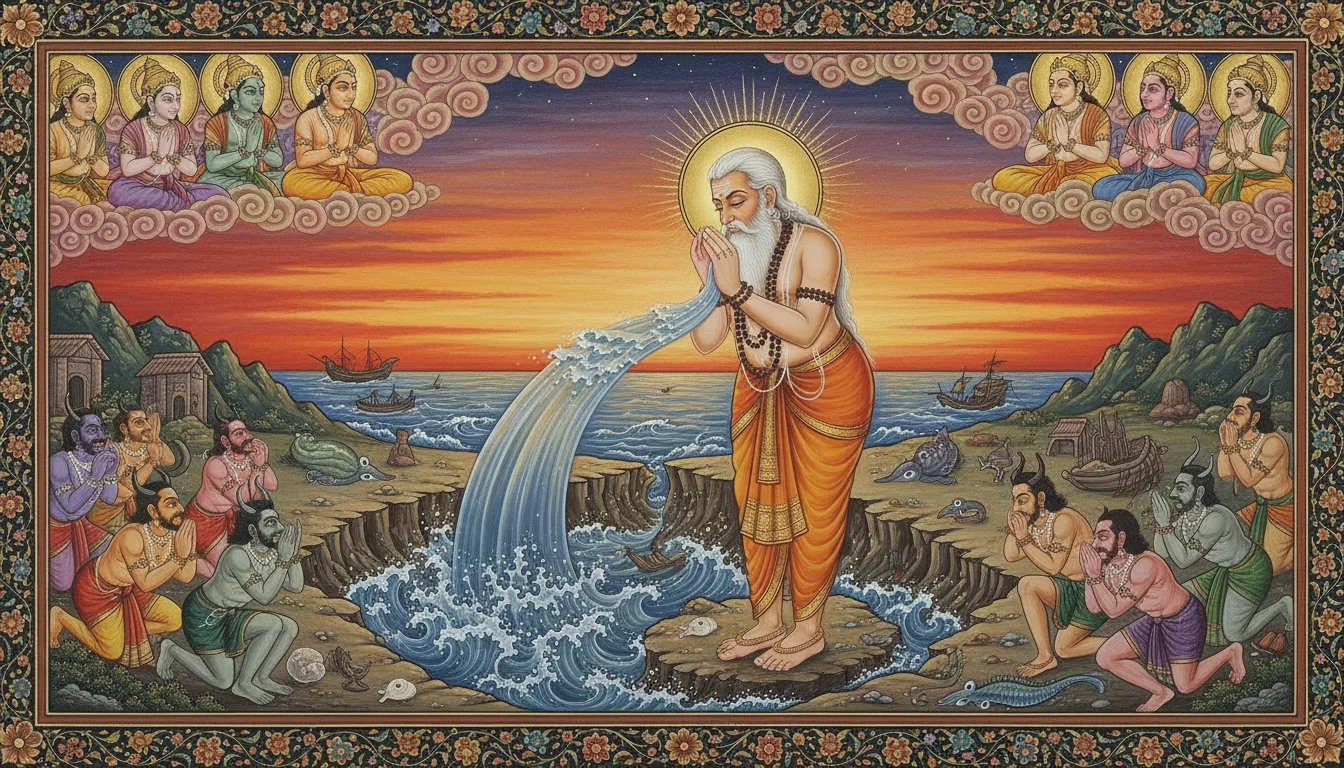
The gods could not reach them beneath the waves. They consulted Lord Vishnu, who directed them to Agastya. The sage agreed to help. Standing at the ocean’s edge, he drank the entire sea in a single gulp, exposing the demons on the suddenly dry seabed. The gods rushed in and destroyed the Kalakeyas.
But when the gods asked Agastya to restore the ocean, he revealed that his digestive power had already absorbed the waters. The ocean would be refilled only later, through the efforts of Bhagiratha bringing the Ganga from heaven. This explains the ocean’s saltiness—it carries the residue of Agastya’s digestion.
Symbolic Interpretation: Historians suggest this myth allegorizes Agastya’s sea voyage—perhaps to Southeast Asia, where his worship was particularly strong in medieval Java. “Drinking the ocean” may represent mastering ocean navigation.
Subduing the Vindhya Mountains
The Vindhya range, jealous of Mount Meru around which the Sun circumambulates, began growing to block the Sun and Moon’s path. The mountains threatened to pierce the heavens.
The alarmed gods approached Agastya. When the sage arrived, the Vindhyas—recognizing their guru—prostrated in reverence. Agastya blessed them: “Remain thus until I return from my journey south.”
He crossed over and settled in the Tamil lands, never returning. The Vindhyas, bound by their promise to their teacher, remain prostrate to this day—which is why the southern Vindhyas are lower than the Himalayas.
Symbolic Interpretation: This myth may encode the historical crossing of the Vindhyas by Vedic culture-bearers. The “subduing” represents the integration of northern and southern traditions rather than literal geography.
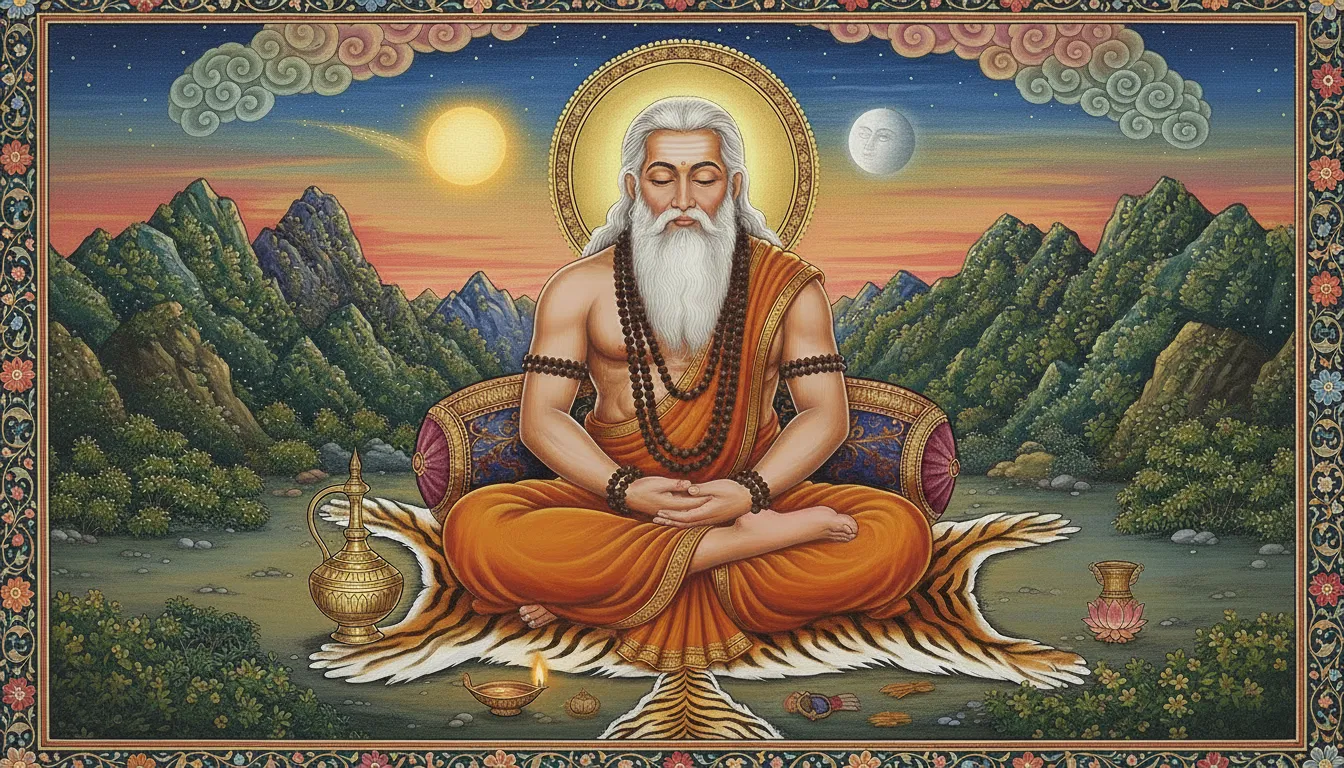
Destroying Vatapi and Ilvala
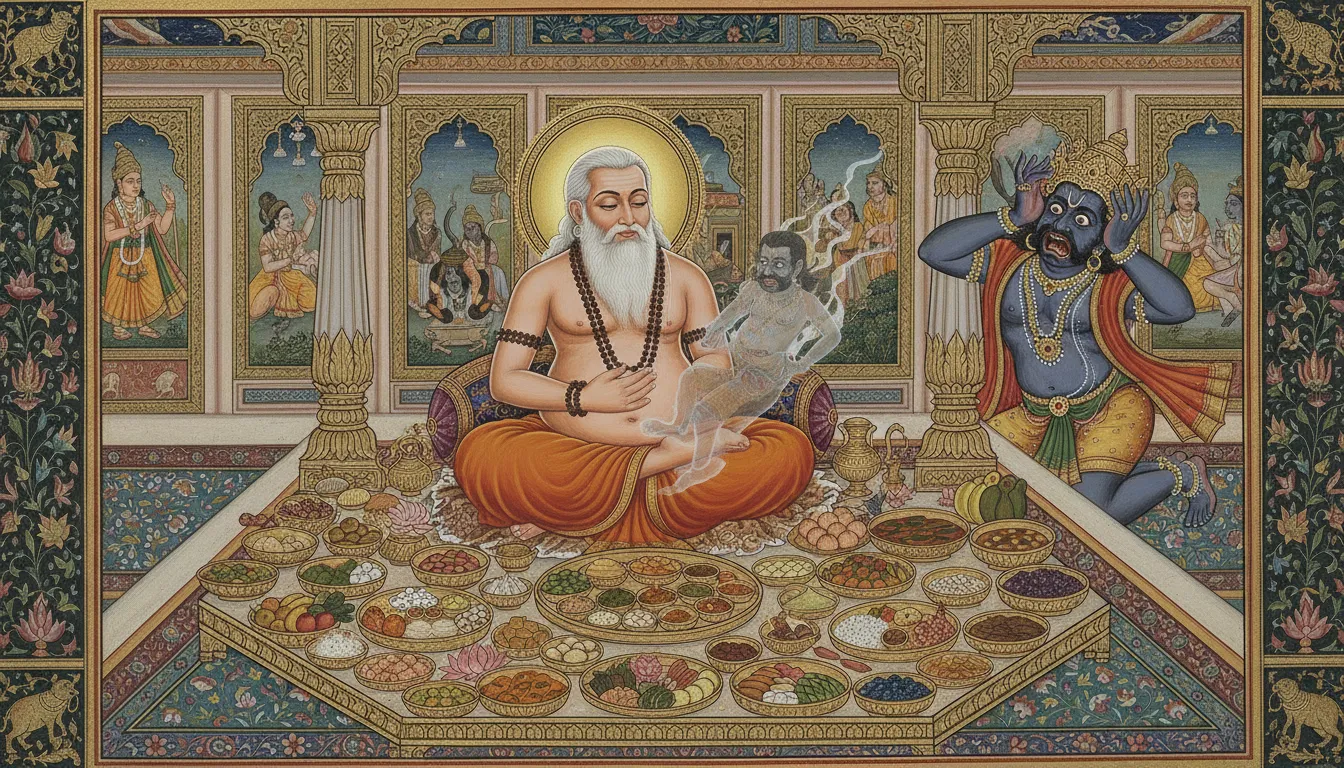
This famous story demonstrates Agastya’s sovereignty over his own body and his protection of the priestly class.
The demon brothers Ilvala and Vatapi had developed a murderous scheme. Vatapi could transform into any form. Ilvala would transform his brother into a goat, cook him as an elaborate feast, and serve the meat to Brahmin guests. After the meal, Ilvala would call: “Vatapi, come forth!” The demon would reassemble and burst from the guest’s stomach, killing them. The brothers then seized their victim’s possessions.
When Agastya arrived seeking wealth, Ilvala prepared his usual trap. But the sage, aware of everything through his powers, consumed the meal deliberately. When Ilvala called for Vatapi, Agastya simply patted his stomach:
“Vatapi, jirno bhava!” (Vatapi, be digested!)
The demon dissolved completely. The terrified Ilvala, facing a power greater than his tricks, surrendered his wealth. Agastya departed with ten thousand cows, equal gold pieces, and a golden chariot—returning to fulfill Lopamudra’s requirements.
Agastya in the Ramayana: Arming the Avatar
The Dandaka Forest Encounter
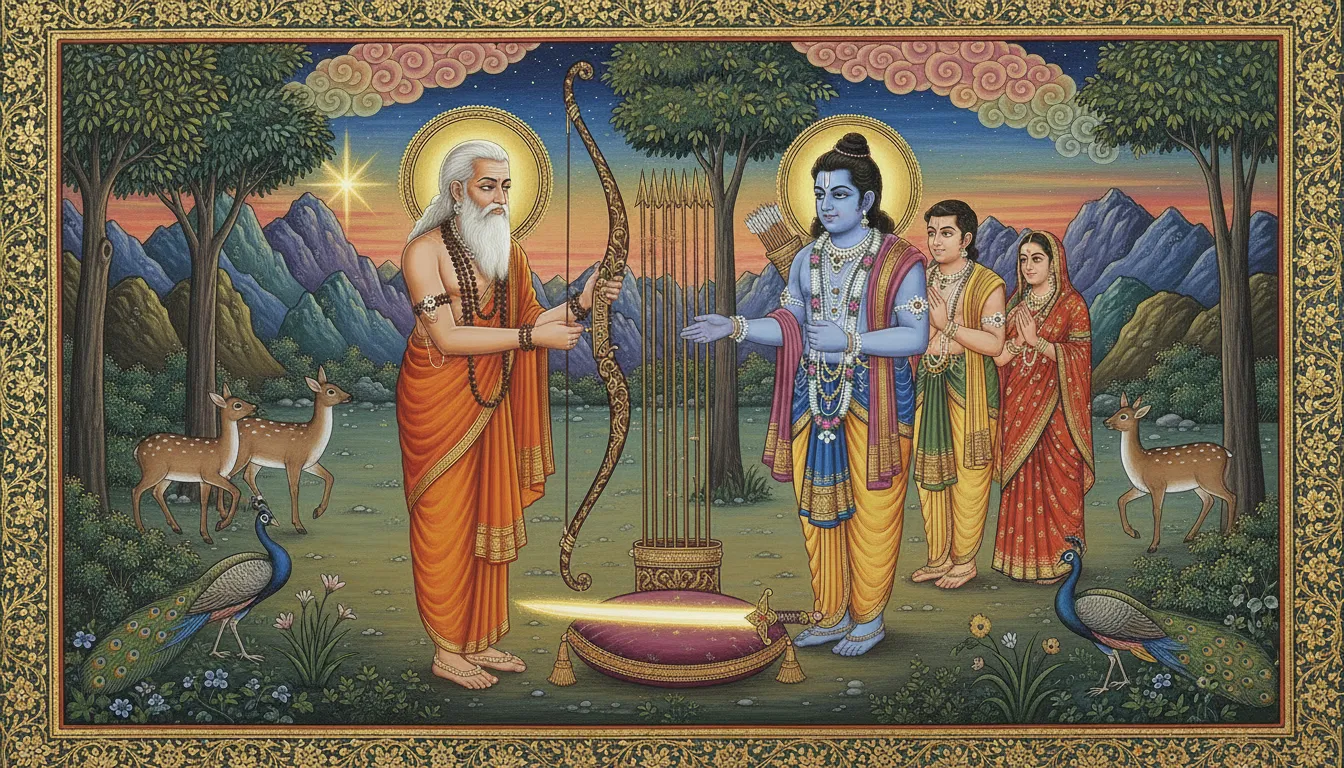
In the Aranya Kanda of the Ramayana, Rama, Sita, and Lakshmana journey through the Dandaka forest during their fourteen-year exile. They seek out Sage Agastya, whose ashram represents a sanctuary of dharma in the demon-infested wilderness.
Agastya receives them with joy, recognizing Rama’s divine nature. The sage had been protecting the region’s rishis and awaiting this meeting.
The Divine Weapons
Agastya presents Rama with weapons of cosmic power:
Vishnu’s Bow (Brahmadatta/Kodanda): This divine bow, inlaid with gold and encrusted with gems, was crafted by Vishwakarma, the architect of the gods. It had previously been given by Brahma to Vishnu, who used it to defeat demons and protect the heavens. Agastya had guarded it, awaiting the proper recipient.
Inexhaustible Quivers: Two quivers from Indra that could never be emptied—no matter how many arrows Rama drew, the quivers remained full.
The Brahmastra: The supreme weapon among celestial arms, capable of destroying entire armies or even the world. Agastya entrusted this to Rama’s careful judgment.
Indra’s Sword: A divine blade completing the arsenal.
These weapons prove essential. Rama would use them against Ravana’s demon armies and finally against Ravana himself. The Brahmastra given by Agastya becomes the instrument of Ravana’s destruction.
The Aditya Hridayam: Heart of the Sun
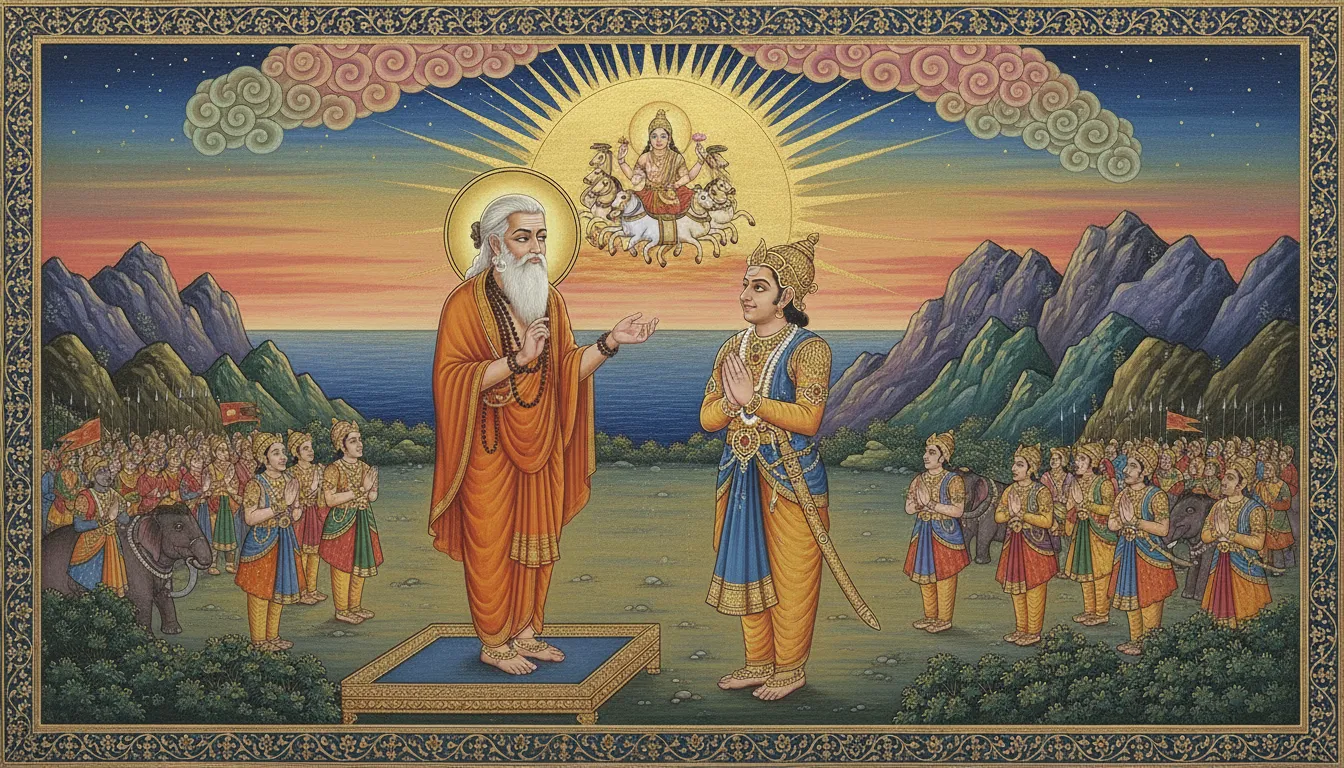
Agastya’s greatest gift to Rama comes not in the forest but on the battlefield of Lanka. As the final confrontation with Ravana approaches, Rama stands exhausted after the long war. The demon king, despite grievous wounds, rises again and again.
Agastya appears on the battlefield and teaches Rama the Aditya Hridayam—“The Heart of the Sun God”—a hymn of thirty-one verses praising Surya, the Sun God, as the source of all light, life, and victory.
“This holy hymn dedicated to the Sun God will result in destroying all enemies and bring you victory and eternal happiness. Worship the Sun God, the ruler of the worlds and lord of the universe, who is crowned by the gods and demons alike.”
Rama recites the hymn three times, becomes filled with solar energy, and finally releases the arrow that ends Ravana’s life. The Aditya Hridayam remains one of the most powerful prayer texts in Hinduism, recited daily by millions for protection, health, and success.
Father of Tamil Language and Literature
The Journey South
Agastya’s crossing of the Vindhya mountains marks one of history’s great cultural transmissions. Carrying Vedic knowledge southward, he encountered the Dravidian civilizations and initiated a synthesis that would define South Indian culture.
The traditions diverge on whether Agastya brought Tamil to the south or learned it there. The Shaiva tradition holds that Lord Shiva himself taught Agastya the Tamil language. Buddhist sources suggest he learned from Avalokiteshvara. Either way, Agastya becomes the crucial link between Sanskrit-Vedic and Tamil traditions.
Agattiyam: The First Tamil Grammar
According to Tamil tradition, Agastya compiled Agattiyam (அகத்தியம்)—the first grammar of the Tamil language. Though this text is now lost, references survive in later works:
- The 13th-century commentary on Nannūl quotes Agattiyam 18 times
- Yapparunkalam virutti references it
- Tamil tradition places its composition in the First Sangam (literary academy), circa 300 BCE
The surviving Tolkappiyam, the oldest extant Tamil grammar, was composed by Tolkappiyar—traditionally considered one of Agastya’s twelve direct disciples. Thus even through his students, Agastya shaped Tamil linguistic foundations.
The First and Second Sangams
Tamil tradition places Agastya as a presiding figure in the first two Sangam assemblies—the legendary literary academies that defined Tamil classical literature. These assemblies, held over thousands of years, produced the corpus of Sangam literature that remains Tamil culture’s foundational achievement.
Reconciling Traditions
Agastya uniquely bridges the North-South divide:
- In the North, he is revered for spreading Vedic knowledge
- In the South, he is honored as champion of Tamil culture
- He represents not conquest but integration
- His story validates both traditions as complementary
Father of Siddha Medicine
The Siddha Tradition
Siddha medicine, one of India’s oldest medical systems, traces its origin directly to Agastya. Unlike Ayurveda’s northern development, Siddha evolved in Tamil Nadu, using the Tamil language for its texts and incorporating local herbal knowledge.
The term “Siddha” derives from “Siddhi” (perfection/attainment). The Siddhars were yogis who achieved mastery over body, mind, and nature. Agastya, called “Siddhar Agathiyar” in this tradition, is considered the foremost among them.
The Eighteen Siddhars
Tradition holds that Agastya taught eighteen principal Siddhars, who spread medicinal knowledge to humanity. The eighteen include:
- Agasthiyar (Agastya himself)
- Nandi
- Thirumular
- Bogar
- Konganavar
- Theraiyar
- and twelve others…
Agastya’s position as first and teacher of all others establishes him as the tradition’s fountainhead.
Medical Texts Attributed to Agastya
Several foundational Siddha texts bear Agastya’s name:
- Agastiyar Gunavagadam: Detailed descriptions of medicinal plants and properties
- Agastiyar Vaidya Kaviyam: Poetic treatments for various diseases
- Agastya Samhita: Alchemical processes and mineral preparations
Key Contributions
The Three Doshas: Agastya’s Siddha teaching, like Ayurveda, centers on three bodily humors—Vata, Pitta, and Kapha. Balance brings health; imbalance brings disease.
Rasa Shastra (Medicinal Alchemy): The processing of minerals and metals (particularly mercury, sulfur, and gold) for medicinal use. This sophisticated metallurgical knowledge combines chemistry, medicine, and spiritual practice.
Varma Therapy: Knowledge of vital points (varma) in the body—the Tamil equivalent of marma therapy. This knowledge supports both healing and martial arts.
Pulse Diagnosis: Tamil Siddhars pioneered naadi paarththal—reading the pulse to diagnose disease.
Palm Leaf Manuscripts
Siddha knowledge was recorded on palm leaf manuscripts, many still preserved by hereditary families in Tamil Nadu. These fragile documents—in poetic Tamil, often encoded to protect secrets—represent a vast repository of medical knowledge.
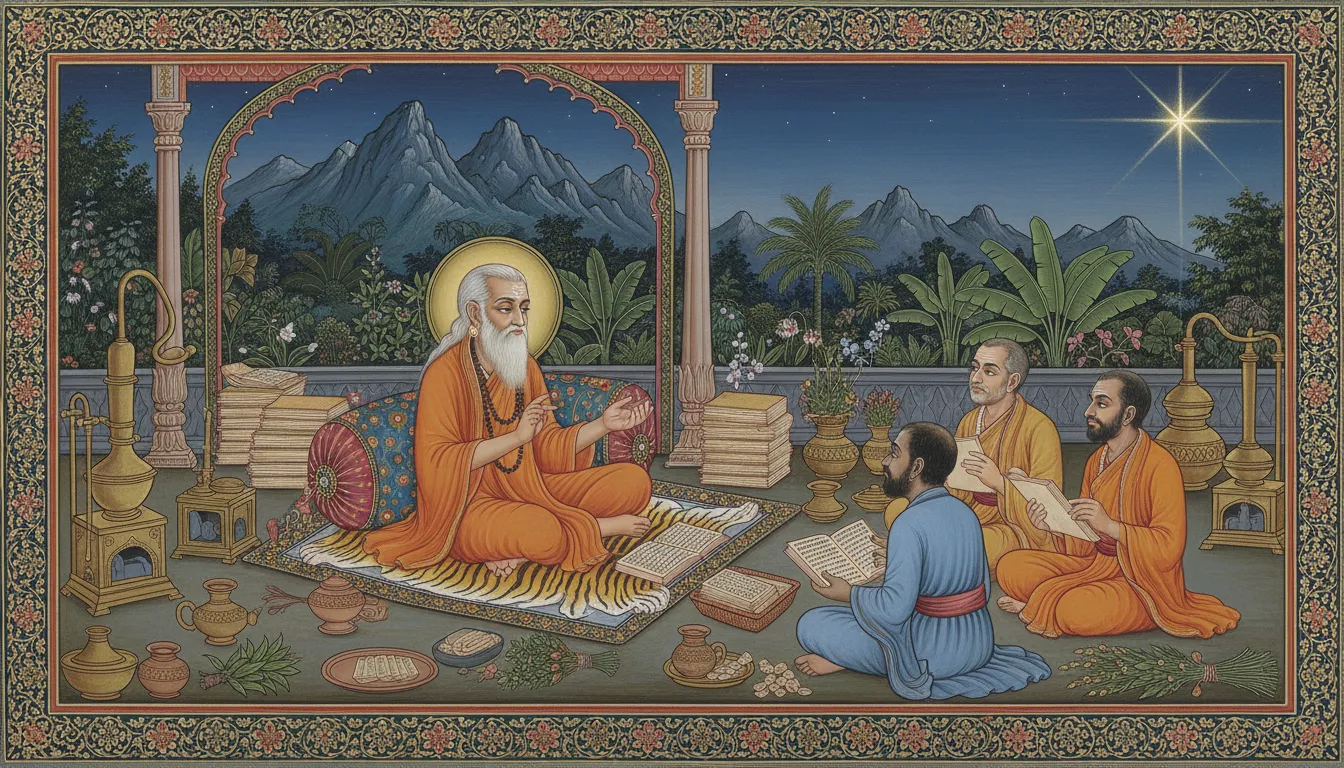
Agastya and the Star Canopus
The Astronomical Connection
Canopus (α Carinae), the second-brightest star in the night sky after Sirius, is called “Agastya” in Hindu astronomy. This stellar naming encodes astronomical observation, mythology, and religious practice.
The Brihat Samhita
Varahamihira’s 6th-century Brihat Samhita devotes Chapter 12 to Canopus/Agastya:
Heliacal Rising: The star reappears when the Sun reaches 24° Leo (from Ujjain’s latitude)
Seasonal Marking: Canopus’s appearance marks autumn’s beginning—the season of blooming lotuses and migrating swans
Rituals (Arghya): Princes should offer arghya to Agastya at dawn, facing the southeast where the star rises. The offerings include fragrant flowers, fruits, precious stones, gold, cloth, cows, rice, sweets, and curdled milk.
Predictive Astrology: The star’s appearance color predicts conditions:
- Disagreeable appearance → Disease
- Yellow → Drought
- Smoky → Cattle affliction
- Unsteady light → Human fears
- Silver/brilliant → Prosperity and health
The Mythological Link
Why name Canopus after Agastya? The myths provide the answer:
When Agastya crossed the Vindhya mountains heading south, he became the first from the Vedic north to observe this brilliant southern star. From the northern plains, Canopus remains below the horizon. Only by journeying south could one see it.
The star’s naming commemorates this journey. Canopus rising signals the beginning of autumn—the calm after monsoon storms. The “cleanser of waters,” the star’s heliacal rising coincides with the Indian Ocean’s calming.
Navigation
Ancient Indian sailors used Canopus for navigation, particularly for voyages to Southeast Asia. The sage’s name on the guiding star blessed their journeys—appropriately, given Agastya’s own mythological journeys across seas (drinking the ocean) and his worship throughout maritime Southeast Asia.
Agastya in Southeast Asia
The Indonesian Connection
Agastya’s influence extends remarkably to Southeast Asia, particularly Indonesia. He is one of the most important figures in medieval-era inscriptions, temple reliefs, and art across the region.
Temples in Java
Prambanan Temple Complex (9th century): This UNESCO World Heritage Site, the largest Hindu temple in Indonesia, features Agastya prominently. In the main Shiva temple, Agastya occupies the southern chamber, forming a triad with Ganesha (west) and Durga (north).
Sambisari Temple: This 9th-century temple, discovered after being buried by volcanic mud, shows Agastya on its southern face.
Javanese Temple Pattern: East Javanese temples follow a consistent pattern: a linga representing Shiva in the central sanctum, with Durga (north), Ganesha (east), and Agastya (south) on exterior niches. This arrangement is unique to Indonesia.
The Dinoyo Inscription
The Dinoyo inscription (760 CE) is primarily dedicated to Agastya, demonstrating his importance in early Javanese religion.
Saiva Siddhanta Transmission
Agastya’s popularity in Java stems from his teaching of Saiva Siddhanta—the philosophical system that Javanese society readily embraced. He represents the transmission of Hindu philosophy across the ocean.
The Agastya Parva
The 11th-century Javanese text Agastya Parva presents teachings combining Puranic stories with Samkhya and Vedanta philosophy. Agastya serves as the principal teacher-figure, transmitting Indian wisdom in Indonesian context.
Cambodia and Vietnam
In Cambodia, 9th-century King Indravarman—sponsor of many great temples—claimed descent from Sage Agastya, lending legitimacy to his architectural and religious projects.
Agastya’s presence is also found in Vietnamese Hindu remains, demonstrating the breadth of his influence across the entire Southeast Asian cultural sphere.
Temples and Sacred Sites in India
Agastyamuni, Uttarakhand
The town of Agastyamuni in Uttarakhand’s Rudraprayag district derives its name from the sage. A temple here marks the traditional site of Agastya’s meditation before his southern journey.
Agasthiyar Falls and Temple, Tamil Nadu
Near Papanasam in Tirunelveli district, the Agasthiyar Falls cascade down from the Western Ghats. A temple complex here honors both Agastya and Lopamudra—a rare site where both receive worship together.
The original Agastya statue was lost in 1992 floods. In 2012, new vigrahas of both Agastya and Lopamudra were installed with full prana pratishtha ceremonies.
Pothigai Hills
The Pothigai hills in the Western Ghats are traditionally identified as Agastya’s principal ashram. From here, the legend says, Tamil language and Siddha medicine emanated.
Andhra Pradesh Temples
Several temples are dedicated to Agastya in Andhra Pradesh:
- Agasteshwara temple at Thodnavada, Chittor district
- Meenakshi Agasteshwara temple at Wadapally, Nalgonda district
- Agasteshwara temple in Guntur district
Karnataka
The Agasteshwara temple at T. Narasipura in Mysore district continues Agastya veneration.
Srirangam, Tamil Nadu
The great Ranganathaswamy Temple at Srirangam contains an Agastya statue in its Sesharaya mandapa, dating from the 16th-18th centuries.
Dasavatara Temple, Deogarh
This 6th-century Gupta-era temple in Uttar Pradesh features an Agastya carving—demonstrating his reverence even in northern India during the early medieval period.
Chalukya-era Temples
The 7th-century Mallikarjuna temple at Mahakuta (Karnataka) and Parvati temple at Sandur show Agastya in their sculptural programs, integrating him into the Shaiva temple iconography.
The Agastya Gotra
Gotra System
In Hindu tradition, gotra identifies patrilineal descent from an ancient rishi. The Agastya gotra traces lineage to the sage himself, connecting modern Brahmins to Vedic origins.
Characteristics
Those belonging to Agastya gotra traditionally:
- Recite the Agastya pravara (lineage invocation) during rituals
- Cannot marry within the same gotra (exogamy rules)
- Have particular ritual obligations and privileges
The gotra system demonstrates Agastya’s continuing social presence—not merely a mythological figure but an ancestor claimed by living communities.
Philosophical Teachings
Integration Over Renunciation
Agastya’s life demonstrates that spiritual power and worldly engagement need not conflict. He married, acquired wealth, had a son, yet achieved the highest spiritual attainments. His path—shaped significantly by Lopamudra’s wisdom—validates the householder life as a legitimate spiritual trajectory.
Power Through Digestion
The Vatapi story and ocean-drinking illustrate a profound principle: true mastery involves the ability to absorb and transform. Agastya doesn’t reject or flee from challenges; he consumes them, making them part of himself. The demons become his nourishment; the ocean becomes his body’s waters.
The Teacher’s Commitment
Agastya’s promise to the Vindhyas—and his choice never to return—shows the teacher’s ultimate commitment. Having promised to bring Vedic wisdom south, he remained, making the south his permanent home. True teaching requires presence, not merely transmission.
Balance of North and South
Agastya’s legacy lies in reconciliation. He honored Sanskrit while enabling Tamil. He carried Vedic ritual while embracing southern forms. His example suggests that cultural exchange enriches rather than diminishes.
Historical Perspectives
Dating the Figure
If Agastya composed Rigveda hymns, his activity falls in the period 1500-1200 BCE by conventional dating (earlier by traditional reckoning). His association with the First Sangam suggests continued cultural presence through the early Common Era.
The layers of tradition—Rigvedic, Epic, Puranic, Tamil—accumulated over 2000+ years. “Agastya” may represent a composite figure, or perhaps an original sage whose story attracted additional legendary material.
The Southern Migration
Archaeological and linguistic evidence confirms significant cultural exchange between North and South India in the first millennium BCE. Whether this involved actual migration, trade contacts, or diffusion of ideas remains debated.
Agastya mythologies encode this historical process. His “subduing” the Vindhyas represents crossing cultural barriers. His teaching Tamil while carrying Sanskrit represents the synthesis that created South Indian civilization.
The Southeast Asian Connection
Hindu influence in Southeast Asia is archaeologically attested from the early Common Era. Indonesian temple inscriptions from the 8th-9th centuries demonstrate thorough familiarity with Agastya mythology.
This influence traveled through trade networks connecting South India with maritime Southeast Asia. Agastya—associated with ocean crossing, southern movement, and cultural transmission—became an appropriate patron figure.
Legacy: Why Agastya Matters Today
For Spiritual Seekers
Agastya offers a model of engaged spirituality. His mastery encompassed practical knowledge—medicine, grammar, astronomy—alongside transcendental realization. He demonstrates that wisdom serves the world rather than fleeing from it.
The Aditya Hridayam he taught remains one of Hinduism’s most powerful prayer texts, recited daily for protection and strength.
For Scholars
Agastya’s traditions offer rich material for studying:
- Cultural transmission across linguistic boundaries
- The development of sacred narrative over centuries
- The interaction of Sanskrit and Tamil literary traditions
- Hindu influence in Southeast Asian religion
For Tamil Identity
Agastya reconciles Tamil pride with pan-Indian heritage. He validates Tamil as a language worthy of grammar and literature while connecting it to broader Indic traditions. His dual reverence—in Sanskrit and Tamil sources alike—models cultural integration.
For Medical History
The Siddha tradition Agastya founded represents one of humanity’s oldest continuous medical systems. Its metallurgical sophistication, herbal knowledge, and diagnostic techniques deserve serious study.
For Those Who Look Up
Every time the star Canopus rises in the southern sky, Agastya’s name rises with it. For navigators, astronomers, and stargazers, he represents humanity’s ancient effort to read meaning in the heavens.
Conclusion: The Sage Beyond Boundaries
Agastya drank the ocean, and the ocean did not diminish him. He consumed demons, and the darkness was transformed. He crossed the mountains, and two civilizations met in his person. He looked south, and a star took his name.
No walls could contain him—not the Vindhyas that separated north from south, not the ocean that separated India from the islands, not the boundaries between Sanskrit and Tamil, between Veda and Sangam, between the disciplines of poet and physician.
His jar-birth, outside normal human genealogy, perhaps predicted this. Agastya was never meant for one lineage, one region, one tradition. He belongs to wherever wisdom is sought and transformation is possible.
The sage who conquered by absorption rather than exclusion offers a model for an age of boundaries. His legacy suggests that true power lies not in walls but in the capacity to embrace, integrate, and transform—to drink the ocean and survive.
References and Further Study
Primary Sources
- Rigveda, Mandala 1, Suktas 165-191
- Mahabharata, Vana Parva (Forest Book)
- Valmiki Ramayana, Aranya Kanda and Yuddha Kanda
- Brihat Samhita of Varahamihira, Chapter 12
- Skanda Purana
- Matsya Purana
Tamil Sources
- Tolkappiyam
- Sangam Literature references
- Siddha medical manuscripts
Indonesian Sources
- Agastya Parva (11th century)
- Dinoyo Inscription (760 CE)
Academic Resources
- Jamison, Stephanie W. and Joel P. Brereton. The Rigveda: The Earliest Religious Poetry of India
- Zvelebil, Kamil. Tamil Literature
- Pollock, Sheldon. The Language of the Gods in the World of Men
- Kulke, Hermann. A History of India
This article is dedicated to preserving and sharing knowledge about the remarkable Vedic sage Agastya. It draws from traditional sources across multiple Hindu lineages, Tamil traditions, and academic scholarship, aiming to present a comprehensive portrait of a figure whose influence spans civilizations and millennia.
Quick Reference
| Attribute | Description |
|---|---|
| Sanskrit Name | Agastya (अगस्त्य) |
| Tamil Name | Agathiyar (அகத்தியர்) |
| Alternative Names | Kumbhayoni, Maitravaruni, Vindhyakuta, Kalasaja |
| Divine Parents | Mitra and Varuna |
| Period | Rigvedic Era (c. 1500–1200 BCE) |
| Status | Saptarishi (One of Seven Great Sages), Tamil Siddhar |
| Spouse | Lopamudra |
| Son | Dridhasyu (also called Idhmavaha) |
| Rigveda Hymns | Mandala 1, Suktas 165-191 |
| Star Association | Canopus (second brightest star) |
| Famous Teaching | Aditya Hridayam |
| Medical System | Founder of Siddha Medicine |
| Language Work | Agattiyam (first Tamil grammar, now lost) |
| Major Legends | Drinking the ocean, subduing Vindhyas, destroying Vatapi |
| Ramayana Role | Armed Rama with divine weapons, taught Aditya Hridayam |
| Key Temples | Agastyamuni (Uttarakhand), Agasthiyar Falls (Tamil Nadu), Prambanan (Indonesia) |
Frequently Asked Questions
Who was Rishi Agastya?
Agastya was one of the Saptarishis (Seven Great Sages) of Vedic tradition, credited with composing hymns 1.165-1.191 of the Rigveda. Born miraculously from a jar (earning the name “Kumbhayoni”), he is celebrated for drinking the ocean to expose demons, subduing the Vindhya mountains, blessing Lord Rama with divine weapons and the Aditya Hridayam, and carrying Vedic civilization to South India. He is revered as the father of Tamil language and Siddha medicine, and the star Canopus is named after him.
What is the story of Agastya drinking the ocean?
When the demon Kalakeyas hid in the ocean to escape the gods after their leader Vritra was killed, Lord Vishnu advised that only Agastya could help. The sage approached the ocean and drank it entirely in a single gulp, exposing the demons on the suddenly dry seabed for the gods to destroy. This story, found in the Mahabharata’s Vana Parva, symbolizes Agastya’s ability to overcome impossible obstacles through spiritual power. Some scholars interpret it as an allegory for his mastering of ocean navigation.
How did Agastya subdue the Vindhya mountains?
The Vindhya mountains grew so tall out of jealousy of Mount Meru that they blocked the path of the sun and moon. The alarmed gods sought Agastya’s help. When the sage approached, Vindhya bowed in reverence to his guru. Agastya asked Vindhya to remain prostrated until his return from a journey south—a return he never made, choosing to settle permanently in Tamil Nadu. Thus the mountains remain subdued to this day, earning Agastya the epithet “Vindhyakuta” (Subduer of the Vindhyas).
What is the connection between Agastya and the star Canopus?
In Hindu astronomy, Canopus—the second brightest star in the night sky—is called “Agastya.” The Brihat Samhita (6th century) describes rituals for worshipping this star. The connection relates to mythology: as Agastya crossed the Vindhya mountains heading south, he became the first from the Vedic north to observe this brilliant southern star, which is not visible from the northern plains. The star was named after him, and its appearance marks the beginning of autumn in the Hindu calendar.
What did Agastya give to Lord Rama?
In the Ramayana, when Rama visited Agastya’s ashram in the Dandaka forest during his exile, the sage gifted him powerful divine weapons: Vishnu’s bow (Brahmadatta/Kodanda) created by Vishwakarma, two inexhaustible quivers from Indra, and the Brahmastra—the supreme celestial weapon. Later, on the battlefield of Lanka, Agastya appeared to teach Rama the Aditya Hridayam hymn, which gave Rama the solar energy needed to finally defeat Ravana.